Why in news?
India’s External Affairs Minister has been actively canvassing for India’s candidature to UNSC permanent seat.
What is United Nations Security Council (UNSC)?
- The UNSC established under the United Nations Charter has the primary responsibility for maintaining international peace and security.
- According to the Charter, the United Nations has four purposes.
- to maintain international peace and security
- to develop friendly relations among nations
- to cooperate in solving international problems and in promoting respect for human right
- to be a centre for harmonizing the actions of nations
- The Security Council has taken permanent residence at the United Nations Headquarters in New York City.
- The Security Council has the power to make binding decisions on member states.
- General António Guterres is the current UN Secretary.
What about the composition of the Council?
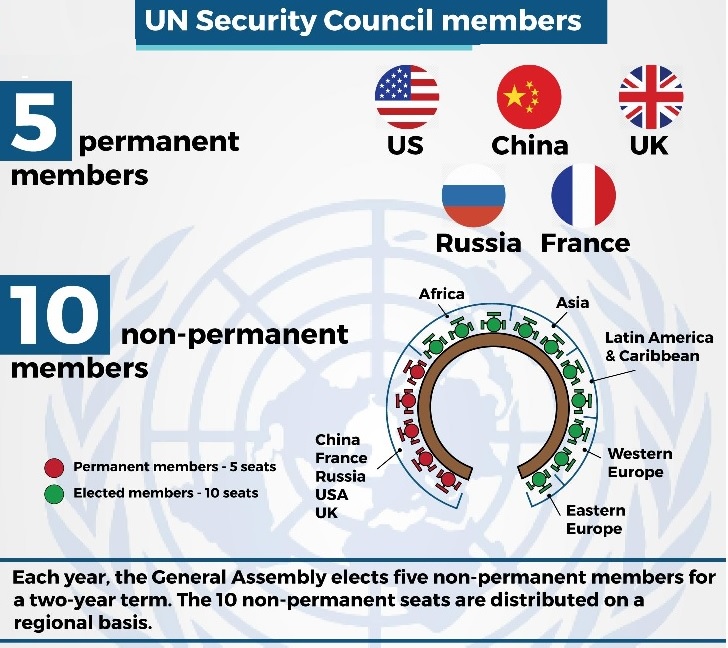
- The Council has 15 members - 5 permanent members and 10 non- permanent members.
- Permanent members- China, France, Russia, the U.S. and the UK were granted the special status of Permanent Member States.
- They have a special voting power known as the "right to veto ".
- If any one of the five permanent members cast a negative vote in the 15-member Security Council, the resolution or decision would not be approved.
- If a permanent member does not fully agree with a proposed resolution but does not wish to cast a veto, it may choose to abstain.
- Non- permanent members- The non- permanent members are elected by the General Assembly for 2 year terms.
- The presidency of the Security Council rotates alphabetically among 15 members every month.
- The main criterion for the eligibility is
- Contribution to the maintenance of international peace and security
- Equitable geographical distribution
- The geographical distribution includes
- African Group – 3 members
- Asia-Pacific Group – 2 members
- Latin American and Caribbean Group – 2 members
- Western European and Others Groups (WEOG) – 2 members
- Eastern European Group – 1 member
What is the need for UNSC reforms?
- Remains unchanged since its inception- The basic structure of the UNSC has remained almost unchanged since its foundation more than 75 years ago.
- Questions the UNSC’s effectiveness- With profound changes in the realities of the global community, the UNSC is being questioned in terms of its legitimacy, effectiveness, and representativeness.
- Diverse issues to be covered- The issues have diversified over the years to include peacebuilding, conflict prevention, non-proliferation, counter-terrorism and protection of civilians.
- Composition- Although the number and regional composition of the members has changed, the size and the composition of the Council have remained unchanged since its foundation.
- Issue with veto- Russia has cast more vetoes (estimated to be 120 times or close to half of all vetoes) than the three western members of the club.
- Often P-5 countries use veto to shield their allies and target the enemies.
- For instance, China repeatedly blocks India’s efforts to include confirmed Pakistani terrorists in the sanctions list.
What were the proposed reforms in UNSC?
- The demands for reform of the UNSC is based on five key issues.
- Categories of membership (permanent, non-permanent)
- The question of the veto held by the five permanent members
- Regional representation
- The size of an enlarged Council and its working methods
- The relationship between Security Council and General Assembly
- Any reform of the Security Council would require the agreement of at least two-thirds of UN member states.
What efforts were taken to promote UNSC reforms?
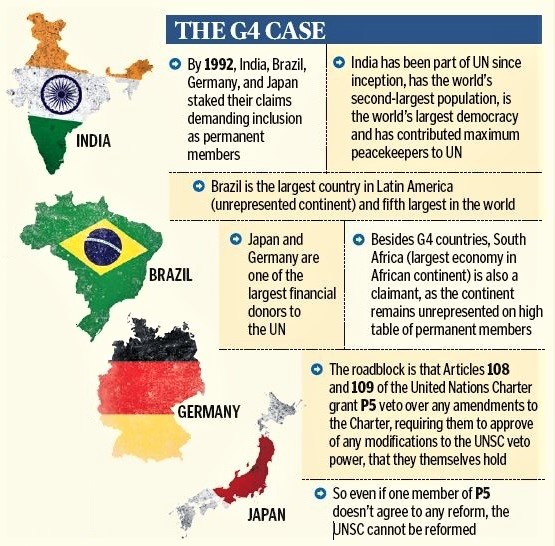
- G4 countries- The G4 countries were created in 2004 and includes Brazil, Germany, India and Japan.
- The G4 has been calling for the enlargement of both permanent and nonpermanent categories as well as supporting each other’s bids for permanent seats on the Council.
- The UN General Assembly has decided to facilitate the reform process through the Intergovernmental Negotiations (IGN) framework on equitable representation and expansion of the UNSC.
- But it was dampened by the U.S., Russia and China being opposed to serious reform of the Council.
- The L.69 group- The L.69 group is of pro-reform member states, including primarily developing countries from Africa, Latin America and the Caribbean, Asia and the Pacific.
- The Group is bound by the firm conviction that expansion in both the permanent and non-permanent categories of membership of the UNSC is imperative to better reflect contemporary world realities.
- The group currently has 42 countries as its members including India.
- Razali Reform Plan -In 1997, the Razali plan was proposed by the then UN General Assembly president Ismail Razali.
- It is a proposal to enlarge the United Nations Security Council from its present 15 members to 24 members.
- Under the plan, the UNSC would have
- Five new permanent members without veto powers
- Four more non-permanent members
What about India & UNSC?
- India was recently elected as the non-permanent member to UNSC from the Asia-Pacific Group for a 2-year term from January 1, 2021.
- India has already held a non-permanent seat on the UNSC for 7 terms.
- India’s Chair- At present, India is chairing the Counterterrorism Committee, that was formed in 2001 after the 9/11 attack in New York.
- India had chaired this committee in the UNSC in 2011-12.
- India is chairing the Taliban Sanctions Committee (1988 Sanctions Committee) with a focus on terrorists and their sponsors who are threatening the peace process in Afghanistan.
- India also chairs the Libya Sanctions Committee that implements the sanctions regime - a two-way arms embargo on Libya, an assets freeze, a travel ban, measures on illicit export of petroleum.
Why does India strive to become a permanent member of UNSC?
- In the case of India's permanent membership, it can bring a lot to the UN table with the
- world's second-largest country by population
- a huge world manufacturing hub
- It is also a nuclear power.
- The permanent membership will match India's capabilities with the needed power dominance.
What lies ahead?
- A group of experts suggested that a new category of semi-permanent members should be created.
- Countries would be elected for a period of 8 to 10 years and would be eligible for re-election.
References
- https://www.thehindu.com/opinion/lead/permanent-membership-of-the-unsc-is-another-story/article65943147.ece
- https://www.un.org/securitycouncil/content/what-security-council
- https://www.news9live.com/knowledge/coffee-club-history-members-main-objectives-and-all-you-need-to-know-198555
- https://www.mofa.go.jp/files/100059111.pdf
Quick facts
Uniting for Consensus (Coffee Club)
- This club was established in 1995 and includes the countries that oppose the expansion of permanent seats in the UNSC.
- There are 12 members including Italy, Spain, Malta, San Marino, Pakistan, South Korea, Canada, Mexico, Argentina, Colombia, Costa Rica & Turkey.
- They does not want any expansion because there are concerns that the expansion will dilute the power.



