Mission Integrated Biorefineries
India announces the launch of the “Innovation Roadmap of the Mission Integrated Biorefineries” at the first-ever Global Clean Energy Action Forum-2022 at Pittsburgh, in the United States.
The “Innovation Roadmap of the Mission Integrated Biorefineries” was developed by the co-leads of the Mission Integrated Biorefineries (India and Netherlands) with active inputs from Brazil, Canada, EC and the UK.
- The Mission Integrated Biorefineries was launched by the Mission Innovation, and is co-led by India and the Netherlands.
- Its core members are Brazil and Canada, and the supporting members are the European Commission and the United Kingdom.
- The Mission aims at greater international collaboration and the need for increased financing for Energy RD&D (Research, Development & Demonstration) during next 5 years through public-private investment.
- The Mission’s goal is to develop and demonstrate innovative solutions to accelerate the commercialisation of integrated biorefineries.
- This will be essential to
- Reduce greenhouse gas emissions,
- Improve supply chain resiliency and diversification, and
- Support the global transition to a net-zero economy.
- It has the target of replacing 10% of fossil-based fuels, chemicals and materials with bio-based Sustainable Fuels, Chemicals, and Materials (SFCM) by 2030.
- The Mission will focus on the following three pillars to achieve the goal:
- Supporting Research, Development & Demonstration,
- Accelerating Pilots and Demonstrations
- Improving Policy and Market Conditions
Mission Innovation
- Mission Innovation (MI) is the inter-governmental platform addressing clean energy innovation through action-oriented cooperation.
- It is a global initiative catalysing a decade of action and investment in research, development and demonstration to make clean energy affordable, attractive and accessible for all.
- This will accelerate progress towards the Paris Agreement goals and pathways to net zero.
- Mission Innovation is a global initiative of 22 countries and the European Commission (on behalf of the European Union).
- India is a member of Mission Innovation.
- Mission Innovation 1.0 was launched alongside the Paris Agreement in 2015.
- Mission Innovation 2.0 was launched in 2021.
Reference
- https://www.pib.gov.in/PressReleasePage.aspx?PRID=1861671
- https://explore.mission-innovation.net/mission/integrated-biorefineries/#]
- http://mission-innovation.net/wp-content/uploads/2022/09/Integrated-Biorefineries-Mission-Innovation-Roadmap.pdf
- http://mission-innovation.net/
- https://gceaf.org/about-page/
AgriAdapt
A free online tool named ‘AgriAdapt’ was launched to help farmers plan their activities based on climatic conditions.
- AgriAdapt was developed by the World Resources Institute (WRI) and National Agro Foundation (NAF).
- The aim of the tool is to direct farmers towards potential farming activities that change in climate.
- This tool make farmers to understand the conditions that impact their farm, so to make more business.
- It communicates the data’s to farmers through maps in the regional language.
- This maps allow users to visualise datasets with a single click on a specific region and gets information on its climate and conditions.
- Satellites and International organisations deliver data’s from collecting information on climate and land suitability.
- The tool’s feature is to target three crops :
- Rice (Tamil Nadu)
- Cotton (Andhra Pradesh )
- Coffee (Colombia)
Reference
- https://www.thehindu.com/news/cities/chennai/chen-social/tool-to-help-farmers-prepare-for-climate-change-launched/article65941773.ece
VSHORADS Missile
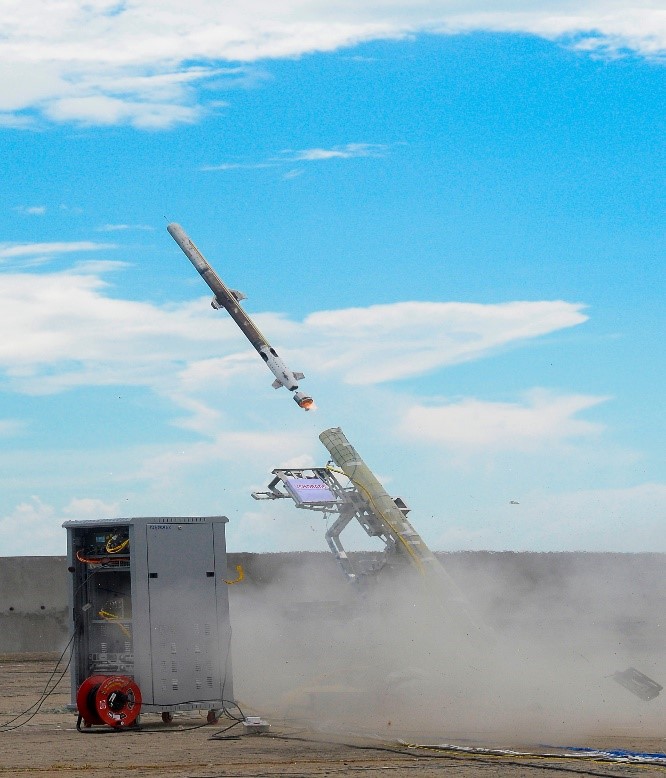
The DRDO completes two successful test flight of Very Short Range Air Defence System missile from a ground based portable launcher.
- It is a Man Portable Air Defence System (MANPAD).
- It was designed and developed by the Research Centre Imarat (RCI), Hyderabad, a laboratory of the Defence Research and Development Organisation (DRDO).
- It is a Short Range Air Defence with a 20kg missile, 25 kg tripod stand and 20-25 NG (National Guard).
- It contains many technologies including small-sized Reaction Control System (RCS) and Integrated avionics.
- It is meant for balancing low altitude aerial threats at short ranges by a dual thrust solid motor.
- The design of the missile including launcher has been highly enhanced to ensure for easy usage.
Reference
- https://pib.gov.in/PressReleasePage.aspx?PRID=1862617
- https://economictimes.indiatimes.com/news/defence/drdo-conducts-successful-test-flight-of-vshorads-missile/articleshow/94486305.cms
Nilgiri Sholakili
Recently found in high altitudes of the Shola forests, wildlife biologist seeks more support for research on Nilgiri Sholakili.
- Nilgiri blue robin (Sholicola major) or Nilgiri Sholakili is a dumpy little bird, slat-blue with a tan belly.
- It is highly restricted and spread over, found at 900-2100 m of elevation in shola forests in upper Nilgiris.
Sholas are patches of stunted montane forest separated by open grassy areas.
- Habitat - It prefers to live in highly threatened habitats and near streams.
- Any change to these areascould bring trouble in the future.
- Threats - Habitat loss and climate change.
- Protection Status - Endangered (IUCN)
- Other endemic bird in the Nilgiris - Nilgiri laughing thrush (Montecincla cachinnans), which is an ‘endangered’ species.

Reference
- https://www.thehindu.com/news/cities/Coimbatore/the-disappearing-song-of-the-nilgiri-sholakili/article65941180.ece
- https://ebird.org/species/whbsho1?siteLanguage=en_IN
Thermokarst Lake
Newly formed thermokarst lakes in Alaska are releasing methane bubbles.
- Methane is the primary contributor for formation of ground-level ozone and a hazardous air pollutant.
- It is a greenhouse gas and 80 times more powerful at warming than carbon dioxide.
- It has a shorter atmospheric lifetime than carbon dioxide, methane is responsible for 30% rise in global temperatures.
- Formation of Thermokarst Lakes - In Alaska, new lakes are emerging due to permafrost and release of methane into the atmosphere like Big Trail Lake.
- Permafrost can also form under-lake chimneys that allow methane to escape from underground.
Permafrost is a massive wedges of ice locked within the ground that stays frozen all year around.
- When ice melts the surface collapses and forms a sinkhole that is filled with water, creating a thermokarst lake.
- The methane bubbles emerging from these newly formed lakes are caused by microbial activity.
- The microbes digest the dead plants and organic matter in the frozen ground, which produces carbon dioxide and methane.
- As it is a flammable gas by lighting the collected gas sample from the lake we can test if the lake is emitting methane or not.
- These types of lakes are abundant in the Arctic where the lakes are hundreds or thousands of years old.
Reference
- https://www.thehindu.com/sci-tech/energy-and-environment/newly-formed-lakes-in-alaska-is-releasing-bubbles-full-of-methane/article65937494.ece
- https://blogs.nasa.gov/earthexpeditions/2022/09/22/alaskas-newest-lakes-are-belching-methane/
IOR+ Conclave
Alongside the DefExpo 2022, scheduled to be held in Gandhinagar, a separate Indian Ocean Region plus (IOR+) conclave will also be held.
Reference
- https://www.thehindu.com/news/national/india-africa-defence-dialogue-and-ior-plus-at-defexpo-2022/article65931237.ece
- https://www.airuniversity.af.edu/JIPA/Display/Article/2331112/indias-indian-ocean-region-strategy/
- https://pib.gov.in/PressReleasePage.aspx?PRID=1694780



