Mains: GS II | Welfare Schemes
Why in News?
An opinion piece by R. Srinivasan titled "The fiscal cost of cash-transfer schemes", calls for rigorous ex ante appraisal akin to a Detailed Project Report (DPR) for infrastructure before launching or expanding social transfer schemes.
What is the scale and trajectory of state cash transfers and subsidies?
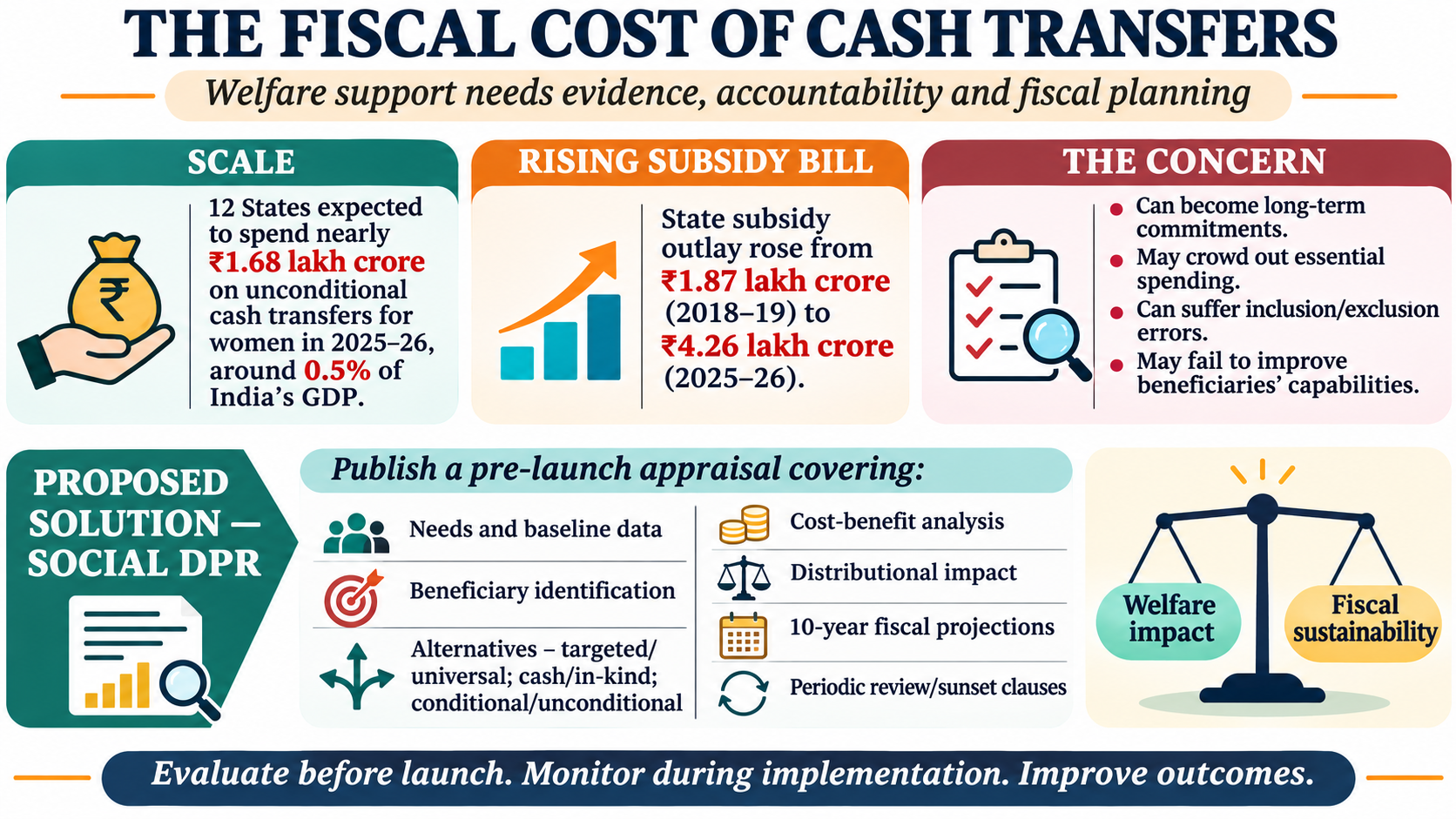
- Women-centric cash transfers - Twelve states were projected to spend nearly Rs.1.68 lakh crore (about 0.5% of national GDP) on unconditional cash transfers for women in 2025–26, up from under 0.2% of GDP roughly two years earlier.
- Broader unconditional cash transfer projections - Broader assessments of state unconditional cash transfers indicate spending rising from around Rs.1.5 lakh crore (roughly 0.6% of GDP) in FY23 toward nearly Rs.4 lakh crore (about 1% of GDP) in FY27.
- Total state subsidies- According to the RBI's study of state budgets, overall state subsidy expenditure more than doubled from Rs.1.87 lakh crore in 2018–19 to Rs.4.26 lakh crore in 2025–26.
- Fiscal pressures - Committed recurring outlays squeeze room for capital expenditure and compound pressures on state borrowings and fiscal deficits.
Why Ex Ante appraisal and "Social DPRs" matter?
- Infrastructure projects typically undergo structured pre-implementation appraisal covering objectives, alternatives, cost-benefit analysis, risks, and success benchmarks before public funds are committed.
- Social cash-transfer schemes, which directly shape household welfare and human capabilities, are frequently launched without an equivalent "Social DPR" or pre-budget public scrutiny.
- Pre-launch appraisal (Ex Ante)- Evaluates needs, target groups, alternatives (targeted versus universal, cash versus in-kind), local price effects, intra-household dynamics, and multi-year fiscal costs before funds are locked in.
- Multi-year costing and sunset clauses- Projecting 10-year fiscal costs, indexing real benefit values where appropriate, and building in sunset clauses, scheduled reviews, or beneficiary time limits help prevent open-ended budget rigidities.
- Post-implementation evaluation and monitoring (Ex Post) - Pairs ongoing real-time tracking with independent audits so legislatures and citizens can verify whether schemes improve actual capabilities rather than merely disbursing funds.
What are the key challenges in current welfare design?
- Political stickiness and post-facto fiscal adjustments - Once introduced, unconditional cash commitments are difficult to scale back, leading states to adjust later through higher debt or cuts to discretionary or capital spending.
- Absence of pilot testing and Bottom-up design- Launching large schemes abruptly without trial runs or ground-level feedback can miss how households actually allocate funds or face local price pressures.
- Linkage gaps with human capital- As noted in policy discussions around the Economic Survey 2025–26, unconditional transfers without links to health, education, and skilling may offer short-term relief without durable capability gains.
- Top-down execution - Target-driven administration can overshadow beneficiary agency, transparency, and outcome accountability.
What is the way forward?
- Require transparent ex ante appraisals before committing budget resources, detailing multi-year cost projections, alternatives considered, distributional effects, and clear outcome metrics.
- Align cash support with human-capital outcomes such as schooling, nutrition, healthcare access, and skill development supported by strong public service delivery.
- Embed periodic evaluations, sunset mechanisms, and real-time fiscal and beneficiary monitoring so schemes can be right-sized or reformed evidence-basedly.
- Safeguard fiscal room for infrastructure, education, and health staffing so short-term transfers do not weaken long-term economic growth and service quality.
Reference
The Hindu | The fiscal cost of cash-transfer schemes



