Mains: GS II - World contitution| International relations
Why in News?
The recent US–Saudi Arabia nuclear deal has reignited debates over the evolving security architecture of West Asia and Understanding the idea of a republic is therefore essential for comprehending contemporary geopolitical developments in the region.
What is a Republic?
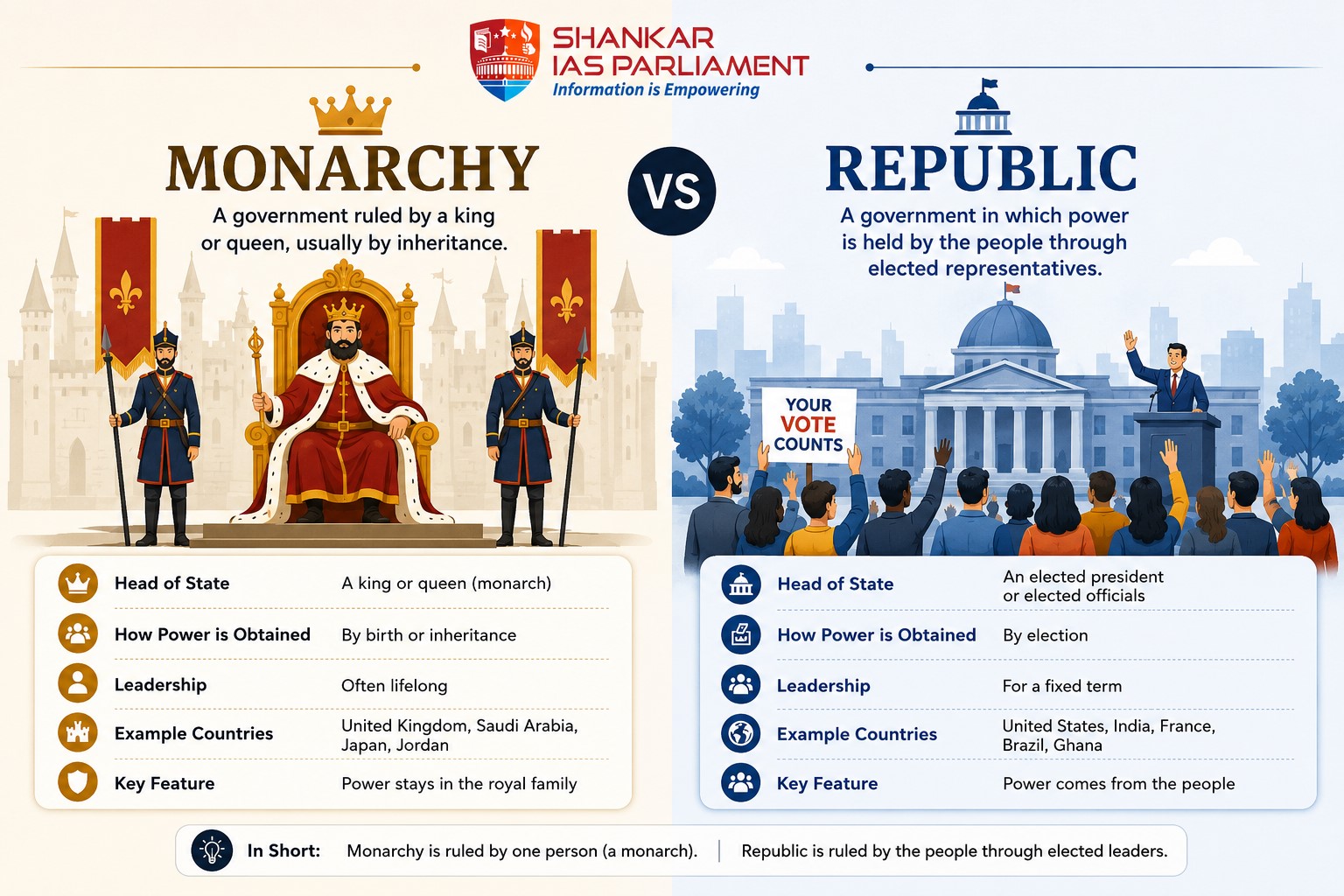
- Definition – A republic is a form of government in which sovereignty and supreme political authority reside in the people rather than in a hereditary monarch.
- Citizens exercise this sovereignty by electing representatives who govern according to laws established within a constitutional framework.
- Origin of the term – The term 'republic' originates from the Latin phrase res publica, meaning "the common thing" or "the public good."
- It reflects the principle that government exists to serve the collective interests of society rather than the personal authority of a ruler.
- Unlike monarchies, where leadership is inherited, or authoritarian regimes where power is concentrated in the hands of a few individuals, republics derive political legitimacy from the consent of the governed.
What is the historical evolution of Republican thought?
- Florence – It emerged as a major centre of republican political thought.
- The legacy of the Greek city-states, the Roman Republic, and the restoration of republican government in Florence between 1494 and 1512 inspired influential thinkers such as Niccolò Machiavelli.
Florence is the capital of Italy's Tuscany region, known globally as the birthplace of the Renaissance, famous for art, and anchored by landmarks like the Florence Cathedral, the Uffizi Gallery, and the Ponte Vecchio.
- Other countries – Subsequently, republican ideas gained prominence in countries such as Britain and the Netherlands.
- However, it was the American Revolution and the French Revolution that fundamentally challenged absolutist monarchies and established republicanism as a dominant model of modern governance.
- These revolutions transformed the idea of political authority by asserting that governments derive legitimacy from the people rather than hereditary rulers.
What are the essential features of a Republic?
- Popular Sovereignty – The people constitute the ultimate source of political authority.
- Governments derive legitimacy through the consent of citizens rather than dynastic succession.
- Constitutional Governance – Republics function within a constitutional framework that establishes:
- Distribution of powers
- Election procedures
- Fundamental rights
- Institutional checks and balances
- Rule of law
- Constitutions ensure that governmental authority remains limited and accountable.
- Universal Suffrage and Representative Government – Most modern republics are based on universal suffrage, allowing citizens to participate in choosing their representatives.
- Although universal suffrage is closely associated with democratic governance, republican governments may historically have extended voting rights only to particular categories of citizens.
- Nevertheless, constitutional mechanisms for regular elections remain central to ensuring that governments reflect the will of the people.
- Representative institutions translate public opinion into governance while maintaining constitutional order.
What are the different forms of Republics?
- Presidential Republic – In a presidential republic, an elected President serves as both:
- Head of State
- Head of Government
- Executive authority is concentrated in the office of the President.
- Parliamentary Republic – In parliamentary republics, the elected Head of State functions separately from the Head of Government.
- Executive authority is exercised by a Prime Minister who commands legislative support.
- Such arrangements combine republican principles with parliamentary governance.
What is the contrasting difference between Iran and Saudi Political system?
- The Islamic Republic of Iran – It was established after the 1979 Iranian Revolution, combines republican institutions with Islamic political philosophy.
- Uniqueness – Unlike several other Islamic republics such as Pakistan and Mauritania, Iran assigns a central constitutional role to religious jurisprudence.
- The defining feature of Iran's political system is the doctrine of velāyat-e faqih (Rule of the Islamic Jurisprudent).
- According to this doctrine, developed by Ayatollah Ruhollah Khomeini, religious authority and political leadership are inseparable.
- The 1979 Constitution of Iran institutionalised this principle by granting overarching authority to the Supreme Leader, who occupies the highest political and religious office within the state.
- Thus, while Iran possesses republican institutions such as elected presidents and parliaments, the Supreme Leader exercises ultimate constitutional authority.
- Ideological Foundations of the Iranian Republic – According to scholar A. K. Ramakrishnan, Iran's post-revolutionary political order emerged through the revolutionary interpretation of Islamic religious texts by religious scholars and intellectuals.
- This ideological leadership enabled people to connect their religious beliefs with:
- Anti-monarchist movements
- Anti-imperialist politics
- Revolutionary political transformation
- Consequently, the Iranian Republic developed an ideological identity that distinguished it from both secular republics and hereditary monarchies.
- Saudi Arabia – In contrast, Saudi Arabia remains a hereditary monarchy where political authority rests with the ruling royal family.
- Unlike republican systems that derive legitimacy through elections and constitutional popular sovereignty, Saudi Arabia derives legitimacy through hereditary succession and traditional monarchical institutions.
- Its governance structure reflects continuity rather than revolutionary transformation.
- This fundamental difference in political organisation contributes to contrasting understandings of authority, legitimacy, and regional leadership.
- Governance and Geopolitics in West Asia – The differing political systems of Iran and Saudi Arabia significantly influence regional geopolitics.
- Following the Iranian Revolution, Iran's revolutionary ideology was widely perceived as a challenge to:
- Arab monarchies
- The existing US-led regional security order
- The ideological appeal of political Islam combined with republican institutions generated concerns among neighbouring monarchies regarding regime stability and regional influence.
- For several decades, these ideological differences contributed to rivalry between Iran and the Arab Gulf monarchies.
To know more about US-Saudi Nuclear deal Click here
Why understanding the Republic matters?
- The concept of a republic extends beyond constitutional theory.
- It influences:
- Political legitimacy
- State institutions
- Distribution of power
- Foreign policy orientation
- Regional leadership ambitions
- In West Asia, understanding republican governance provides important insights into why Iran approaches regional politics differently from neighbouring monarchies.
- Political institutions shape national interests, security perceptions, and diplomatic strategies.
What are the challenges faced by Republics?
- Political Corruption – Misuse of public office and money power in elections can destroy public trust and subvert the rule of law.
- Economic Inequality – Wide gaps in wealth alienate large portions of the population, leading to social unrest and political polarization.
- Erosion of Institutions – The weakening of courts, legislatures, and watchdogs allows executive overreach and reduces accountability.
- Social and Cultural Division – Deep-rooted prejudices, sectarian conflicts, and the rejection of pluralism fracture the shared identity required for a stable republic
What lies ahead?
- The evolving strategic landscape of West Asia demonstrates that security is influenced not only by military alliances and diplomacy but also by differing systems of governance.
- The US–Saudi Arabia nuclear agreement reflects Riyadh's continued reliance on American strategic support while simultaneously recognising Iran's significance within the regional security architecture.
- At the same time, the contrasting political structures of the Islamic Republic of Iran and the Kingdom of Saudi Arabia continue to shape their competing visions of legitimacy, leadership, and regional order.
- Understanding the idea of a republic—its origins, constitutional foundations, and distinctive institutional characteristics—therefore provides an essential framework for analysing contemporary geopolitical developments in West Asia and the broader dynamics of international politics.
Reference
The Indian Express| Republic



