0.1453
7667766266
x

National Investment Policy for Urea (NIPU)–2026

iasparliament Logo
July 28, 2026

Mains: GS III – Indian Economy and Issues relating to Planning, Mobilisation of Resources.

Why in News?

Recently, the Cabinet Committee on Economic Affairs (CCEA) has approved the National Investment Policy for Urea (NIPU)–2026.

What is the National Investment Policy for Urea (NIPU)–2026?

  • About the policy – The NIPU 2026b was approved to promote fresh investments in the domestic urea sector and strengthen India’s self-sufficiency in fertilizer production.
  • Key objectives
    • Achieving Urea Self-Reliance Enhance domestic urea production, reduce reliance on imports, and ensure a stable fertiliser supply for India.
    • Investment & Viability Facilitate the attraction of private capital, ensure commercial viability, and guarantee assured returns within the urea manufacturing sector.
    • Cost Transparency Distinguish between fixed and variable costs to improve transparency in urea production pricing.
    • Assured Returns A Return on Equity (RoE) range of 12% to 16% (with a floor of 12% and a ceiling of 16%) supports investor returns while protecting the public interest in affordable fertiliser.

Gas-Based Urea Production

  • Gas-based urea production uses natural gas as the main raw material and energy source for nitrogen fertilizer.
  • Hydrogen is extracted from methane to produce ammonia, which is then combined with carbon dioxide from the same gas to form solid urea granules.
  • Advantages
    • Efficiency – It serves as a cleaner and more efficient chemical feedstock relative to traditional coal- or naphtha-based production methods.
    • Dual Role – It functions both as a chemical building block, supplying hydrogen and carbon dioxide, and as a fuel source for the high heat and pressure demands of the plant.
    • Economic Impact – Numerous countries encourage the development of modern gas-based facilities to reduce import dependence and stabilize domestic fertilizer supply.

What is the status of Urea in India?

  • Domestic production – India is the world’s largest urea importer, although it is only the second-largest consumer.
  • Current domestic production is about 30 million tonnes, while demand is about 40 million tonnes.
  • Import dependent – As per the Minister of Chemicals and Fertilizers data, the urea imports increased to 103.50 lakh tonnes in 2025-26 fiscal from 56.47 lakh tonnes in the preceding year.
  • Major Urea Import Sources
    • China – The top supplier in early 2026, providing over 22% of India’s urea imports after record shipment volumes.
    • Russia – A key supplier of nitrogenous and compound fertilizers, contributing 15% to 18% of India’s urea imports.
    • Oman and Gulf Nations – Longstanding Middle Eastern partners that maintain steady supply volumes despite regional energy and shipping challenges.

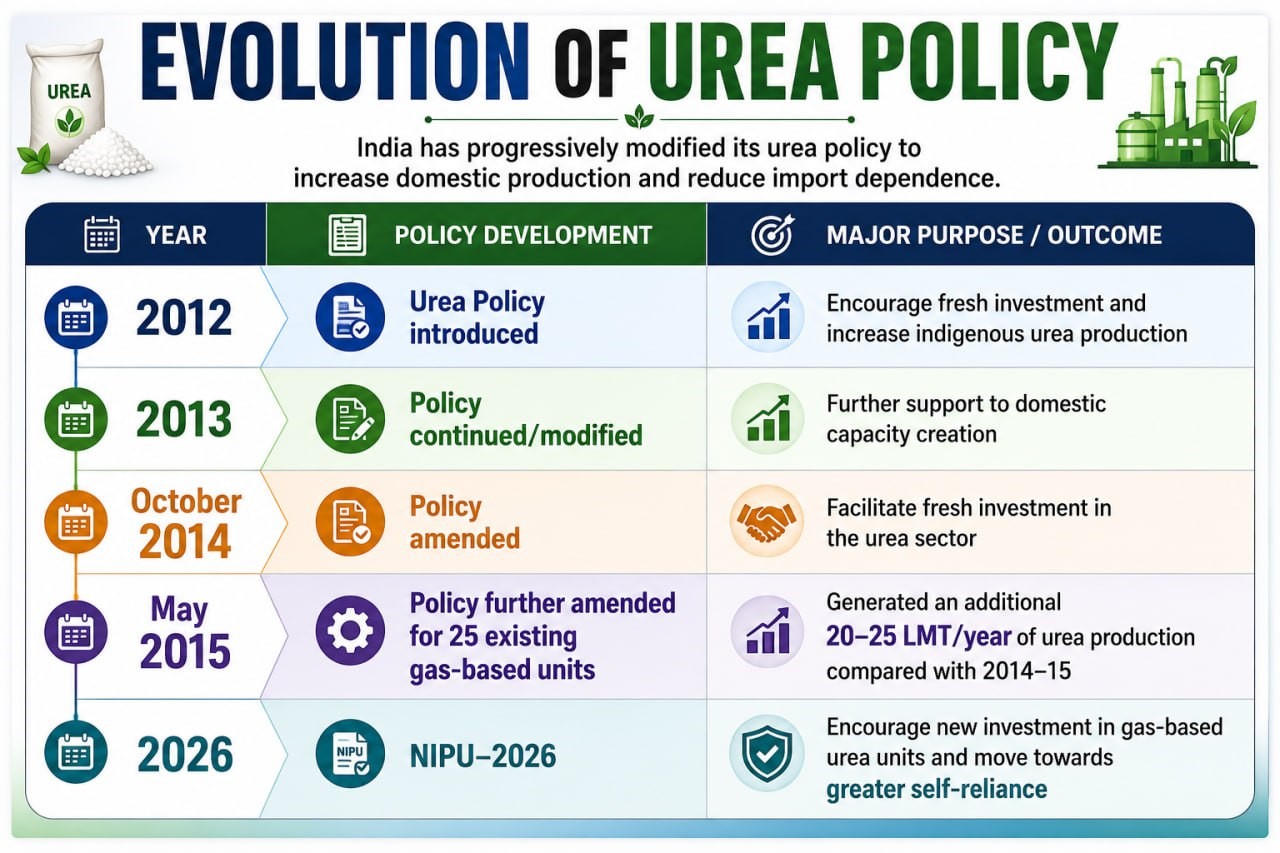
What is the historical content of urea production policy in India?

NIPU 2026. UPSC


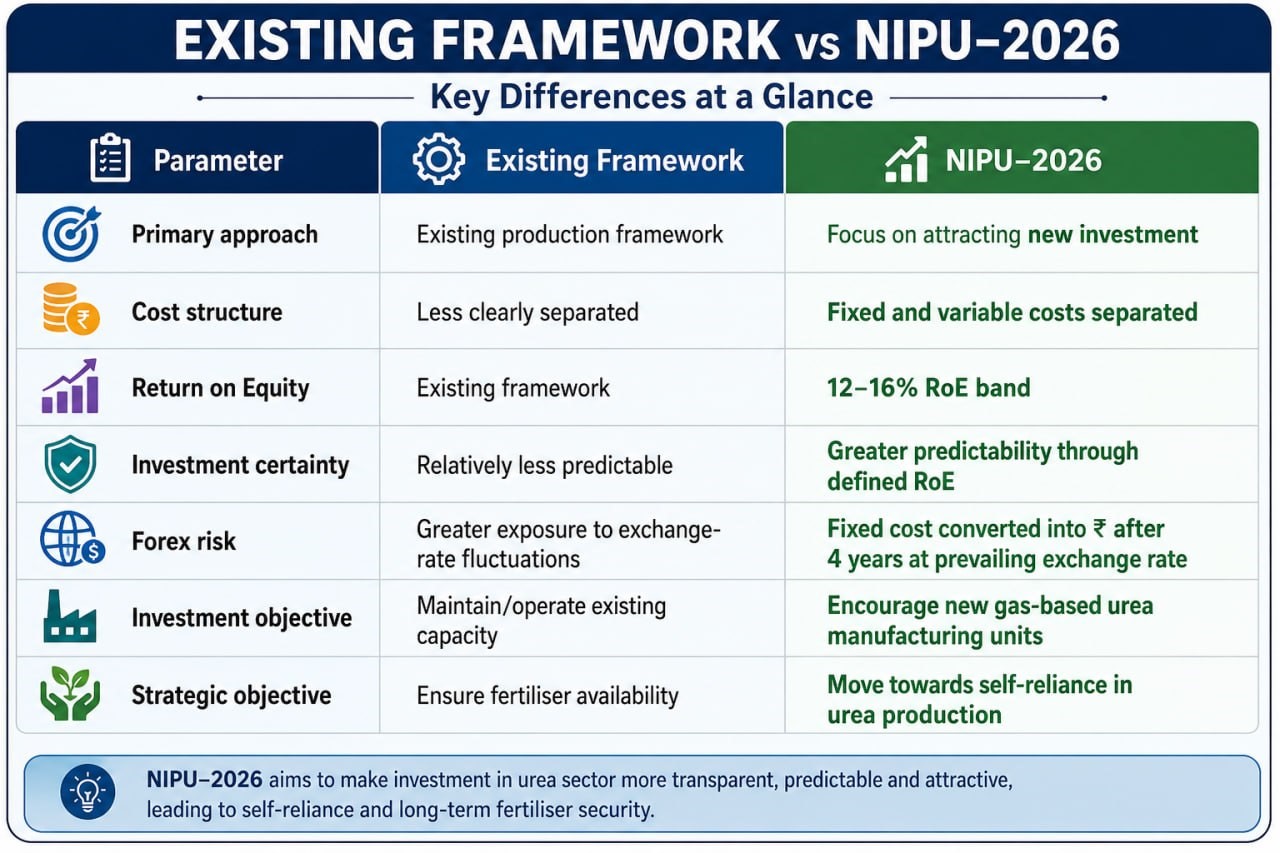
What is the difference between existing framework and NIPU 2026?

NIPU 2026 1.UPSC

What is the “necessity of NIPU 2026 in India?”

  • Global Supply Chain Vulnerabilities – Geopolitical tensions in West Asia have the potential to disrupt fertiliser and natural gas supply chains.
  • Rising Demand Pressures – Increased fertiliser demand, driven in part by weather-related fluctuations in agricultural requirements.
  • Import Dependence – India remains dependent on imported urea and feedstock.
  • Soil Health Concerns – There are concerns that excessive use of chemical fertilisers, particularly urea, negatively impacts soil health and disrupts nutrient balance.
  • Food Security Concerns – El Niñodriven fertiliser shortages during kharif season underscore Indias vulnerability, making stable urea supply essential for agricultural productivity and food security.
  • Investment Imperative – It is necessary to attract new investment in domestic gas-based urea manufacturing capacity.

What are the broader implications of NIPU 2026 for India?

  • Agricultural Security – Urea serves as a primary source of nitrogen for Indian agriculture. Enhancing domestic production can increase the reliability of fertiliser supply chains.
  • Economic Security – Reliance on imports exposes India to fluctuations in international prices, variable freight costs, exchange-rate volatility, and potential geopolitical disruptions.
  • Supply Stability – Provides reliable seasonal inputs for essential crops, reducing risks from geopolitical trade disruptions and climate variability.
  • MSME Growth – Creates local business opportunities for domestic engineering, manufacturing, and logistics sectors during plant construction.
  • Atmanirbhar Bharat – The NIPU–2026 initiative aligns with the broader objective of reducing critical import dependence by promoting domestic manufacturing.

What lies ahead?

  • However, increasing urea production alone is insufficient to address the broader challenges associated with fertiliser use in India.
  • India must also address the imbalance in nitrogen, phosphorus, and potassium (N:P:K) application, excessive nitrogen use, and declining soil health through the following measures:
    • Implementation of Soil Health Carsds.
    • Promotion of balanced fertilisation.
    • Adoption of integrated nutrient management practices.
    • Increased utilisation of organic and bio-fertilisers.
    • Implementation of precision agriculture technique.

References

The Hindu | India’s Policy on Urea



Login or Register to Post Comments
There are no reviews yet. Be the first one to review.

ARCHIVES

sidetext