0.1385
7667766266
x

The Antimicrobial Resistance (AMR) Paradox

iasparliament Logo
November 28, 2026

Mains: GS II | Health

Why in News?

Data from the ICMR Antimicrobial Resistance Surveillance and Research Network (AMRSN) examines why India has strengthened scientific and policy readiness yet still struggles to contain drug-resistant infections.

What is Antimicrobial Resistance?

  • Antimicrobial Resistance (AMR) occurs when microbes evolve to withstand drugs designed to treat infections, threatening routine care, critically ill patients, and modern medical procedures.
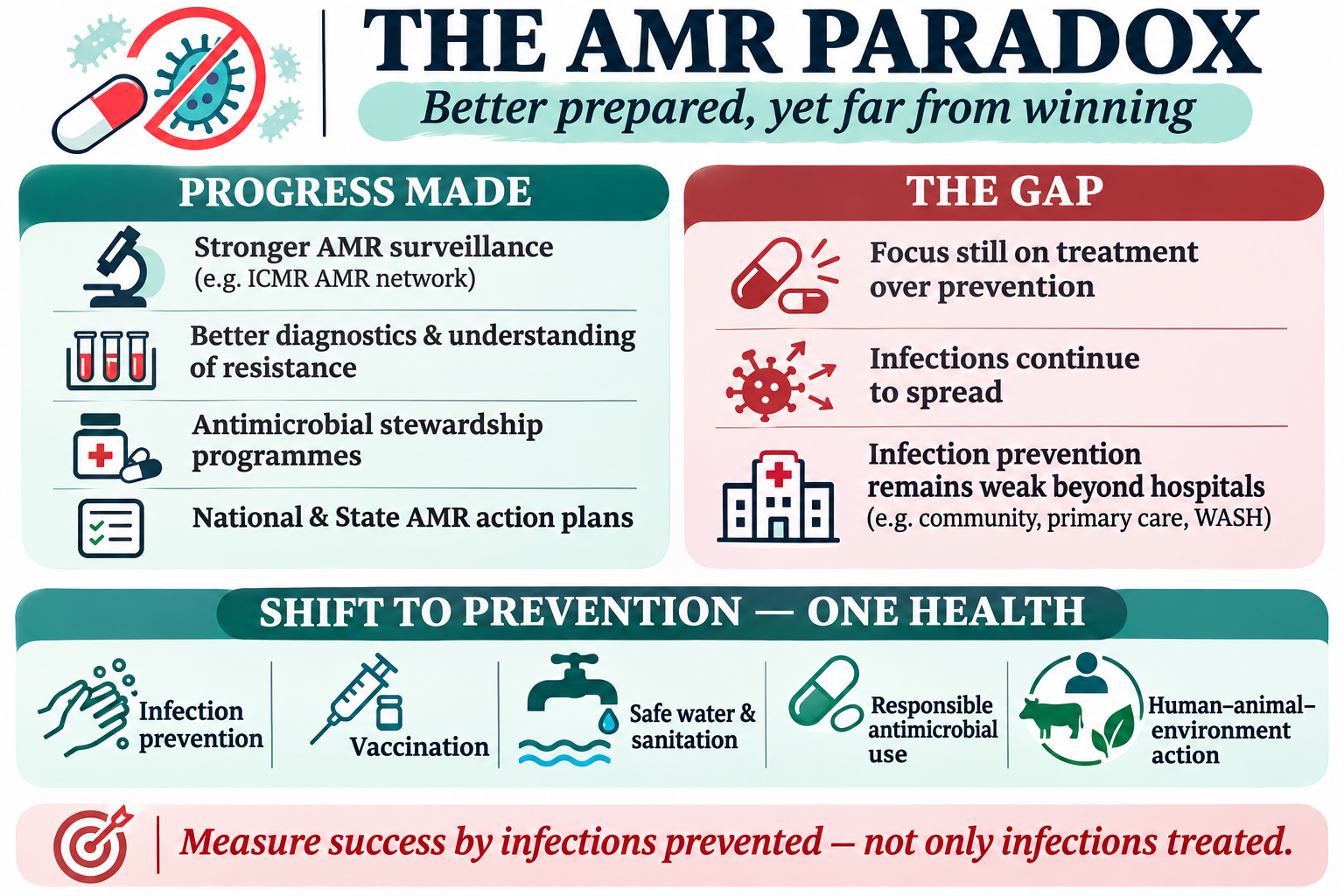
  • In India, initiatives such as the ICMR AMRSN and national and state action plans have built stronger surveillance, diagnostics, stewardship programmes, and treatment options.
  • Yet resistant pathogens such as Escherichia coli, Klebsiella pneumoniae, and carbapenem-resistant Acinetobacter baumannii continue to challenge healthcare across both tertiary and smaller hospitals.

What is the Amr paradox and global stakes?

  • The AMR paradox lies in becoming better equipped to monitor and treat resistant infections without sufficiently interrupting the conditions that allow resistance to emerge and spread.
  • Treating a single resistant case or opening a laboratory does not automatically stop transmission or curb misuse across communities, hospitals, farms, and the environment.
  • Lancet commission on 21st century Global threats -Identifies 17 major threats affecting human health and survival between 2025 and 2100, placing AMR alongside climate change, pandemics, childhood malnutrition, air pollution, obesity, inequality, nuclear conflict, and malicious use of AI.
  • Amenable DALYs- Estimates that differences between plausible best-case and worst-case futures for AMR could amount to 3.44 billion disability-adjusted life years (DALYs) over this century.
  • It showing that outcomes remain open to policy action rather than being predetermined.
  • Domestic Capacity Building - Reflects gains in AMR surveillance, diagnostic tools, understanding of resistance mechanisms, antimicrobial stewardship programmes, expanded treatment options, and national and state action plans.

Capacity gains versus unresolved gaps

Dimension

Preparedness and capacity gains

Unresolved implementation gaps

Surveillance and Diagnostics

ICMR AMRSN generates evidence, and diagnostic tools and laboratory networks have expanded.

Diagnostic results do not always reach clinicians quickly enough to change treatment decisions in time.

Hospital Care and Stewardship

Stewardship programmes and treatment options for difficult infections have been introduced or expanded.

High resistance persists even in smaller secondary-care hospitals, and treating a patient does not prevent the next patient from acquiring a resistant infection.

Community and One Health Systems

National and state action plans have raised AMR on the policy agenda.

Inappropriate antibiotic use in the community, weak infection prevention, poor sanitation, and antibiotic use in animal and environmental systems continue.

what are the key challenges in translating readiness into control?

  • Disproportionate focus on treatment over prevention - Relying primarily on new antibiotics or treating established resistant infections cannot substitute for preventing infections and blocking transmission.
  • Last-mile clinical and diagnostic delays - Sophisticated tests and stewardship rules lose impact when turnaround times are slow or stewardship is concentrated mainly in tertiary facilities.
  • Community misuse and broader drivers- Inappropriate antibiotic use in communities, weak hygiene and sanitation, and antimicrobial use in animals and the environment sustain resistance pressure.
  • Measuring inputs rather than health outcomes - Counting stewardship programmes or surveillance laboratories does not by itself show whether infections are falling, right-fit treatment is arriving faster, or preventable deaths are declining.

What is the way forward?

  • Strengthen infection prevention and control, clean water and sanitation, and vaccination to stop infections before antibiotics are needed.
  • Speed up diagnostic workflows so results guide clinical choices promptly, while curbing inappropriate antibiotic use in hospitals and communities.
  • Address antimicrobial use across animal and environmental systems alongside human healthcare so resistance reservoirs are contained across sectors.
  • Track concrete results declining infections, faster appropriate treatment, avoided preventable deaths, and contained resistance while the window for effective action remains open.

AMR paradox

Reference

Indian Express | AMR paradox

There are no reviews yet. Be the first one to review.

ARCHIVES

sidetext