Mains: GS III – Science and Technology
Why in News?
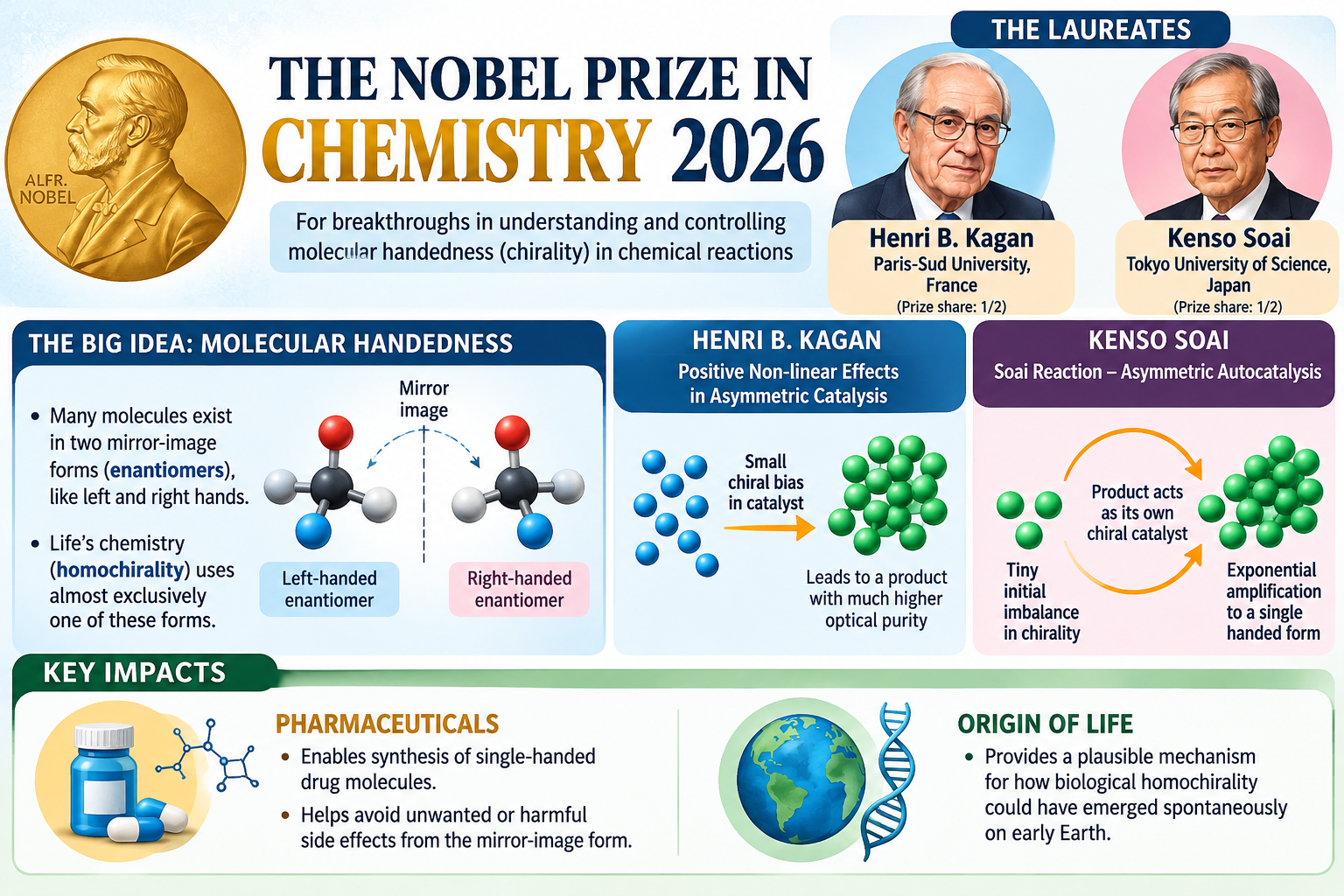
The 2026 Nobel Prize in Chemistry was awarded to Henri Kagan and Kenso Soai for their foundational discoveries in asymmetric catalysis and molecular amplification.
What is the background and significance of the 2026 Chemistry Nobel Prize?
- Key Scientific Achievement – Henri Kagan and Kenso Soai demonstrated that it is possible to amplify a molecule’s "handedness" (chirality) and direct chemical reactions to selectively produce a single enantiomer.
- Dual Impact Across Science and Industry – Their work revolutionized the production of ultra-pure pharmaceutical drugs while providing critical empirical clues into how life on Earth could have evolved from primitive, non-living chemical precursor molecules.
What is Chirality, Enantiomers, and Homochirality in nature?
- Chirality – Derived from the Greek word kheir (hand), chirality refers to a geometric property where a molecule cannot be superimposed on its mirror image, much like human left and right hands.
- Enantiomers – The non-superimposable left-handed and right-handed mirror-image pairs of a chiral molecule are called enantiomers.
- Although they share identical chemical formulas and physical properties, they can interact in completely different ways with biological systems.
- Homochirality Paradox – While standard lab synthesis produces a 50 –50 mixture of left- and right-handed molecules (a racemic mixture), living organisms are overwhelmingly single-handed.
- For instance, biological DNA and RNA use exclusively right-handed sugars, while proteins are built almost entirely from left-handed amino acids, a fundamental biological phenomenon known as homochirality.
Why does molecular handedness matter in drug development and biotechnology?
- Differential Biological Activity – Because human cell receptors, enzymes, and DNA are themselves chiral, they bind differently to left- and right-handed drug molecules.
- Pharmacological Risks of Racemic Drugs – In many cases, one enantiomer provides therapeutic benefits, while its mirror-image twin may be inert, cause unwanted side effects, or prove toxic (as seen historically in tragic cases like thalidomide).
- Enantiomeric Purity in Pharmaceuticals – Kagan and Soai’s methods enable chemists to selectively manufacture single-enantiomer drugs of exceptionally high purity, eliminating toxic side-effects and drastically reducing required drug dosages.
What are the key discoveries of Henri Kagan and Kenso Soai?
- Henri Kagan’s Asymmetric Catalysis – Kagan pioneered chiral catalysts (such as DIOP) that guide chemical reactions to synthesize overwhelmingly one mirror-image form over another, laying the groundwork for modern asymmetric synthesis.
- The Soai Reaction and Asymmetric Autocatalysis – Kenso Soai discovered the famous "Soai Reaction," where a chiral product acts as an auto catalyst for its own formation.
- Even a tiny, minute imbalance in enantiomeric ratio (e.g., 50.01% left vs 49.99% right) amplifies exponentially during the reaction, yielding nearly 100% enantiomeric purity.
- Explaining the Origin of Life – Soai's autocatalytic amplification provided the first experimental proof of how slight, random symmetry-breaking events in prebiotic Earth could have expanded to create the homochiral foundation required for biological life.
What are the policy and technological imperatives for India’s pharmaceutical and biochemical sectors?
- Chiral Drug Manufacturing Expertise – India’s Active Pharmaceutical Ingredient (API) sector must invest heavily in asymmetric catalysis and green chiral synthesis technologies to transition from generic manufacturing to high-value, single-enantiomer novel therapeutics.
- R&D Capabilities in Chemical Biology – Promote targeted research grants via agencies like CSIR and DST in biocatalysis and asymmetric synthesis to reduce reliance on imported chiral building blocks.
Reference
The Hindu | Chemical Noble Prize



