0.1256
7667766266
x

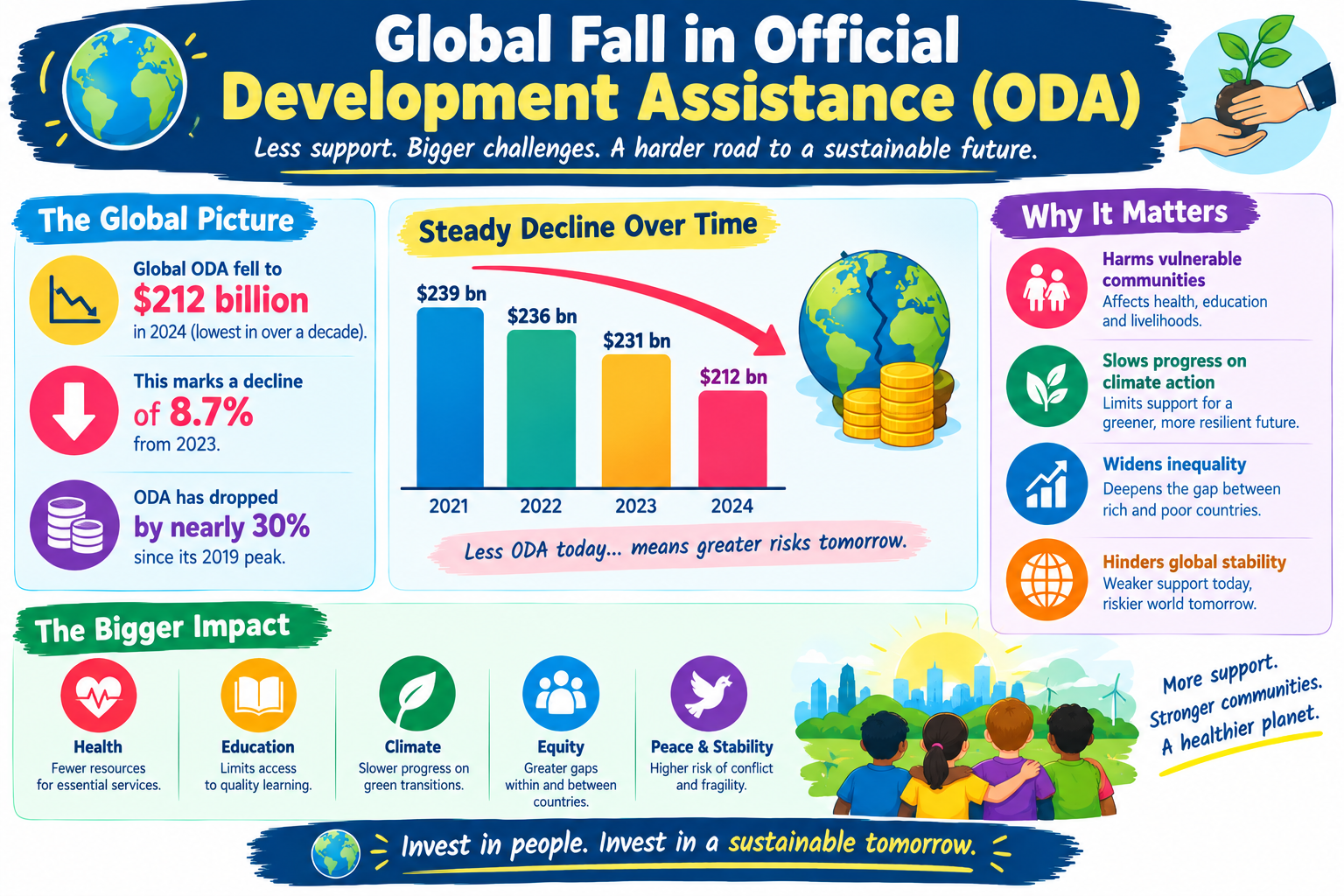
Global Fall in Official Development Assistance (ODA)

iasparliament Logo
October 12, 2026

Prelims: Current events of national and international importance | International Relations

Why in News?

Recently, the United Nations Conference on Trade and Development (UNCTAD) highlighted the global Official Development Assistance (ODA) is projected to fall to $152 billion in 2026.

  • This marks the 3rd consecutive annual decline in global development aid, bringing net ODA to its lowest level in real terms since 2014.
  • According to UNCTAD and OECD estimates, 16 out of 33 member countries of the OECD Development Assistance Committee (DAC) including the five largest donor nations have announced formal aid reductions for 2026.

Key Drivers

  • Fiscal Strain - Major donor countries are increasingly reprioritizing national budgets toward domestic industrial subsidies, defence spending, and managing elevated sovereign debt burdens, resulting in broad-based budgetary retrenchment for foreign aid.
  • Diversion of ODA Allocation - A growing share of reported ODA is being retained domestically within donor states (to cover in-country refugee costs) or diverted toward short-term geopolitical/humanitarian crises, leading to a sharp contraction in long-term developmental financing for low-income countries.
  • Impact on Vulnerable Regions
    • Least Developed Countries (LDCs) and Small Island Developing States (SIDS) are disproportionately affected, facing severe aid cuts in health, education, and climate adaptation programs.
    • The reduction widening the SDG Financing Gap (projected at over $4 trillion annually for developing economies).

Implications

  • Widening Global Fiscal Divide
    • Developing nations are confronting a narrowing fiscal margin to fund development goals while attempting to absorb energy price shocks, trade fragmentation, and volatile portfolio capital flows.
    • High global interest rates mean that replacing concessional ODA with non-concessional market borrowing increases sovereign debt risks and triggers debt-distress spirals.
  • Divergence in Competitiveness - Developed nations are executing large-scale industrial subsidies (e.g., green transition incentives), whereas developing nations facing shrinking aid and constrained domestic budgets are unable to compete or finance local climate resilience infrastructure.

Official Development Assistance (ODA)

  • Definition: Defined by the OECD-DAC as government aid designed to promote the economic development and welfare of developing countries.
  • Concessionality Threshold: Must be concessional in character and contain a grant element of at least 25% (calculated at a rate of discount of 10%).
  • UN Target: The long-standing international benchmark obligates developed nations to commit 0.7% of their Gross National Income (GNI) as ODA—a target achieved consistently by only a small handfull of countries (e.g., Norway, Sweden, Luxembourg, Denmark).

Global Fall in Official Development Assistance (ODA)

Reference

Down to Earth | Assistance to fall for third year in 2026

There are no reviews yet. Be the first one to review.

ARCHIVES

sidetext
Iasparliament

#18, Old Plot No 109, New Plot No 259,
AL Block, 4th Avenue, Shanthi colony, Anna Nagar,
Chennai 600040.

Shankariasacademy  7667766266
044 66024500
Shankarias academy icon
© 2026 Shankar IAS Academy