Prelims: Current events of national and international importance | Science & Technology
Why in News?
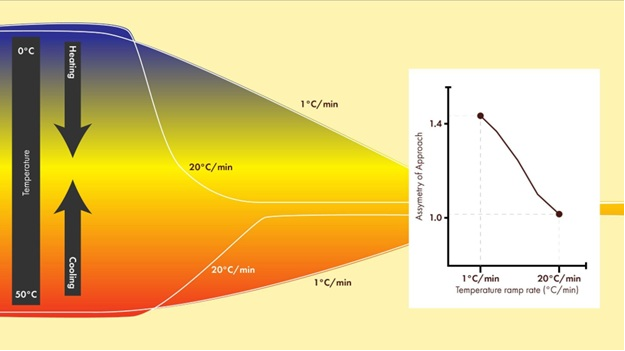
Scientists from the Raman Research Institute (RRIdiscovered that applying sudden thermal shocks (rapid temperature ramps) can temporarily liquefy dense "jammed" glass-like systems.
Key Highlights of the Discovery
- Erasing Structural Memory- Jammed systems, materials that behave mechanically like solids while maintaining disordered, liquid-like internal particle structures, normally retain "memory imprints" of past thermal paths.
- Thermal Shock Mechanism - By suddenly increasing the temperature ramp rate, the jammed microgel particles are forced to rearrange, momentarily converting the solid-like matrix into a flowing liquid state.
- Eliminating Path Asymmetries - In standard heating and cooling cycles, jammed microgel suspensions follow asymmetrical relaxation paths.
- Rapid thermal shocks eliminate these path-dependent asymmetries, enabling precise structural control.
- Experimental Methodology- Lead researcher synthesized microgel particles, suspended them in water, stirred and sonicated the mixture, and subjected the suspension to controlled temperature ramps while observing particle dynamics.
Thermoresponsive Microgels & Drug Delivery
- Swelling Capability - Microgels are soft, deformable polymer networks capable of absorbing 300 to 500 times their dry weight in water.
- Temperature-Triggered Release
- Cool State- Microgels remain swollen like puffed-up jelly at lower temperatures, allowing pharmaceutical molecules to be easily loaded inside.
- Warm State - Upon reaching a critical transition temperature—specifically above 34°C (just below normal human body temperature)—the microgels rapidly collapse, squeezing out and releasing the drug payload at targeted physiological sites (e.g., hyperthermic tumor environments).
- Clinical Significance - Understanding how external thermal perturbations influence structural recovery ensures predictable drug release kinetics, minimizing off-target toxicity.
Reference
DST | New study on temperature changes induced structure recovery



