Prelims: Current events of national and international importance | Internal Security & Defence Policy
Why in News?
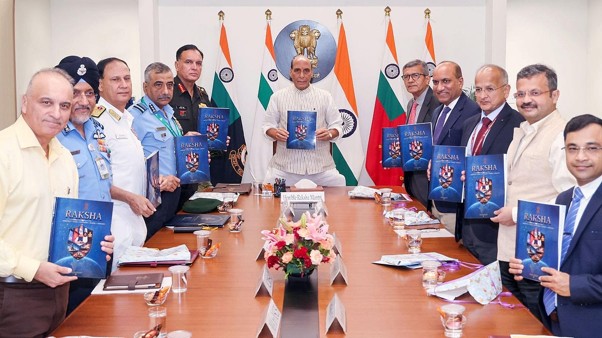
Union Defence Minister released 'RAKSHA', a strategic blueprint on defence diplomacy outlining India's strategic roadmap and vision for global defence partnerships over the next decade (2026–2036).
- Time Horizon - 10-Year Roadmap (2026–2036).
- Nodal Coordination - Ministry of Defence (MoD) in coordination with Ministry of External Affairs (MEA).
- Primary Maritime Role - Net Security Provider & First Responder in the Indian Ocean Region.
- 4 Key Pillars of the RAKSHA Framework
- Strategic Partnerships - Deepening bilateral and multilateral security cooperation with like-minded global and regional partners.
- Capacity Building - Expanding joint military exercises, specialized training programs, and sharing operational best practices with friendly foreign nations.
- Indigenous Defence Exports - Promoting Make-in-India defence platforms to position the nation as a reliable, high-tech global defence manufacturing hub.
- Maritime Security - Strengthening India's operational role as a Net Security Provider and First Responder across the Indian Ocean Region (IOR).
Strategic Significance
- Alignment with Foreign Policy - Formally elevates defence diplomacy as a core operational pillar of India's foreign policy rather than a secondary military engagement tool.
- Indo-Pacific & IOR - Reaffirms India's commitment to preserving a rules-based international maritime order, freedom of navigation, and regional stability amid evolving Indo-Pacific dynamics.
- Defense Industrial Integration- Complements domestic self-reliance initiatives (Aatmanirbhar Bharat) by leveraging Indian manufacturing scale to export indigenous platforms to partner nations.
- Inter-Agency Synergy- Establishes a synchronized operational linkage between the Ministry of Defence (MoD), Ministry of External Affairs (MEA), and the Armed Forces leadership.
Reference
PIB | ‘RAKSHA’ defence diplomacy document



