Mains: GS II – Welfare Schemes for Vulnerable Sections of the population by the Centre and States and the Performance of these Schemes.
Why in News?
Recently, India has received three Guinness World Records titles under the nationwide Swasth Nari, Sashakt Parivar Abhiyaan (SNSPA), marked by unprecedented coordination, mass mobilisation, and efficient digital use.
What is Swasth Nari campaign?
- Swasth Nari campaign – The "Swasth Nari, Sashakt Parivar" (Healthy Woman, Empowered Family) campaign was a nationwide health initiative in India launched by Prime Ministry of Health and Family Welfare on September 17, 2025, to run until October 2, 2025.
- Significance – It was celebrated as a large-scale "Jan Andolan" (mass movement) involving various government ministries, medical colleges, and community organizations.
What are the Key objectives and activities?
- Health and nutrition improvement – The core goal was to improve the health of women and children through comprehensive services.
- Health screenings – It included extensive screening for non-communicable diseases such as breast and cervical cancer, anemia, diabetes, hypertension, and TB.
- Health camps – The campaign organized numerous health camps at various government facilities, providing preventive, promotive, and curative services.
- Awareness and counselling – Health camps also offered counseling on nutrition, menstrual hygiene, mental health, and lifestyle choices.
- Community participation – The initiative encouraged broad community involvement, with over 20 ministries, medical colleges, and private organizations participating.
- The campaign’s massive community mobilisation that involved more than 5 lakh Panchayat representatives, 1.14 crore students, 94 lakh Self-Help Group members, and 5 lakh other community members
- Digital integration – Beneficiaries were enrolled in digital health services like the ABHA and encouraged to use online platforms for health pledges and information.
What are the Digital turns in women’s healthcare?
- Foundation – India’s journey towards digitising women’s healthcare began in earnest in the mid-2000s, marking a shift from manual, paper-based record system to data-driven health governance utilising digital tracking systems.
- Varied technologies – India has deployed diverse technologies, including Interactive Voice Response Systems (IVRS), SMS, telemedicine, and mobile health applications, to strengthen maternal healthcare.
- Notably, these choices have been shaped by the targeted population’s socioeconomic status and literacy levels.
- The Mother and Child Tracking System (MCTS) – It was launched in 2009, represented the first systematic attempt to create digital registries for pregnant women and children, aiming to track immunisation schedules and antenatal care visits.
- This evolved into the Reproductive and Child Health (RCH) portal, which consolidated multiple vertical programmes into an integrated digital platform.
- The Kilkari mobile health programme – This was rolled out in 2016 as a part of the Digital India Initiative, delivers 72 weekly automated voice messages in Hindi to those women registered in the RCH portal.
- The programme now reaches over 29 million women across 18 states and union territories.
- eSanjeevani telemedicine platform – It was integrated into the public system, has delivered over 100 million consultations since 2020.
- Government data suggests that women constitute the majority of beneficiaries, with more than half of consultations pertaining to female patients.
- National Digital Health Mission in 2020 – It was later rebranded as the Ayushman Bharat Digital Mission (ABDM) – marked an acceleration toward a comprehensive health data infrastructure.
- The COVID-19 pandemic functioned as a catalyst, normalising telemedicine, digital health records, and mobile health applications.
- Co-WIN platform – It demonstrated the state’s capacity for mass digital health coordination.
- These infrastructures have since been efficiently utilised for women’s health initiatives, as evidenced by the recent SNSPA campaign.
How Digitisation has yielded measurable improvements in certain dimensions of healthcare delivery?
- Improve immunisation coverage – Studies on the mMitra voice message service for maternal health indicate that digital tracking systems have improved immunisation coverage.
- mMitra has enabled automated reminders and reducing dropout rates between vaccine doses, apart from aiding doctor consultations for bleeding and promoting institutional child delivery.
- Increased home visits – Research proves that mobile health applications used by frontline health workers have increased antenatal home visits by 15.7% and postnatal visits by 12%, while facilitating health education and systematic screening.
- The ability to generate real-time data on service delivery gaps has enhanced administrative visibility, potentially enabling more responsive resource allocation.
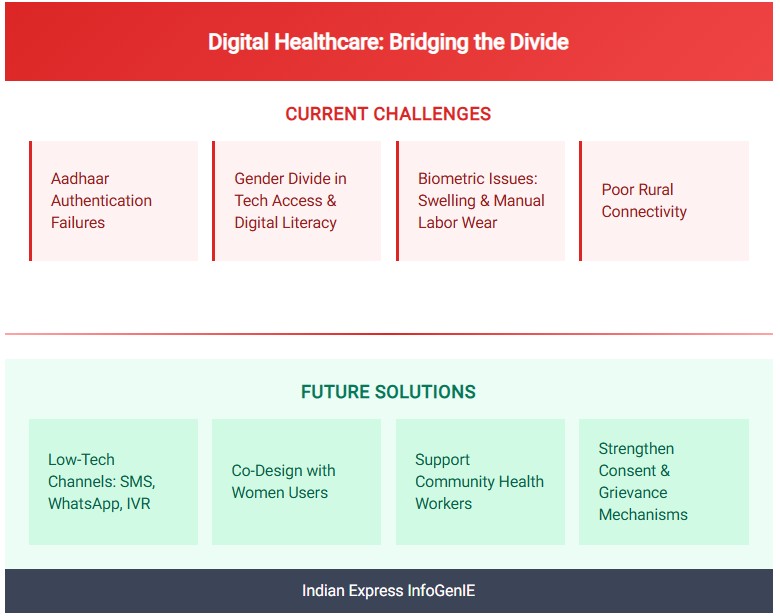
What lies ahead?
- State-level initiatives like Haryana’s proposal to assign unique “pregnancy IDs” linked to the RCH portal may help illustrate the importance of integrating technology in medical care.
- Although the initiative aims at improving monitoring of sex-selective abortion and ensuring maternal healthcare benefits, it also illustrates how digital infrastructures can be deployed both to protect and to discipline women’s reproductive lives.
- Nonetheless, a more progressive trajectory could be possible if digitisation is reframed through an inclusive approach that takes into account the intersectional vulnerabilities of women in India.
- This requires prioritising low-tech, multilingual channels (SMS, WhatsApp Chatbots & IVR) co-designed with women users; strengthening enforceable consent, grievance and redress mechanisms.
- The digital tools need to be used to support rather than replace community health workers, enabling ASHAs to leverage data for advocacy and claim-making, not just reporting.
- Digitisation can advance women’s health only when it redistributes power, protects autonomy, and actively mitigates the inequalities it risks entrenching.
- An imperative now made tangible by initiatives like the Swasth Nari, Sashakt Parivar Abhiyaan, signalling India’s readiness to translate scale into sustained structural transformation.
Reference
The Indian Express| Swasth Nari Campaign



