Prelims: Current events of National and International Importance| Environment
Why in News?
India is moving forward with a comprehensive Sustainable Aviation Fuel (SAF) framework, highlighted by a proposed three-pillar national policy and the operational readiness of the country's first commercial-scale SAF plant at the Indian Oil Corporation (IOC) Panipat refinery.
Three-Pillar Policy Framework
- Announced by Civil Aviation Minister Kinjarapu Ram Mohan Naidu, the draft framework relies on three main pillars–
- Coordination– A National Council to oversee inter-ministerial implementation.
- Domestic Production– Boosting local output and feedstock access (such as used cooking oil and agro-residues) via public-private partnerships.
- National Registry– A DGCA-managed registry to log transactions and verify carbon reductions.
Blending Mandates & Timeline
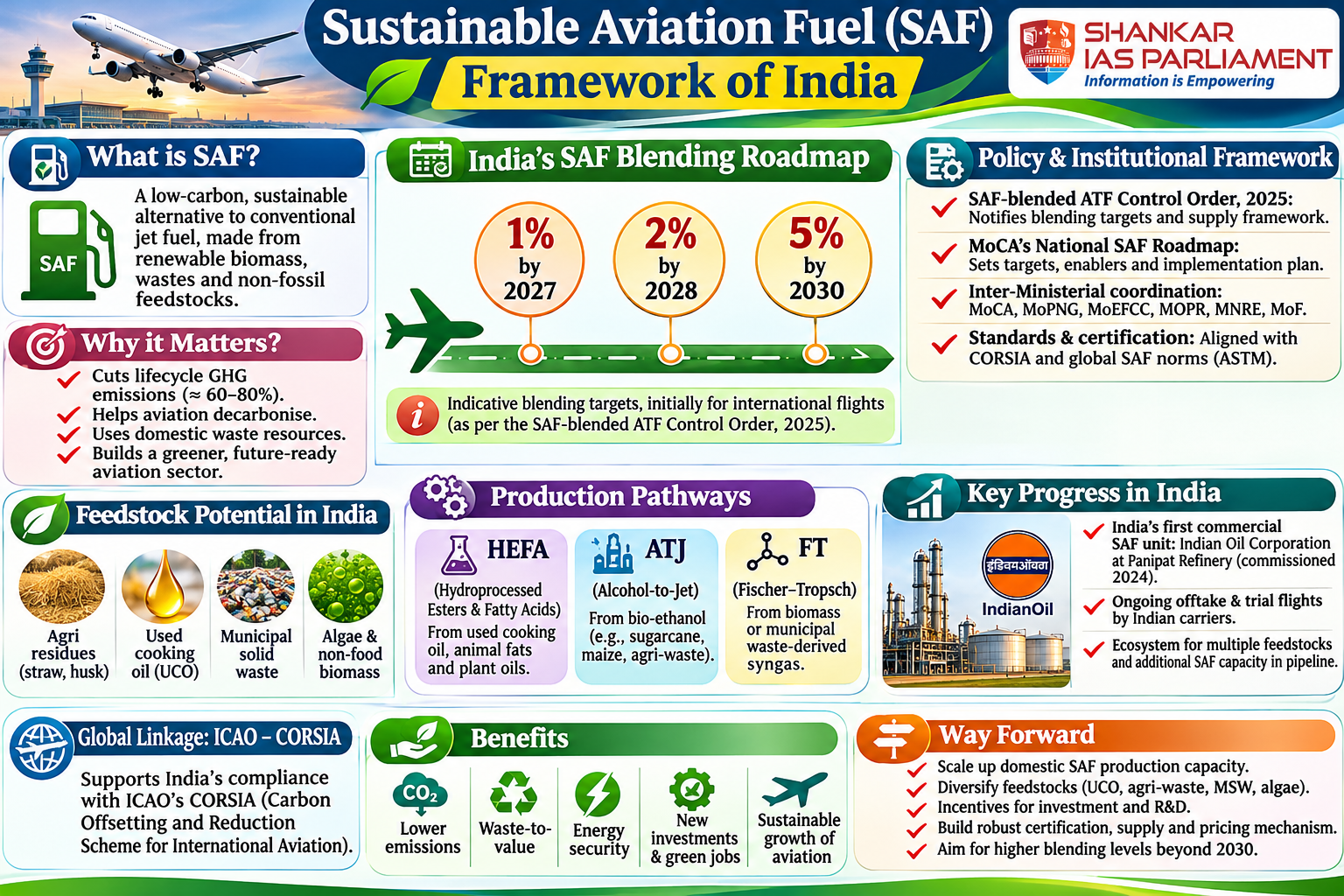
- International Targets– India aims for indicative SAF blending levels of 1% in 2027, 2% in 2028, and 5% by 2030 for international flights, mirroring ICAO's CORSIA schedule.
- Regulatory Compliance– Blended fuels are governed by the Aviation Turbine Fuel Order, adhering to BIS and ICAO standards.
Commercial Readiness and Supply
- Panipat Plant– Located at IOC's Haryana refinery, the facility is ready for commercial supply, certified to handle feedstocks like used cooking oil, and scaled to meet the initial 2027 blending target.
- Industry Partnerships– IOC has established supply arrangements with Air India, alongside exploration MoUs involving HPCL, Akasa Air, and Airbus.
Reference
Down To Earth| Sustainable Aviation Fuel Policy



