Prelims:Current events of National and International Importance| Polity
Why in News?
Recent reports said that a special session of Parliament could be convened before the regularly scheduled Winter Session this year
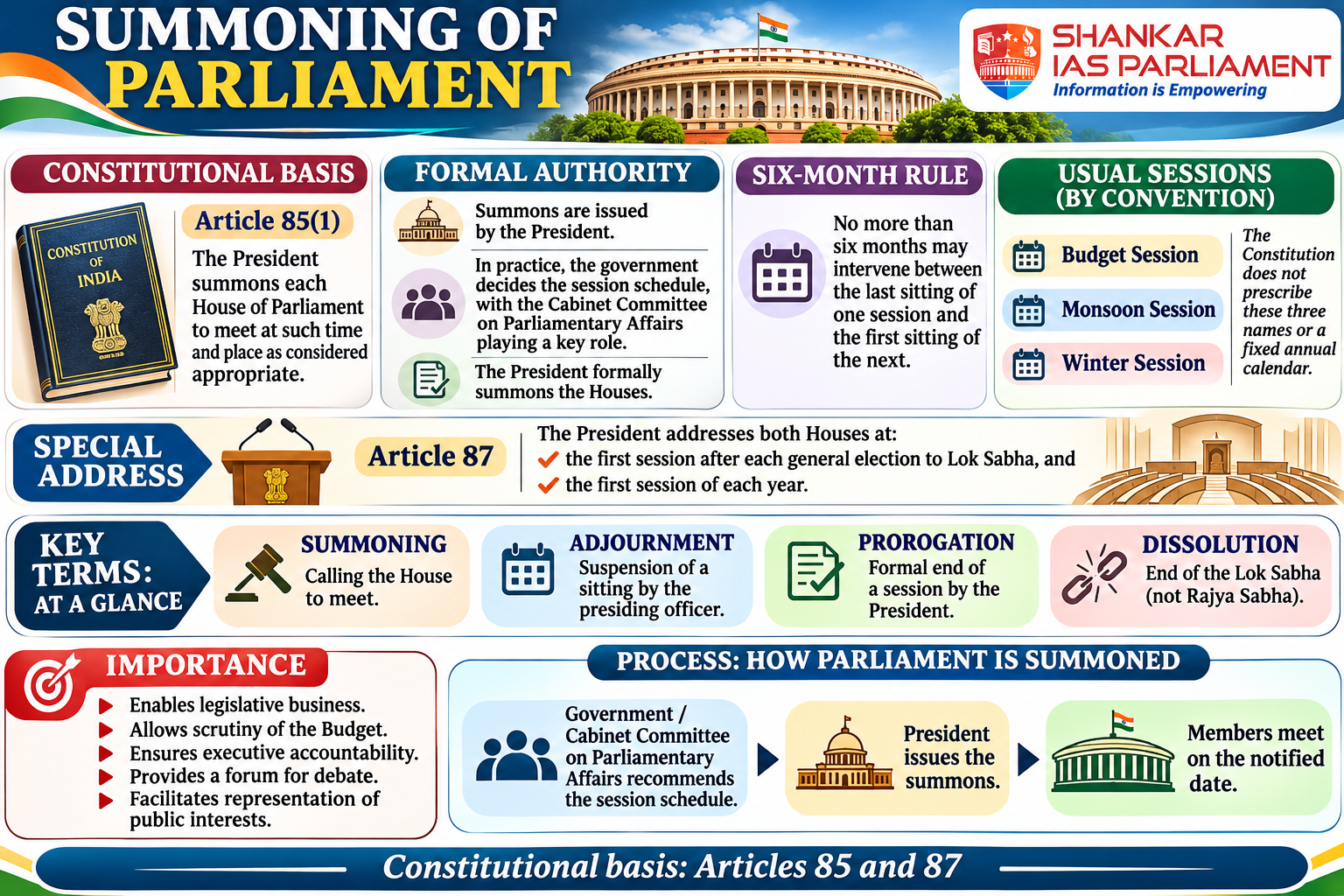
Summoning of Parliament in India is the formal call by the President of India for each House of Parliament to meet for a session under Article 85(1) of the Constitution.
Although the Constitution does not use the term "special session," such sessions are summoned under the same constitutional power to meet outside the usual schedule for urgent business or major milestones.
Summoning of Parliament
Constitutional Authority– Article 85(1) empowers the President to summon each House at a chosen time and place.
Role of the Government– In practice, the government decides the dates through the Cabinet Committee on Parliamentary Affairs, and the President issues the formal summons in their name.
Six-Month Rule– No more than six months can pass between the last sitting of one session and the first sitting of the next.
India has no fixed parliamentary calendar and usually holds three sessions a year– Budget, Monsoon, and Winter.
Convening of Special Session
Cabinet Decision– The Cabinet Committee on Parliamentary Affairs decides to call a special session outside the three regular sessions.
Presidential Summons– Acting on the government's advice, the President formally summons MPs under Article 85.
As The Indian Express notes, regular sessions typically carry about 15 days' notice by convention, whereas a special session can be called at shorter notice.
What Sets Special Sessions Apart
Purpose and Timing– They are held outside the regular Budget, Monsoon, or Winter sessions for urgent legislative/national matters or specific milestones—such as the eve of independence (1947), the Indo-China War (1962), or the GST rollout (2017). [1, 2]
Modified Proceedings– Presiding officers (the Lok Sabha Speaker and Rajya Sabha Chairman) can limit proceedings and suspend regular devices like Question Hour.