Prelims: Current events of national and international importance | Economy
Why in news?
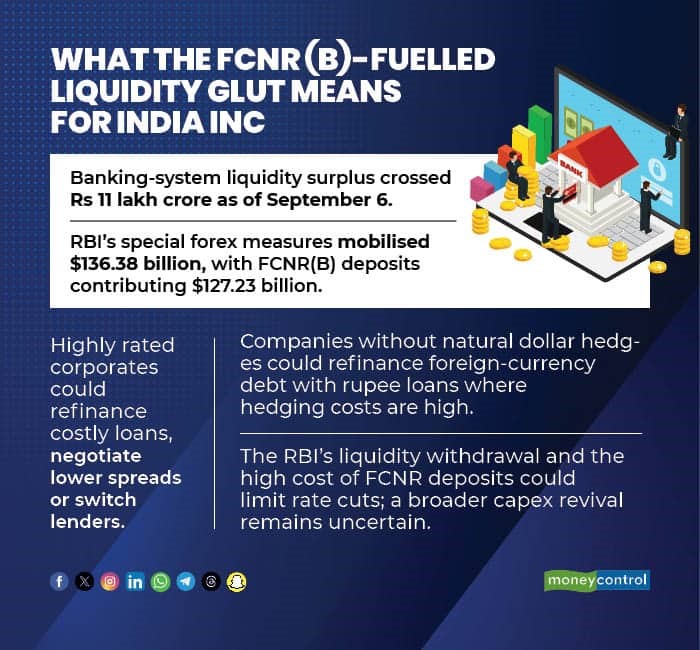
RBI liquidity surplus has crossed Rs 11 lakh crore, with abundant bank funds likely to affect loan rates, fixed deposits and short-term market yields.
- Surplus liquidity – Commercial banks have an excess of cash and liquid funds beyond what they need for
- day-to-day operations,
- customer withdrawals, and
- minimum reserve requirements.
- Reason for increase – Sizeable foreign-currency inflows mobilised by Indian banks through the RBI’s special FCNR(B) deposit window.
- Foreign Inflows – Banks raised about $136.4 billion from non-residents and foreign lenders, primarily via special FCNR(B) deposit and swap schemes.
- When foreign currency is converted/swapped into Indian rupees, it increases rupee liquidity in the domestic financial system.
- Rupee Flooding – Swapping these foreign funds with the RBI swelled India's forex reserves by $44.9 billion to $785.7 billion, but flooded the domestic money market with excess rupees.
- Problem of Excess Liquidity – Too much liquidity means banks have plenty of funds to lend, which can push short-term interest rates below the RBI's repo rate of 5.25%.
- The excess liquidity increased the challenge for the RBI in keeping overnight market rates aligned with its policy rate.
- RBI's Response
- Open Market Operations (OMO) - RBI sells government bonds to absorb money from banks.
- Variable Rate Reverse Repo (VRRR) - Banks park surplus funds with RBI for a specified period.
- Foreign-exchange swaps - Used to manage both forex liquidity and rupee liquidity.
- Announced a Rs 1 lakh crore open-market bond sale in three tranches to drain record surplus liquidity.
Impacts
- Market Impact – The RBI's liquidity absorption measures can push bond yields upward.
- Following the announcement of a Rs.1 lakh crore bond sale, the 10-year government bond yield rose by six basis points to 7.04% & 5-year yield climbed nearly 10 basis points to 6.62%.
- For borrowers – Support softer lending rates, particularly if banks pass on easier funding conditions through changes in their lending rates.
- Lower funding pressure could encourage banks to compete more actively for creditworthy borrowers.
- Loans could become cheaper if banks pass on the lower funding costs.
- For fixed-deposit investors – the impact could be less favourable.
- With banks holding surplus liquidity, their need to attract fresh deposits may decline, potentially limiting the scope for higher FD rates.
- Surplus liquidity can reduce returns for FD investors.
Reference
Business standard | RBI absorbs ₹1.10 lakh crore surplus liquidity



