Why in News?
The Union Government has proposed Article 371K to provide special constitutional safeguards for Ladakh, following an in-principle agreement to establish a directly elected UT-level body with legislative, executive, financial and planning powers.
What is Article 371?
- Articles 371 and 371A to 371J provide special constitutional arrangements for different States and regions.
- However, Article 371 was not originally designed as a special protection for tribal or Northeastern regions.
- Historical Background –
- Post-Independence – At Independence, India comprised British provinces and princely states.
- Princely states joined India under different historical and administrative circumstances, which initially classified as Part B States.
- Original Article 371 (1950) – The original Article 371 provided for Central supervision over Part B States.
- It was intended as a transitional arrangement during the early years of the Constitution.
- Reorganisation of States (1956) – The States Reorganisation Act and 7th Constitutional Amendment, 1956 abolished the Part A, Part B and Part C classification.
- The original Article 371 consequently ceased to operate in its earlier form.
- Emergence of Special Provisions – Article 371 was subsequently replaced by provisions providing special arrangements for Maharashtra and Gujarat.
- These focused on equitable regional development, including Vidarbha, Marathwada, Saurashtra and Kutch.
- Different Forms of Article 371 - India adopted a flexible constitutional approach to accommodate regions with different:
- Historical circumstances
- Social and cultural structures
- Administrative requirements
- Regional inequalities
- Political demands
- Thus, Article 371 evolved into an instrument of asymmetric federalism, allowing different regions to receive different constitutional arrangements.
What is the Evolution of Special Constitutional Provisions?
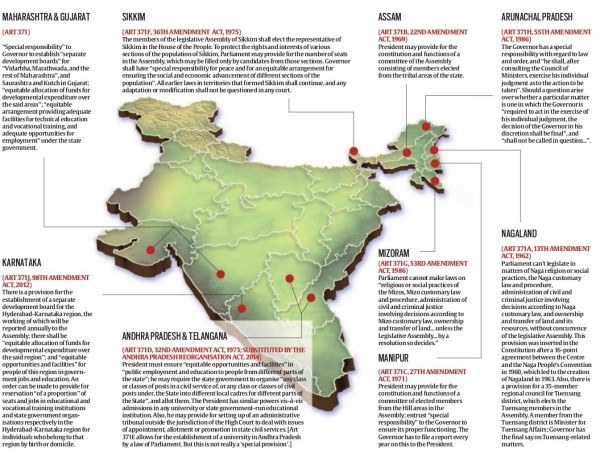
- Article 371A - Nagaland – Emerged from the Naga political movement and the 16-Point Agreement of 1960.
- Protects Naga religious and social practices, customary law and procedure.
- Provides protection to the ownership and transfer of land.
- Article 371B - Assam – Created in the context of demands from Assam's tribal and hill areas.
- Provides for a special committee in the Assam Legislative Assembly.
- Article 371C (Manipur) – Introduced after Manipur became a full State.
- Addresses the political relationship between the tribal hill areas and Imphal Valley.
- Provides for a special committee of the Legislative Assembly consisting of members elected from hill areas.
- The Governor has a special responsibility regarding the administration of hill areas.
- Article 371D - Andhra Pradesh – Emerged from regional tensions between Telangana and Andhra.
- Based on the Six-Point Formula of 1973.
- Seeks equitable opportunities in education and public employment across different regions.
- Article 371F – Sikkim – Introduced following Sikkim's integration into the Indian Union in 1975.
- Intended to manage the constitutional and administrative transition of the erstwhile independent State.
- Article 371G - Mizoram – Emerged from the 1986 Mizo Peace Accord.
- Protects Mizo religious and social practices, customary law and procedure.
- Provides protection to customary administration of justice and ownership and transfer of land.
- Certain Parliamentary laws on these matters do not automatically apply unless agreed to by the Mizoram Assembly.
- Article 371H - Arunachal Pradesh – Provides the Governor with special responsibility for law and order in the State.
- Article 371I - Goa – Provides that the Goa Legislative Assembly shall consist of not less than 30 members.
- Article 371J – Karnataka – Added to address regional backwardness in the Hyderabad-Karnataka region, now Kalyana Karnataka.
What Could Article 371K Mean for Ladakh?
- Proposed Constitutional Arrangement
- Article 371K could provide Ladakh with a special constitutional framework despite being a Union Territory without a legislature.
- It may establish a directly elected UT-level body with legislative, executive, financial and planning powers.
- Legislative & Administrative Powers
- The body could legislate on land, culture and language, forests, environment and natural resources.
- It may also exercise powers over subjects assigned to the UT under Article 240.
- The elected executive could supervise civil servants, including APAR-related matters, within its jurisdiction.
- Ladakh leaders have also sought control over law and order.
How Could 371K Differ from Existing Provisions?
- Protection of Resources – The demand for protection of land and natural resources resembles the protective framework under Articles 371A and 371G.
- Democratic Institutions – Unlike some existing provisions, Ladakh is seeking a substantial directly elected governing institution with legislative, executive and financial powers.
- Application of Central Laws – If certain Central laws are made applicable only with the approval of the proposed elected body.
- This provision would resemble the stronger protective mechanism found under Articles 371A and 371G.
- Control over Administration – If the elected executive receives control over bureaucracy and law and order,
- The proposed arrangement would provide the UT-level leadership with substantial administrative authority.
What is the Significance of Article 371K?
- Constitutional Accommodation – It would demonstrate the flexibility of the Constitution to create region-specific governance arrangements.
- Protection of Local Interests – Special constitutional safeguards could provide greater protection to land, culture, language, environment and natural resources.
- Democratic Decentralisation – A directly elected UT-level body could provide greater local participation in governance and decision-making.
- Asymmetric Federalism – It would illustrate India's approach of accommodating regional diversity through differentiated constitutional arrangements.
|
Key Concerns: Scope of Article 371K
|
- The effectiveness of Article 371K will depend on the extent of powers constitutionally protected.
- Merely creating an elected body with legislative powers may offer limited safeguards.
- Stronger protection would require control over land, natural resources, recruitment and administration.
- A role in deciding the applicability of Central laws could provide additional protection.
- Greater control over law and order and bureaucracy would further strengthen the institution.
|
What could be done?
- Clearly Define Powers – The constitutional provision should clearly specify the legislative, executive, financial and planning powers of the proposed body.
- Ensure Constitutional Protection – Important areas such as land, natural resources, culture and local employment should receive clearly defined safeguards.
- Strengthen Democratic Accountability – The proposed institution should have appropriate mechanisms for representation and financial transparency.
- Balance Local Autonomy and National Interests – The framework should balance local aspirations and environmental concerns with India's strategic and national interests in the region.
- Ensure Effective Implementation – Constitutional safeguards should be supported by appropriate administrative, financial and institutional mechanisms.
What lies ahead?
- The evolution of Article 371 reflects India's constitutional ability to accommodate regional diversity through asymmetric federalism.
- For Ladakh, Article 371K could represent a new model of constitutional accommodation for a Union Territory without a legislature.
- Its effectiveness, however, will depend on the precise powers and safeguards ultimately incorporated into the constitutional provision.
Reference
The Indian Express| Article 371K and Special Constitutional Safeguards for Ladakh



