0.2612
7667766266
x

Superkilonova

iasparliament Logo
December 22, 2025

Prelims: Current events of national and international importance | Science & Technology

Why in News?

Scientists have recently observed an event that resembles a superkilonova at 1.3 billion light-years away.

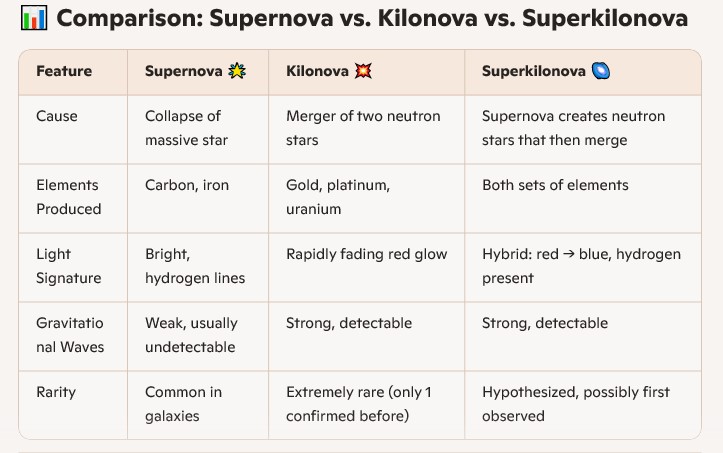
  • Superkilonova – It is a rare kind of cosmic explosion, an enhanced version of a kilonova, which itself results from the collision of two neutron stars.

Formation: From Supernova to Kilonova

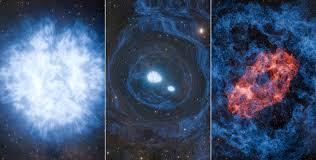
  • Supernova Explosion – A massive star explodes in a supernova (left), which generates elements like carbon and iron.
  • Birth of Neutron Stars – In the aftermath, two neutron stars are born (middle), at least one smaller than the Sun.
  • Gravitational Waves – The neutron stars spiral together, sending gravitational waves rippling through the cosmos, before merging in a dramatic kilonova (right).
  • Kilonova Merger – Finally, they collide in a kilonova, creating heavy elements like gold and platinum.

Kilonova

Superkilonova

  • It is a confirmed event caused by the merger of two neutron stars.
  • The material ejected into space includes heavy, radioactive elements (gold, platinum, neodymium).
  • As these elements decay, they emit light in the optical and infrared parts of the spectrum.


  • It is similar in origin (neutron star merger) but with an extra energy source.
  • After the merger, some ejected matter may fall back towards the merged object and become hotter.
  • This heat energises the surrounding ejecta.
  • It resulted in brighter, bluer, and longer-lasting than a normal kilonova.


Recent Discovery –

  • The astronomers detected a bright source 1.3 billion light-years away.
  • Initially, it looked like a kilonova for three days, then resembled a supernova, but more data is needed.

Key Findings

  • Event AT2025ulz – Observed in August 2025, this transient may represent the first superkilonova—a supernova followed by a neutron star merger.
  • Dual Explosion – Evidence suggests a massive star exploded, forming two neutron stars that quickly merged.
  • Gravitational Waves – LIGO, Virgo, and KAGRA detected a signal from a merger involving at least one unusually tiny neutron star.
  • Optical Counterpart – Caltech’s Zwicky Transient Facility (ZTF) spotted AT2025ulz, a fading red object 1.3 billion light-years away.
  • Spectral Evolution – It started as a fading red emission, then brightened into blue light accompanied by hydrogen features.
  • Possible Mechanism – A rapidly spinning star may have split (fission) or fragmented, producing two sub-solar neutron stars that merged.

References

  1. The Hindu | Superkilonova
  2. Caltech | Possible "Superkilonova" exploded


Login or Register to Post Comments
There are no reviews yet. Be the first one to review.

ARCHIVES

MONTH/YEARWISE ARCHIVES

sidetext
Free UPSC Interview Guidance Programme
sidetext