0.0947
7667766266
x

Stubble Burning in India

iasparliament Logo
October 10, 2026

Prelims: Current events of national and international importance | Environment

Why in News?

According to a bulletin, Madhya Pradesh recorded the highest number of paddy stubble-burning incidents among seven states monitored.
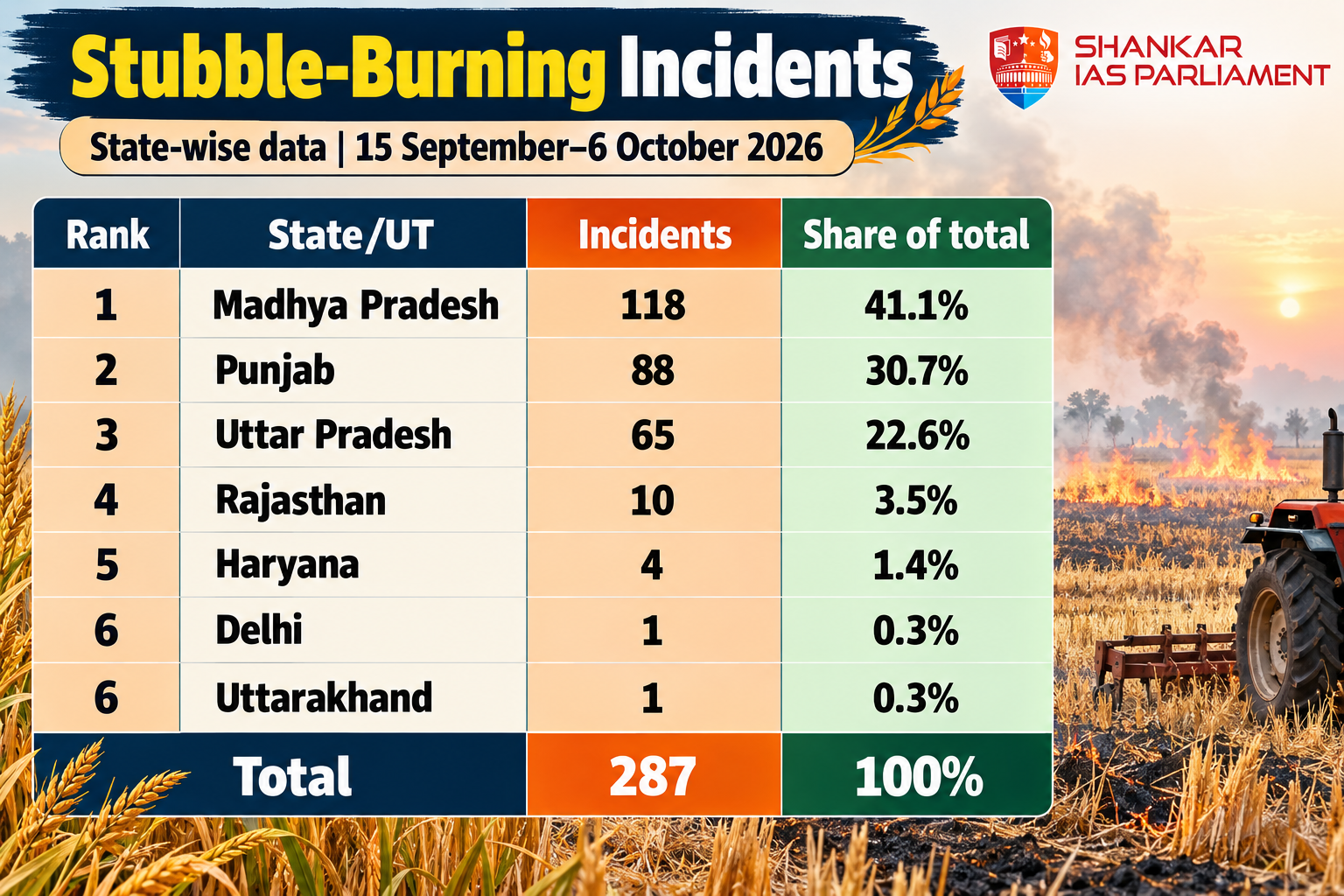
  • Report released by – Consortium for Research on Agroecosystem Monitoring and Modelling from Space (CREAMS) of the Indian Agricultural Research Institute (IARI).
  • Key findings
    • Between 15 September and 6 October 2026, 287 incidents were reported across seven states.
    • Madhya Pradesh reported 118 incidents, followed by Punjab with 88 incidents and Uttar Pradesh with 65 incidents.
    • According to the report, Punjab recorded the lowest number of incidents for this period in the past seven years.

Stubble Burning in India 2026 upsc

  • Stubble Burning – It refers to the intentional burning of crop residues remaining in fields following harvest.
  • This practice is especially prevalent in paddy cultivation, where farmers burn residual straw to expedite field preparation for subsequent crops.
  • It is commonly practised when the interval between paddy harvesting and wheat sowing is short.
  • Causes of Increased Stubble Burning in Madhya Pradesh
  • The report identifies several primary factors contributing to this trend:
    • Changing cropping patterns – Farmers are increasingly shifting from soybean, black gram, and other Kharif crops to paddy.
    • Climate-related risks – Extreme weather conditions are making it difficult to cultivate some alternative crops.
    • Ease of disposal – Burning offers a quick and low-cost way to clear fields.
    • Agricultural mechanisation – Harvesting methods that leave significant crop residue increase the need for effective residue management.
  • Environmental Impacts

Area

Impact

Air quality

Releases particulate matter (PM2.5 and PM10) and other pollutants

Human health

Can aggravate asthma, respiratory illness and cardiovascular risks

Soil fertility

May reduce soil organic matter and harm beneficial soil organisms

Greenhouse gases

Releases carbon dioxide and other gases, including methane and nitrous oxide under some burning conditions

Biodiversity

Can harm insects, microorganisms and small animals

Regional environment

Smoke can reduce visibility and contribute to atmospheric pollution


Consortium for Research on Agroecosystem Monitoring and Modeling from Space (CREAMS)

  • It is an inter-disciplinary research initiative of the Indian Agricultural Research Institute, New Delhi.
  • Coordinated by – Division of Agricultural Physics.
  • It undertakes research and builds capacity in using remote sensing, agro-meteorology and agro-models for qualitative and quantitative assessment of crops and crop environment from field to regional scale in India.


Reference

Down To Earth | Stubble Burning in India

There are no reviews yet. Be the first one to review.

ARCHIVES

sidetext


