Prelims: Current events of national and international importance | Environment
Why in News?
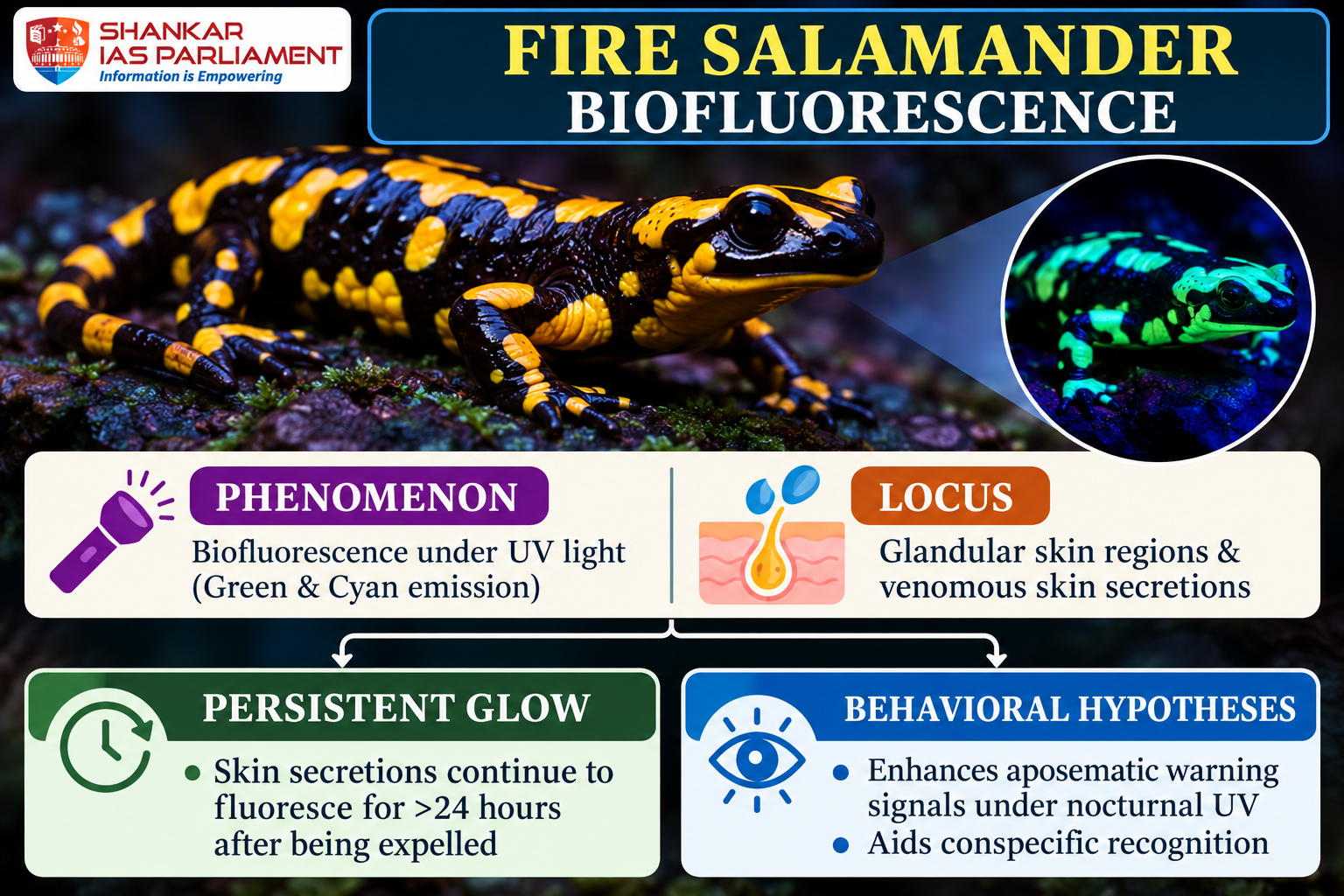
Recently, researchers published a discovery revealing that Europe's familiar fire salamander (Salamandra salamandra) possesses a hidden biofluorescent glow under ultraviolet (UV) light.
Key Findings
- Glandular Origin and Persistent Secretions
- When exposed to UV light, the salamander's skin particularly along its yellow markings and underside re-emits visible green and cyan light.
- Crucially, the venomous skin secretions expelled by the animal continue to glow brightly for more than 24 hours after release, pointing to unique chemical properties.
- Ecological & Evolutionary Hypotheses
- Enhanced Aposematism - Fire salamanders rely on bright yellow-and-black warning coloration (aposematism) combined with toxic steroidal alkaloids (samandarines) to deter predators.
- Fluorescence may amplify these visual signals under dim, UV-rich nocturnal conditions.
- Conspecific Communication - May serve as a visual marker allowing salamanders to locate or recognize each other in dense, dark forest habitats.
Strategic Significance
- Overlooked Terrestrial Adaptations- Bioflurescence in a well-studied terrestrial vertebrate underscore how advanced optical and field tools continue to reveal hidden biological traits.
- Conservation Context - The International Union for Conservation of Nature (IUCN) classifies fire salamanders as vulnerable in parts of their range due to habitat fragmentation and chytrid fungal threats.
- Understanding their sensory ecology and nocturnal behaviors aids targeted conservation planning.
Reference
Science Daily | Secret glow in toxic fire salamanders



