0.1219
7667766266
x

Rising landmine casualties and threats to the global ban

iasparliament Logo
November 26, 2026

Mains: GS II | International Relations

Why in News?

The Landmine Monitor 2026 report revealed that global landmine and explosive-remnants casualties climbed 10% in 2025 to a five-year high of at least 6,929 people.

What are anti-personnel landmines and the global ban framework?

  • Anti-personnel landmines are explosive devices placed under, on, or near the ground and designed to be detonated by the presence, proximity, or contact of a person rather than a vehicle.
  • Because they remain active until triggered or cleared, they do not distinguish between combatants and civilians or between active fighting and peacetime recovery.
  • The 1997 Ottawa Treaty - Prohibits the use, stockpiling, production, and transfer of anti-personnel mines, while obligating States Parties to clear mined areas and assist victims; it has been joined by 162 states.
  • International Humanitarian Law (IHL) Principles - Under core humanitarian law standards, parties to a conflict must distinguish between combatants and civilians, avoid indiscriminate attacks, and spare civilians from disproportionate harm.
  • Key Non-Signatories and Treaty Strain- Major military powers outside the treaty include the United States, Russia, and China, while states such as Myanmar and Syria are also outside the convention.
  • Between 2025 and 2026, Estonia, Finland, Latvia, Lithuania, and Poland initiated withdrawals from the treaty the first withdrawals in its history.
  • Ukraine purported to suspend its operation during the war with Russia, a move States Parties ruled unlawful under the treaty.

Why casualties are climbing and why the ban is under pressure?
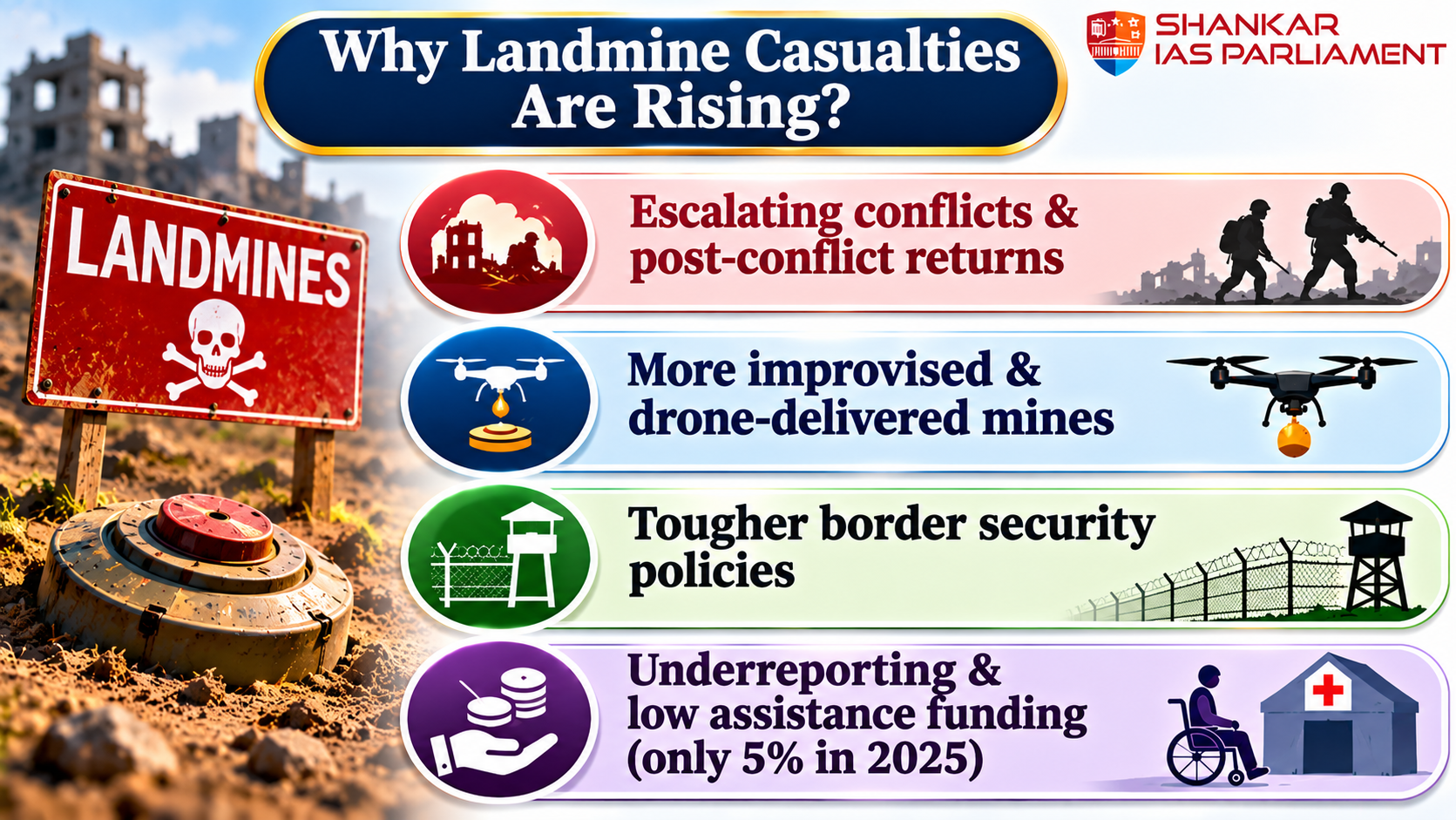
  • Escalating armed conflicts and post-conflict returns - Ongoing fighting in places such as Myanmar and Ukraine, alongside returns of displaced people to contaminated land in Syria following political change in late 2024, has driven sharp casualty spikes.
  • Proliferation of improvised and drone-delivered mines - Improvised mines accounted for 1,530 recorded casualties in 2025, while modern warfare has introduced newer deployment methods including drone-dropped and 3D-printed mines that complicate detection and clearance.
  • Hardening border security doctrines- European border states withdrawing from the Ottawa Treaty cited perceived security threats from Russia, with countries such as Poland and Finland moving toward reintroducing or acquiring anti-personnel mines for border defense.
  • Underreporting and weak assistance funding- True casualty figures are likely higher because war zones often lack systematic reporting, while victim assistance received only 5% ($38.3 million) of international mine action funding in 2025 despite rising rehabilitation needs.

Landmine casualties

What is the multidimensional impact?

Dimension

Key impacts and vulnerabilities

Humanitarian and Public Health

Out of at least 6,929 casualties in 2025 (1,955 killed, 4,930 injured, 44 unknown), 84% were civilians, and children made up half of civilian casualties where age was known; injuries frequently cause amputations, sensory loss, and lifelong disability.

Livelihoods, Food Security, and Gender

Mined farmland cannot be safely cultivated, prolonging displacement and reducing agricultural output; when primary earners are killed or disabled, women often bear heavy caregiving and household income burdens.

Border Management and Internal Security

At least 65 territories had suspected or confirmed mine contamination by November 2026 (with eight assessed as having massive contamination exceeding 100 square kilometers), while non-state armed groups and cross-border tensions continue to pose security risks.

Ecological and Soil Degradation

Detonations and unexploded ordnance leach heavy metals into soil and groundwater, damage ecosystems, and trigger wildfires.

What are the key challenges for Global governance and policy?

  • Erosion of a Hard-won humanitarian norm - Withdrawals and suspensions risk normalizing anti-personnel mines as standard military tools after decades of stigmatization.
  • Asymmetric threat dynamics - State militaries and non-state armed groups using improvised or low-cost mines challenge traditional arms-control verification and containment.
  • Long tail of clearance costs- Even as 32 States Parties have completed mine clearance since the treaty entered force (including Oman in 2025 and Croatia in 2026), clearing contaminated land takes years or decades and requires sustained technical and financial commitment.
  • Underfunded survivor care- Limited allocation toward medical care, prosthetics, mental health, education, and livelihoods leaves survivors facing long-term marginalization.

What is the way forward?

  • States Parties and international institutions should press for adherence to the Ottawa Treaty, encourage non-signatories to join, and urge withdrawing states to reconsider in light of long-term civilian harm.
  • States concerned about border security can rely on sensors, surveillance, unmanned systems, and non-lethal barriers rather than indiscriminate mines, while expanding safer clearance technologies.
  • Increase predictable funding for mine clearance, mine-risk education (especially for children and returning refugees), and comprehensive survivor rehabilitation.
  • Pair demining with agricultural land restoration, livelihood support, and community safety planning so displaced families can return to productive land securely.

Reference

The Hindu | Why are landmine casualties rising?

There are no reviews yet. Be the first one to review.

ARCHIVES

sidetext


