Mains: GSII – Polity| Governance
Why in News?
On October 12, 2026, Delhi Police denotified Jantar Mantar as a protest site and designated Ramlila Maidan, Burari Ground and CBD Ground as alternatives. This renewed debate on the Right to Protest under Article 19 and the distinction between law and order and public order.
What Are the Constitutional Provisions Related to the Right to Protest?
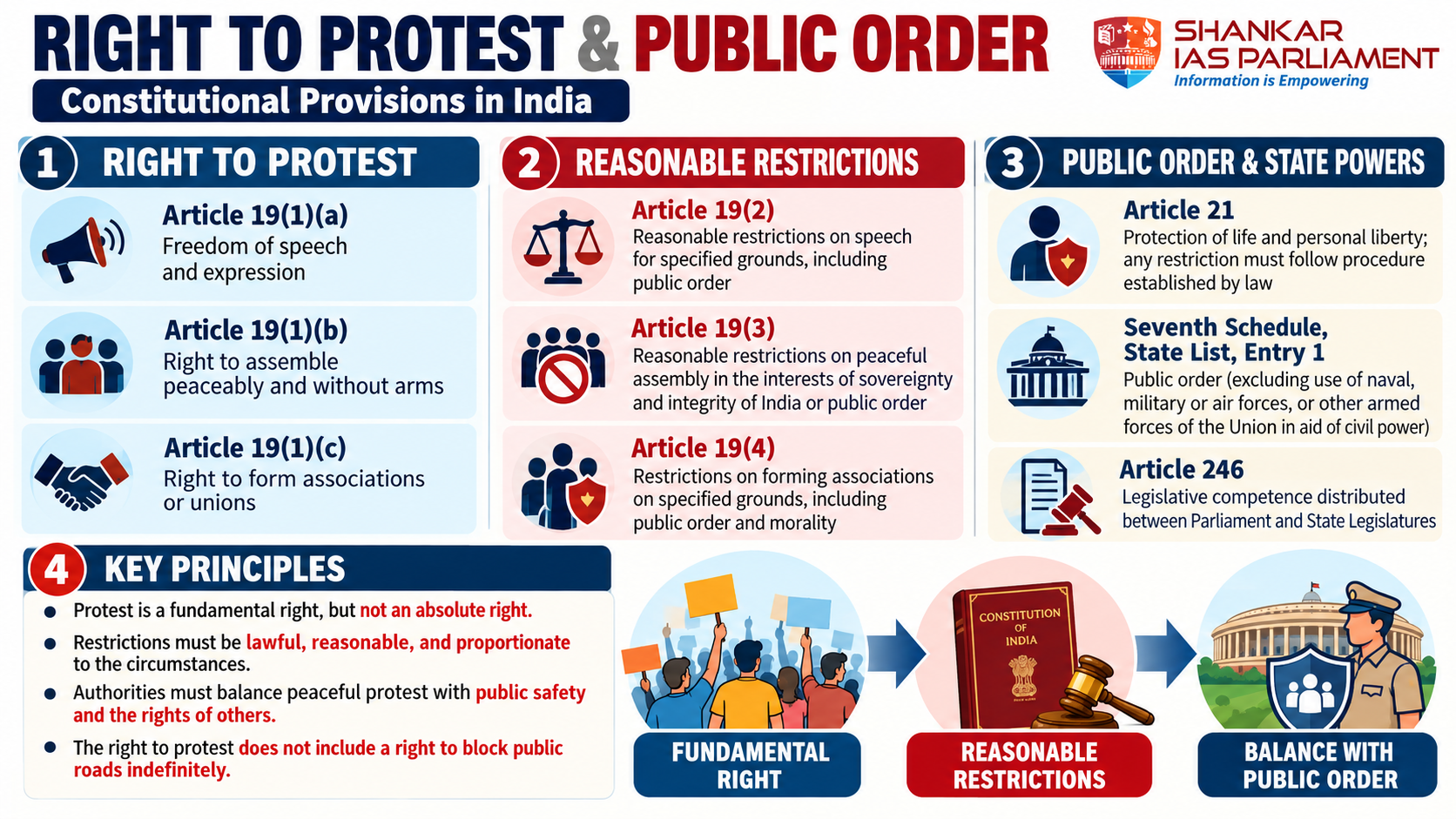
- Article 19(1)(a) – Guarantees freedom of speech and expression.
- Article 19(1)(b) – Guarantees the right to assemble peaceably and without arms.
- Article 19(2) – Permits reasonable restrictions on freedom of speech and expression on specified grounds, including public order.
- Article 19(3) – Permits reasonable restrictions on peaceful assembly in the interests of the sovereignty and integrity of India and public order.
- Article 239AA(3)(a) – Excludes public order, police and land from the legislative powers of the Delhi Legislative Assembly.
Article 19(3) expressly includes public order and the sovereignty and integrity of India as grounds for restricting peaceful assembly. It does not include every general law-and-order concern as an independent ground.
- Administrative authority – Delhi Police functions under the Ministry of Home Affairs (MHA), which plays a key role in regulating protests in Delhi.
How Are Law and Order and Public Order Different?
- The Supreme Court has distinguished these concepts because restrictions on fundamental rights must satisfy the applicable constitutional grounds.
- Law and Order - Refers to general peace and order in society or a locality.
- Includes localised disturbances, such as street fights or obstruction of a road.
- Every breach of peace does not necessarily disturb public order.
- Public Order – Refers to disturbances affecting the wider community and public peace.
- Includes serious disruptions to transport, communication or access that affect the community.
- Public order can justify reasonable restrictions under Article 19, subject to constitutional and legal requirements.
- Security of the State – Concerns threats to the security and stability of the State.
- Represents a more serious category of disturbance than public order.
- Supreme Court’s analogy – In Ram Manohar Lohia v. State of Bihar (1966), the Court described law and order, public order and security of the State as three concentric circles.
- Law and order is the largest circle, public order lies within it, and security of the State is the smallest.
What Is the Supreme Court’s Position on the Right to Protest?
- Himat Lal K. Shah v. Commissioner of Police, Ahmedabad (1972) – The Court upheld the authority of the police to require prior permission for public meetings on streets.
- However, the State cannot prohibit assemblies on every public street or public place, thereby effectively taking away the right to assemble.
- Ramlila Maidan Incident (2012) – The Court emphasised the importance of protecting fundamental rights while maintaining public order.
- Restrictions must be proportionate to the nature and seriousness of the disturbance.
- Every breach of peace does not amount to a threat to public order warranting extensive restrictions.
- Mazdoor Kisan Shakti Sangathan v. Union of India (2018) – The case concerned restrictions on demonstrations at Jantar Mantar and the proposal to shift them to Ramlila Maidan.
- The Court recognised the need to balance the rights of protesters with the rights of residents.
- It held that specific areas could be earmarked for demonstrations in the public interest.
- It allowed a limited portion of Jantar Mantar Road to remain available for regulated protests by smaller groups.
How Can Protest Sites Be Designated and Regulated?
- Prior permission – Authorities may require organisers to obtain permission before conducting public demonstrations.
- Designated venues – Specific locations may be earmarked to manage crowds and minimise disruption.
- Reasonable conditions – Restrictions may regulate the number of participants, timing, route and duration of demonstrations.
- Public safety – Authorities may impose proportionate measures to protect residents, traffic movement and essential services.
- Legal authority – Police restrictions must be based on valid legal provisions and remain consistent with constitutional safeguards.
What Are the Major Concerns Regarding Restrictions on Protests?
- Curtailment of fundamental rights – Excessive restrictions may weaken freedom of speech and peaceful assembly.
- Reduced access to decisionmakers – Shifting protests away from government institutions may reduce their visibility and effectiveness.
- Misuse of public order – Authorities may invoke public order without demonstrating a sufficient connection between a proposed protest and a wider public disturbance.
- Closure of democratic channels – Restricting legitimate protest venues may intensify public frustration and push demonstrations into less regulated spaces.
- Balancing competing rights – Unregulated protests may affect traffic, residents and public services, requiring proportionate regulation.
What Measures Are Needed to Balance the Right to Protest and Public Order?
- Proportionate restrictions – Restrictions should address identifiable risks and should not unnecessarily curtail fundamental rights.
- Transparent permission procedures – Clear criteria, time limits and written reasons should guide decisions on protest permissions.
- Accessible protest venues – Authorities should ensure that designated sites remain reasonably accessible to the institutions and decisionmakers concerned.
- Judicial review – Courts should examine whether restrictions have a valid legal basis and satisfy constitutional requirements.
- Dialogue and consultation – Authorities should engage with organisers and residents to resolve concerns before imposing extensive restrictions.
- Accountability – Police action should remain subject to constitutional safeguards and applicable legal procedures.
What lies ahead?
- The right to protest is an essential component of democratic participation and peaceful dissent.
- While the State can regulate demonstrations to protect public order and the rights of others, such regulation must not become a means of suppressing legitimate criticism.
- The constitutional objective should be to regulate protests, not eliminate the space for peaceful dissent.
Reference
The Indian Express| Right to protest and Public order



