Prelims: Current events of national and international importance | Energy
Why in news?
Centre for Research on Energy and Clean Air (CREA) has released the latest India Energy Snapshot for Q2 FY27.
- Findings based on – Data from GRID-INDIA, the Union Ministry of Coal, the Central Electricity Authority and the National Power Portal.
Key Findings
- India’s electricity generation – Rose 11% year on year to 536 billion units (BU) in the second quarter (Q2) of the financial year 2026-27 (FY26).
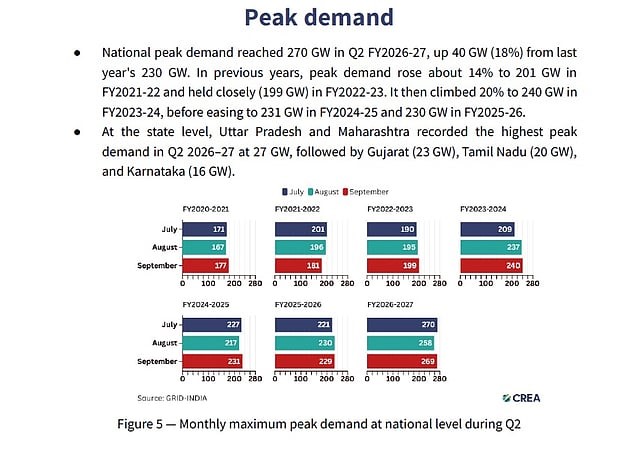
- Peak power demand – Hit a record 270 gigawatts (GW) on July 16, 2026, 18% higher than the corresponding quarter a year ago, compared with 230 GW in Q2 FY26.
- Rise in non-fossil energy – The combined non-fossil electricity generation, including renewables, hydropower and nuclear power, reached a record 177 BU, up from 163 BU in Q2 FY26.
- Non-fossil sources accounted for around 33% of total electricity generation in the quarter, while coal continued to supply most of the power.
- Coal remains dominant
- Coal and lignite – Continued to dominate the electricity mix, contributing around 66% of total power generation.
- Their output increased by 12.5% year-on-year, rising from 312 billion units (BU) in Q2 FY26 to 351 BU in Q2 FY27.
- Coal stocks at thermal power plants fell to 21 million tonnes, only 36% of the normative requirement of 58 million tonnes.
- Coal Supply Concerns – The number of power plants with coal stocks below 25% of the required norm rose from 32 to 84 between August 22 and September 30, 2026.
- Coal dispatches and freight rake loading declined during the quarter, putting pressure on the supply chain.
- Coal production followed its usual seasonal pattern, increasing 7.6% year on year in July before declining 4.3% in August. August 2026 recorded the lowest monthly coal production so far that year.
- Growth in Renewable energy
- Renewable electricity generation – Crossed 100 BU for the first time, excluding large hydropower and accounted for 19% of total electricity generation.
- Solar – Remained the fastest-growing major source of electricity, with generation increasing 39% year on year to 51 BU, accounting for 10% of total electricity generation for the first time.
- Solar accounted for 58% of the increase in renewable electricity generation during the quarter.
- Wind generation – rose 29% to 45 BU,
- Nuclear generation – Increased 2%.
- Large hydropower generation – Declined 20% year on year, despite increasing 53% quarter on quarter from 39 BU in Q1 FY27 to 60 BU in Q2.
- Renewable capacity expansion
- Installed power capacity – India’s installed power capacity reached 555 GW by the end of August 2026, up 12% from August 2025, 23% from August 2024 and 31% from August 2023.
- Non-fossil sources accounted for around 55% of installed capacity.
- Renewable energy capacity, excluding large hydropower, reached 243 GW, or 44% of the total installed capacity.
- During Q2 FY27, about 7 GW of renewable capacity was added, compared with only 0.8 GW of thermal capacity.
- Energy storage – India had 9.1 GWh of operational Battery Energy Storage Systems (BESS), with an additional 3 GWh expected by December 2026.
- During nighttime peak demand, storage contributed up to 5.5 GW, compared with 4.1 GW in the previous quarter, meeting around 1 to 2% of national electricity demand.
Reference
Down to Earth | India’s total electricity generation increases 11% YoY in Q2 FY27: Report



