Mission
Behind every clean street in urban India lies a chain of infrastructure and systems that manage the waste generated by cities.
- Every large Indian city generates waste that comes from households, markets, institutions, commercial establishments, and public spaces.
- Much of this waste is directed to dumpsites, where it accumulates over time and forms legacy waste sites.
- To tackle this challenge, the Swachh Bharat Mission-Urban (SBM-U) was launched in October 2014.
- Over 12 years, SBM-U has been building infrastructure beyond basic sanitation.
- Its focus now extends to managing urban waste and creating better spaces for cities to live, work, and gather.
- Under the Swachh Bharat Mission-Urban 2.0, launched in October 2021, cities across India are undertaking the transformation of legacy dumpsites into productive and environmentally sustainable spaces.
- The scale of this effort is reflected in the 3.66 crore metric tonnes of legacy waste remediated between January and December 2025.
- During this time, 459 Urban Local Bodies across 29 States achieved complete dumpsite remediation.
- The Lakshya Zero Dumpsite initiative under this mission is driving a structured and time-bound effort to scientifically remediate such sites across States and Urban Local Bodies.
Gorakhpur, Uttar Pradesh
- The Problem –
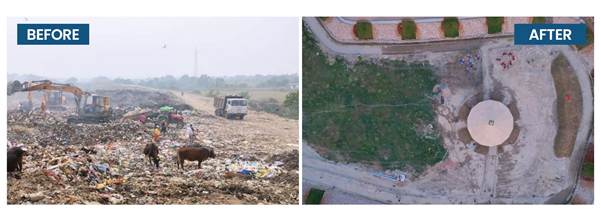
- In Gorakhpur, Uttar Pradesh, a 40-acre site once stood as a towering mound of accumulated municipal waste.
- For seven years, it served as the city’s primary waste disposal site.
- The growing waste mound affected the surrounding environment and created difficult living conditions for nearby residents.
- The Remediation –
- The site was scientifically remediated through biomining, with around 400 tonnes of waste processed every day.
- The process separated the accumulated waste into refuse-derived fuel, black soil, recyclables, and inert material.
- Recovered black soil was used for filling low-lying areas, while refuse-derived fuel went to cement industries for co-processing.
- Gradually, the waste mound gave way to reclaimed land.
- The Transformation –
- The transformation continued beyond clearing the accumulated waste.
- The entire 40-acre site was developed into the Kachre Se Kanchan Rapti Eco Park.
- The new public space now includes green lawns, walking and jogging tracks, and a children’s play area.
- An open gym, yoga zone, solar lighting, and water conservation structures further expand its public use.
- Food courts, parking facilities, and other amenities have also been incorporated into the park.
- Several installations made from recycled waste materials highlight the possibilities of resource recovery.
- The park has also created space for local livelihoods.
- The women-led self-help group Shakti Ki Rasoi operates a restaurant within the park.
- Today, the park attracts around 500 visitors each day.
- A site once defined by accumulated waste has thus become a space for recreation and community life.
Delhi (Bhalswa)
- In the national capital, another towering mound is steadily shrinking.
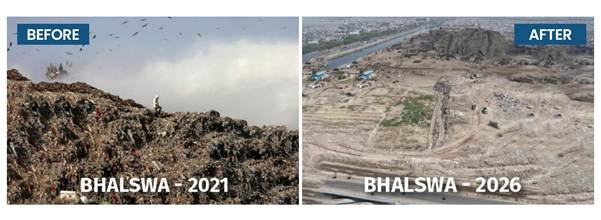
- The Bhalswa dumpsite, spread over about 70 acres, once held vast quantities of legacy waste.
- Since July 2022, biomining has been carried out in mission mode continuously at the site.
- In September 2025, the annual Swachhata Hi Seva cleanliness campaign was launched nationally from Bhalswa.
- The site was taken up for accelerated remediation.
- In November 2025, the Dumpsite Remediation Accelerator Programme (DRAP) was launched.
- DRAP is a nationwide, mission-mode initiative that fast-tracks the remediation of remaining dumpsites under Swachh Bharat Mission-Urban 2.0.
- As part of DRAP, results are now visible in Bhalswa –
- By May 2026, more than half of the site had been reclaimed.
- By 31 July 2026, 99.07 lakh metric tonnes of legacy waste had been remediated.
- The work goes beyond removing old waste –
- Fire-prevention measures, leachate management, and other environmental safeguards support safety around the site.
- Newly awarded work to process fresh waste at the landfill is also being expedited.
- The goal is to prevent new legacy waste from building up again.
Nagpur, Maharashtra
- Transition to Scientific Management –
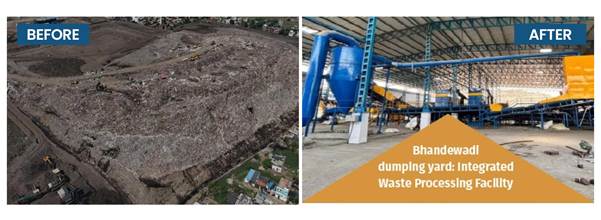
- In Nagpur, the Bhandewadi dumping yard is being reshaped into a working waste-processing facility.
- As a rapidly growing city of over 30 lakh people, Nagpur generates waste from homes, markets, institutions, and public spaces.
- A significant share of waste used to go to the Bhandewadi dumping yard, which became a major legacy waste site over time.
- The city chose to move from open dumping to scientific waste management.
- Legacy waste was excavated, segregated, and processed in a systematic way.
- More than 10 lakh metric tonnes of accumulated waste have been treated, enabling the reclamation of acres of valuable land once locked under waste.
- Current Facilities & Benefits –
- The story did not end with reclamation.
- The site is now an Integrated Municipal Solid Waste Processing Facility.
- Here, materials are recovered, waste is composted, and waste-derived fuel is produced.
- Modern machines process the waste, while real-time monitoring and CCTV keep a close watch.
- Dust control and leachate treatment help protect the surroundings.
- Dependence on landfills has fallen markedly.
- Air, water, and soil quality have improved, along with public health in surrounding areas.
- The city has also added composting plants, modular processing units, and construction and demolition waste systems.
- Here, waste is no longer seen as a liability, but as a resource to be recovered.
Raichur, Karnataka
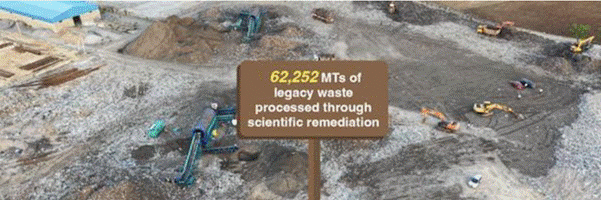
- In Raichur, Karnataka, the reclaimed land is taking a different form, with 35 acres of Yakalaspura dumpsite being transformed through scientific legacy waste remediation.
- Around 62,252 metric tonnes of waste have been processed, reclaiming nearly 22 acres of urban land.
- Part of the restored site now supports sustainable land use, including a Miyawaki forest spread across approximately 5-7 acres.
- It demonstrates how a former dumpsite can be converted into a thriving ecological space.
- Around 60,000 bamboo and native saplings are being planted to expand green cover, support biodiversity, and restore the soil.
- The plantation began on 5 June 2026, with the site inaugurated on World Environment Day.
- The Yakalaspura transformation is more than waste remediation.
- The initiative is developed around the concept of “Toxic Waste to Ecological Wealth”.
- It demonstrates how reclaimed dumpsite land can support ecological restoration and sustainable urban development.
The Movement Beyond Cleanup
- A reclaimed dumpsite is more than recovered land.
- It represents a changing approach to managing the waste generated by cities.
- Across Gorakhpur, Delhi, Nagpur, and Raichur, the pattern is the same – waste mountains are excavated, sorted, and turned back into usable land.
- Machines and plants alone cannot make this last.
- City Solid Waste Action Plans, tracked progress on the SBM-U portal, and annual Swachh Survekshan rankings keep the work on course long after the ribbon is cut.
- Infrastructure and institutions together turn a one-time cleanup into a lasting system.
- Swachh Bharat Mission–Urban began with sanitation, but it has grown well beyond it.
- It is now reshaping how cities reclaim land, restore ecology, and build public spaces where people live, work, and gather.
Reference
PIB



