Mains: GS II – International Issues
What is the geographical parallel between the Strait of Hormuz and the Malacca-Singapore Straits?
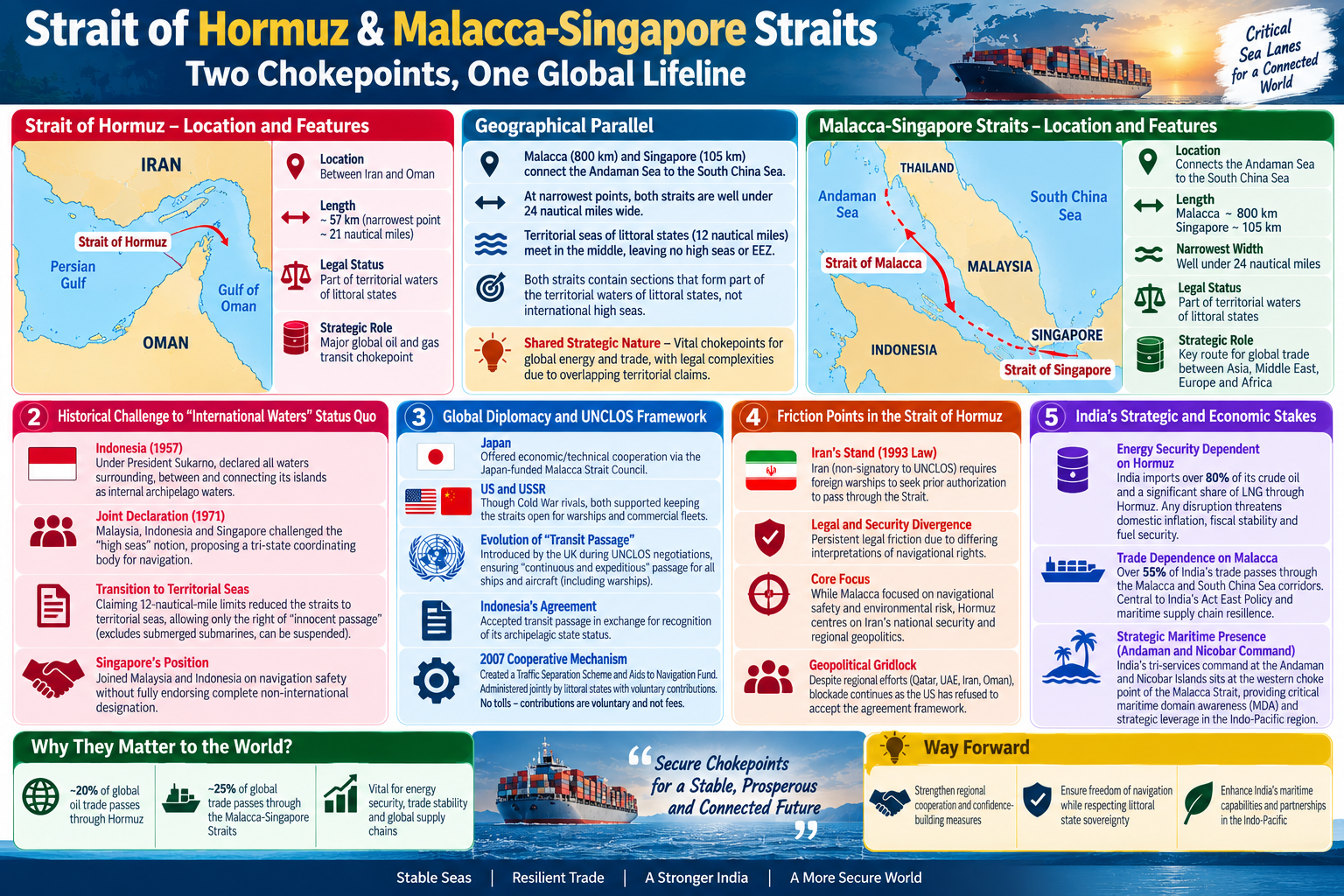
- Geographical Overlap –
- The Strait of Malacca (800 km) and Strait of Singapore (105 km) connect the Andaman Sea to the South China Sea.
- At their narrowest points, both straits measure well under 24 nautical miles wide.
- Territorial Intersection – When littoral states claimed 12-nautical-mile territorial seas, the zones met in the middle, leaving no strip of high seas or Exclusive Economic Zone (EEZ) between them.
- Shared Strategic Nature – Both the Strait of Hormuz (between Iran and Oman) and the Malacca-Singapore Straits contain sections that form part of the territorial waters of their respective littoral states rather than international high seas.
How did the Malacca-Singapore littoral states historically challenge the "International Waters" status quo?
- Historical Context (1957–1971) –
- Indonesia (1957) – Under President Sukarno, Indonesia declared all waters surrounding, between, and connecting its islands as internal archipelago waters to protect territorial integrity from colonial/big-power interference.
- Joint Declaration (1971) – Malaysia, Indonesia, and Singapore challenged the notion that the Straits were "high seas," proposing a tri-state coordinating body to administer navigation.
- Transition to "Territorial Seas" –
- Claiming 12-nautical-mile territorial limits reduced the legal status of the straits to territorial seas under customary law, where foreign ships enjoyed only the restricted right of "innocent passage" (which excludes submerged submarines and can be suspended for security reasons).
- Singapore, dependent on global trade, joined Malaysia and Indonesia on navigation safety without fully endorsing the complete non-international designation.
How did global diplomacy and UNCLOS establish the "Transit Passage" and Cooperative Mechanism framework?
- Major Power Dynamics –
- Japan – Offered economic/technical cooperation via the Japan-funded Malacca Strait Council rather than demanding an internationalized regime.
- US and USSR – Though Cold War rivals, both united to keep the straits open for politically uncluttered transit by warships and commercial fleets.
- Evolution of "Transit Passage" –
- Introduced by the UK during final UNCLOS negotiations, transit passage guaranteed "continuous and expeditious" passage for all ships and aircraft (including warships) through straits connecting high seas/EEZs.
- Indonesia accepted transit passage in exchange for international recognition of its archipelagic state status.
- The 2007 Cooperative Mechanism –
- Created a Traffic Separation Scheme and an Aids to Navigation Fund.
- Funding and Sovereignty – Administered jointly by the three littoral states alongside voluntary contributors (e.g., The Nippon Foundation, industry bodies, user states).
- No Toll Policy – Contributions are voluntary and do not constitute tolls; littoral states impose no fees/tolls on ships exercising transit passage.
What are the primary friction points and governance bottlenecks in the Strait of Hormuz?
- Legal and Security Divergence –
- Iran's Stand (1993 Law) – Iran (a non-signatory to UNCLOS) enacted a law requiring foreign warships to seek prior authorization to pass through the Strait, creating persistent legal friction.
- Core Focus – While the Malacca issue centered on navigational safety and environmental risk, the Hormuz impasse centers fundamentally on Iran's national security and regional geopolitics.
- Geopolitical Gridlock and US Resistance –
- Regional diplomatic efforts (involving Qatar, UAE, Iran, and Oman) have explored the Malacca model.
- Even though Iran and Oman reached an agreement framework to reopen the Strait, the blockade/siege continues because the US has refused to accept the arrangement.
What are India’s strategic and economic stakes in the operational stability of both the Malacca and Hormuz straits?
- Energy Security Dependent on Hormuz – India imports over 80% of its crude oil and a significant portion of its LNG requirements through the Strait of Hormuz.
- Any prolonged siege, blockade, or regional conflict directly threatens domestic inflation, fiscal deficits, and fuel security.
- Trade Dependence on Malacca – The Strait of Malacca acts as India's gateway to East Asia, ASEAN, and the Pacific.
- Over 55% of India’s trade passes through the Malacca and South China Sea corridors, making it central to India’s Act East Policy and maritime supply chain resilience.
- Strategic Maritime Presence (Andaman and Nicobar Command) – India's tri-services command at the Andaman and Nicobar Islands sits directly at the western choke point of the Malacca Strait, providing India with critical maritime domain awareness (MDA) and strategic leverage in the Indo-Pacific region.
Reference
The Hindu | Malacca-Singapore Model



