Safeguarding Wetlands of International Importance
Ramsar Sites in India — At a Glance
Wetlands are among the most productive ecosystems on Earth, storing freshwater, recharging groundwater, buffering floods, sustaining fisheries and agriculture, and supporting migratory birds and biodiversity.
The Ramsar Convention, an intergovernmental treaty adopted in Ramsar, Iran, on 2 February 1971, entered into force in 1975.
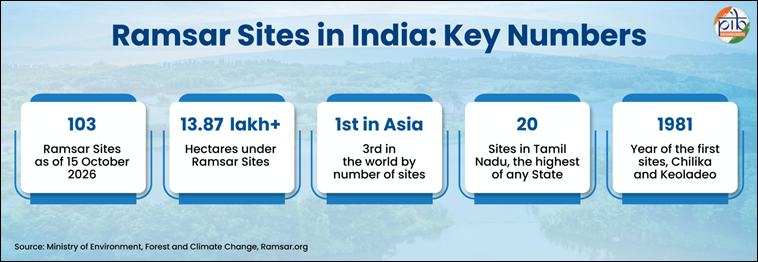
As of October 2026, it has 172 Contracting Parties and over 2,536 designated Ramsar Sites worldwide.
India became a Party to the Convention on 1 February 1982.
Its network has expanded nearly fourfold since 2014, from 26 to 103 Ramsar Sites, covering over 13.87 lakh hectares across 28 States and Union Territories.
India ranks first in Asia and third globally in the number of designated sites.
Understanding Ramsar Sites
A Ramsar Site is a wetland recognised as a Wetland of International Importance for its ecological, botanical, zoological, limnological or hydrological significance.
The Convention rests on three pillars:
- Wise use of all wetlands.
- Designation and effective management of Ramsar Sites.
- International cooperation for wetland conservation.
How is a Wetland Designated?
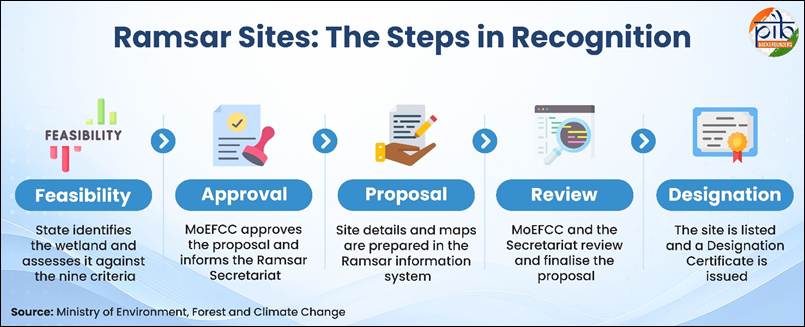
The State Government or Union Territory Administration identifies a suitable wetland, after which the Ministry of Environment, Forest and Climate Change coordinates approval and forwards the proposal to the Ramsar Secretariat.
Criteria for Designation
A wetland must satisfy at least one of the Convention’s nine criteria:
- Wetland type: Represents a rare, unique or near-natural wetland type.
- Species and ecological communities: Supports threatened species or contributes significantly to regional biodiversity.
- Life-cycle support: Provides breeding grounds, critical habitats or refuge during adverse conditions.
- Waterbirds: Regularly supports at least 20,000 waterbirds or 1% of a waterbird population.
- Fish: Supports significant fish diversity, spawning grounds, nurseries or migration routes.
- Other taxa: Regularly supports at least 1% of a population of a wetland-dependent non-avian animal species.
Benefits of Ramsar Designation
- International recognition: Enhances the visibility of wetlands and strengthens support for their conservation.
- Technical guidance: Provides access to international standards, management guidance and expert assistance.
- Cooperation and funding: Facilitates international collaboration and access to potential conservation funding.
Commitments After Designation
States and Union Territories must ensure the wise use of wetlands and protect their ecological character.
The article highlights formal notification under the Wetlands (Conservation and Management) Rules, 2017, preparation of an Integrated Management Plan, regular ecological monitoring and updating the Ramsar Information Sheet every six years.
India’s Ramsar Sites — From 26 to 103
India’s Ramsar network includes high-altitude lakes, floodplains, mangroves, coral reefs, village tanks and urban marshes.
Tamil Nadu has the highest number of sites (20), followed by Uttar Pradesh (14).
In 2025, 11 wetlands were added, taking the total to 96. Surha Tal in Uttar Pradesh became the 100th site in June 2026, followed by Glaw Lake as the 101st in August.
On 15 October 2026, Sukhna Wetland in Chandigarh and Sauj Jheel in Uttar Pradesh were designated, taking the total to 103.
- First Ramsar Sites: Chilika Lake (Odisha) and Keoladeo National Park (Rajasthan) were designated on 1 October 1981. Chilika was removed from the Montreux Record in 2002 following successful ecological restoration.
- Montreux Record: Identifies Ramsar Sites where changes in ecological character have occurred, are occurring or are likely to occur, requiring priority conservation attention.
- Latest additions: Sukhna Wetland is a human-made reservoir created in 1958, supporting threatened species and migratory birds. Sauj Jheel is a shallow floodplain lake that hosts over 30,000 waterbirds and provides habitat for threatened birds.
- Largest Ramsar Site: Sundarban Wetland in West Bengal covers 4,23,000 hectares, holds over 60% of India’s mangrove area and supports the Royal Bengal tiger.
How Ramsar Sites Aid in Conservation
- Ecosystem restoration: Chilika Lake supports 118 fish species and provides breeding and wintering grounds for waterbirds.
- Sustainable livelihoods: East Kolkata Wetlands naturally treat wastewater through about 4,000 hectares of fish ponds, producing around 10,500 tonnes of fish annually and directly supporting 50,000 people.
- Climate resilience: Sundarban mangroves protect inland areas from cyclones, storm surges and saltwater intrusion while supporting fisheries.
- Threatened species: Beas Conservation Reserve supports India’s only known population of the endangered Indus River dolphin and has undertaken gharial reintroduction.
- Community stewardship: Residents around Rajasthan’s Khichan Wetland protect over 22,000 wintering demoiselle cranes from threats.
Government Initiatives for Wetland Conservation
- Wetlands (Conservation and Management) Rules, 2017: Provide the regulatory framework, establish State/UT Wetlands Authorities and prohibit encroachment, waste dumping and untreated effluent discharge.
- National Plan for Conservation of Aquatic Ecosystems (NPCA): Integrates lake and wetland conservation programmes; updated guidelines were issued in 2024.
- Amrit Dharohar: Promotes species conservation, nature tourism, wetland livelihoods and carbon-stock assessment.
- Mission Sahbhagita and Save Wetlands Campaign: Encourage participatory conservation; over two million volunteers have helped map more than 1.7 lakh wetlands.
- MISHTI: Targets mangrove restoration across nine States and four Union Territories.
- Wetlands of India Portal: Provides information on wetlands, conservation projects, initiatives and training.
- Wetland City Accreditation: Indore and Udaipur became India’s first Ramsar-accredited Wetland Cities in January 2025.
Way Forward
India must translate the expansion of its Ramsar network into measurable ecological improvements through scientific monitoring, evidence-based management plans, stronger intergovernmental coordination and community participation.
Integrating wetland conservation with development planning and sustainable livelihoods is essential to protect biodiversity, water security and climate resilience for future generations.
Reference
PIB



