Why in News?
The mainstream macroeconomics’ focus on individual choices overlooks the role of business investment, profit expectations and uncertainty in determining economic growth and instability.
What Are the Limitations of Mainstream Macroeconomics?
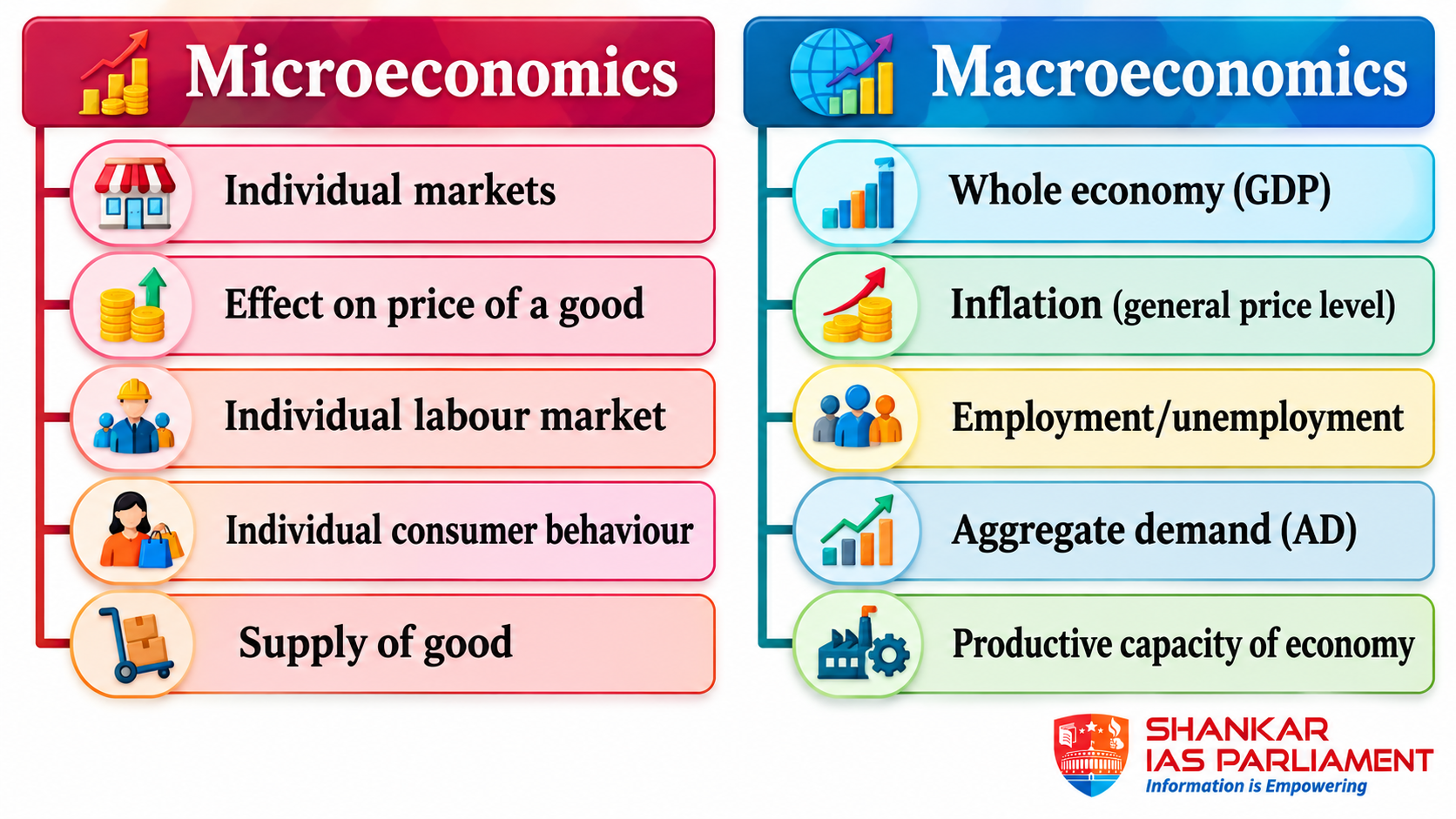
- Overemphasis on individual choices – It explains aggregate economic outcomes primarily through individual decisions, potentially overlooking broader economic structures and class differences.
- Limited focus on investment uncertainty – It gives insufficient importance to volatile business investment and changing profit expectations.
- Assumption of savings–investment linkage – It tends to overlook that savings may not automatically generate corresponding investment or future consumption demand.
- Underestimation of economic instability – It may not adequately explain how speculative investment, herd behaviour and financial risks amplify economic booms and recessions.
What Are the Key Contributions of Keynesian Economics?
- Savings do not guarantee investment – Keynes argued that savings may remain unspent because business investment depends on expected profitability and economic uncertainty.
- Income determines savings and investment equilibrium – Investment generates income, and the resulting increase in income produces an equivalent amount of aggregate savings in the Keynesian framework.
- Investment drives economic growth – Business investment expands productive capacity, increases aggregate demand and generates employment.
- Uncertainty causes instability – Investors may increase investment during booms and withdraw it during recessions, amplifying economic fluctuations.
- Role of economic structure – Economic outcomes depend on the distribution of capital and investment decision-making power, not merely on individual preferences.
How Do Profit Expectations and Uncertainty Cause Economic Instability?
- During Economic Booms – Businesses may increase investment due to optimism and fear of missing profitable opportunities, sometimes creating speculative bubbles.
- During Downturns – Uncertainty and fear of losses encourage businesses to postpone investment, reducing demand, output and employment.
- The 2008 global financial crisis illustrates how speculative housing investment and financial behaviour can generate a boom followed by a severe recession.
- The growing concentration of U.S. stock market gains among artificial intelligence (AI) hyperscalers has raised concerns about potential speculative excesses.
What Is the Significance of Heterodox Economics?
- Structural approach – It examines how ownership of capital, class relations and institutional arrangements shape economic outcomes.
- Distributional perspective – It recognises that individuals occupy unequal positions in the economy, with different levels of wealth and decision-making power.
- Critique of unregulated capitalism – It highlights how profit-driven investment decisions may conflict with broader social welfare.
- Policy relevance – It emphasises the need to understand business investment, financial behaviour and economic structures while designing policies for stability and employment.
What Are the Implications for Macroeconomic Policy?
- Encourage productive investment – Policies should promote investment in infrastructure, manufacturing and other productive sectors to support output and employment.
- Manage financial instability – Regulation and supervision should address excessive speculation, leverage and asset-price bubbles.
- Strengthen aggregate demand – Public investment can support demand and employment when private businesses are reluctant to invest.
- Reduce structural inequalities – Policies should improve access to productive assets and opportunities while ensuring that economic growth benefits wider sections of society.
- Look beyond interest rates – Monetary policy should be complemented by fiscal policy, financial regulation and measures addressing structural constraints on investment.
What lies ahead?
- Keynesian economics demonstrates that an economy cannot be understood solely as the sum of individual choices.
- Business investment, profit expectations, uncertainty and the distribution of economic power shape aggregate demand, employment and economic stability.
- A comprehensive macroeconomic framework must therefore combine individual behaviour with structural analysis and appropriate public policy.
Reference
The Hindu| Keynesian Economics and Macroeconomic Instability



