Why in News?
Project 18A envisages developing next-generation stealth guided-missile destroyers to enhance India's naval firepower in the changing maritime security environment in the Indo-Pacific, particularly China's expanding naval presence.
What is Project 18A?
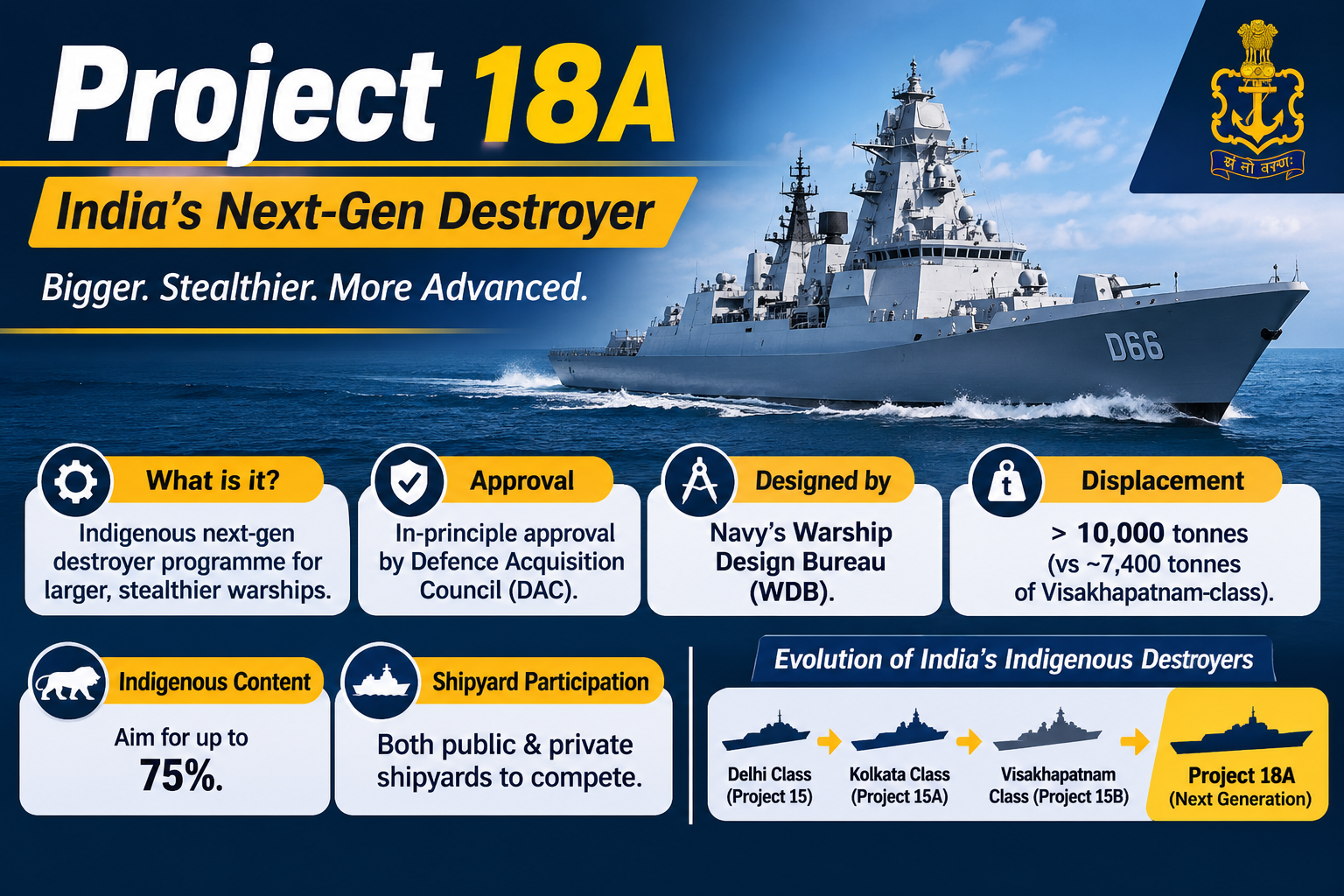
- Project 18A – It is an indigenous next-generation destroyer programme aimed at developing larger, stealthier and technologically advanced guided-missile warships.
- Approval – The Defence Acquisition Council (DAC), chaired by the Defence Minister, has accorded in-principle approval.
- Designed by – Navy’s in-house Warship Design Bureau (WDB).
- Displacement – Expected to exceed 10,000 tonnes, compared with approximately 7,400 tonnes for Visakhapatnam-class destroyers.
- Indigenous Content – Aim for up to 75%.
- Shipyard Participation – Both public and private shipyards are expected to participate competitively.
- Evolution of India's Indigenous Destroyers – Project 18A will continue India's indigenous guided-missile destroyer development.
- Delhi Class – Project 15.
- Kolkata Class – Project 15A.
- Visakhapatnam Class – Project 15B.
- Next Generation – Project 18A.
- Click to read more about Project 18
Why Does the Indian Navy Need Next-Generation Destroyers?
- Changing Maritime Security Environment
- Chinese Naval Presence – Increasing Chinese naval deployments, submarines and research vessels intensify strategic competition in the Indian Ocean.
- Emerging Threats – Unmanned systems, long-range precision weapons and hypersonic technologies are transforming naval warfare.
- Regional Security – India requires stronger maritime capabilities to safeguard its strategic interests across the Indo-Pacific.
- Protection of Maritime Interests
- Sea Lane Security – Protects critical maritime trade routes and commercial shipping.
- Indian Ocean Security – Strengthens India's ability to maintain a credible naval presence across the Indian Ocean Region.
- Power Projection – Supports India's strategic commitments and maritime influence across the Indo-Pacific.
- Limitations of Existing Warships
- Limited Missile Capacity – Existing platforms face limitations in accommodating larger missile inventories.
- Sensor Constraints – Advanced threats require improved surveillance, detection and electronic warfare capabilities.
- Future Readiness – Larger platforms provide greater flexibility for integrating emerging weapons and technologies.
What are the Major Weapons and Technological Capabilities?
- Advanced Missile Systems
- BrahMos Missiles – Expected to support supersonic anti-ship and land-attack operations.
- Long-Range Cruise Missiles – Indigenous systems could strengthen long-range offensive capabilities.
- Surface-to-Air Weapons – Advanced missiles will support fleet air-defence operations.
- Advanced Surveillance and Defence
- Advanced Radars – Enable improved detection and tracking of emerging aerial and maritime threats.
- Integrated Combat Systems – Coordinate sensors, weapons and communication networks.
- Electronic Warfare – Strengthens the ability to detect, counter and disrupt hostile systems.
- Multi-Threat Defence – Designed to address ballistic missiles, hypersonic weapons and coordinated drone attacks.
- Multi-Role Operational Capabilities
- Carrier Protection – Provides air and missile defence for aircraft carrier battle groups.
- Anti-Submarine Warfare – Strengthens capabilities to counter hostile submarines.
- Offensive Operations – Enables precision strikes against hostile naval and land-based targets.
What is the Significance of Project 18A for India?
- Maritime Security – Strengthens India's ability to protect maritime interests and strategic sea lanes.
- Blue-Water Navy – Enhances long-range operational endurance and power projection across the Indo-Pacific.
- Strategic Deterrence – Strengthens India's response capabilities against emerging maritime threats.
- Defence Indigenisation – Promotes domestic warship design, construction and defence manufacturing.
- Technological Advancement – Encourages indigenous development of advanced sensors, weapons and combat-management systems.
- Industrial Development – Creates opportunities for domestic shipyards, defence manufacturers and technology enterprises.
What area the Challenges in Implementing Project 18A?
- Technological Complexity – Integrating advanced radars, missile systems and electronic warfare technologies requires sophisticated capabilities.
- Cost Overruns – Large-scale warship programmes face risks of delays and escalating procurement costs.
- Import Dependence – Certain specialised components and technologies may continue to require foreign sourcing.
- Execution Delays – Design finalisation, competitive bidding and construction may affect project timelines.
- Industrial Coordination – Effective collaboration between the Navy, shipyards and domestic defence manufacturers is essential.
What is the Way Forward?
- Strengthen Indigenisation – Increase domestic development of propulsion systems, sensors, weapons and electronic components.
- Promote Private Participation – Encourage public-private partnerships in advanced warship construction.
- Research and Development – Strengthen collaboration between DRDO, research institutions and domestic defence industries.
- Technology Integration – Prioritise advanced surveillance, electronic warfare, missile defence and unmanned systems.
- Project Management – Ensure timely design finalisation, procurement and construction through effective institutional coordination.
What lies ahead?
- Project 18A represents an important step towards building a technologically advanced, self-reliant and capable blue-water navy.
- It can strengthen India's maritime deterrence, protect strategic interests and enhance its position in the Indo-Pacific.
Reference
The Hindu| Project 18A, and why is the Navy embarking on building futuristic warships?



