Strengthening Worker Protection
India’s social security framework is expanding through EPFO coverage, digital reforms and welfare schemes for organised and unorganised workers.
- Social protection coverage increased from 19% in 2015 to 68.4% in 2026, bringing over one billion people within its framework.
- Key initiatives include EPFO, e-Shram, PM-SYM and the Pradhan Mantri Samajik Sahayata Yojana.
Social Security as a Pillar of Worker Protection
- Changing employment patterns, particularly informal, gig and platform-based work, increase the need for income security.
- Social security protects workers against income loss, retirement-related vulnerabilities and other life contingencies.
- EPFO, under the Ministry of Labour and Employment, provides provident fund, pension and insurance benefits to eligible workers.
Three Pillars of EPFO-led Social Security
EPFO provides three major forms of protection:
Employees’ Provident Fund Scheme (EPF), 2026
- Enables retirement savings through employee and employer contributions with accrued interest.
- Permits partial withdrawals for housing, education, marriage and medical needs.
Employees’ Pension Scheme (EPS), 2026
- Provides monthly pensions on superannuation, retirement or disability.
- Extends pension benefits to eligible dependents of deceased members.
Employees’ Deposit Linked Insurance Scheme (EDLI), 2026
- Provides insurance protection to eligible EPF members in case of death during service.
- Offers benefits up to ₹7 lakh without a separate insurance premium.
Expanding EPFO Coverage Across the Workforce
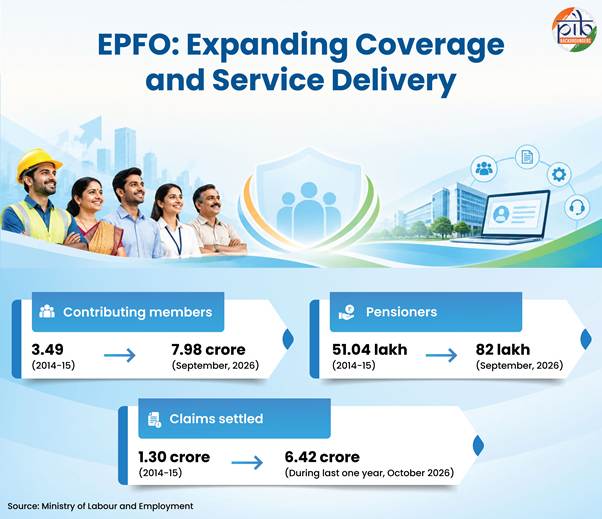
- Contributing members: Increased from 3.49 crore in 2014–15 to approximately 7.98 crore in September 2026.
- Establishments: 7.68 lakh establishments were contributing to EPFO as of September 2026.
- Pensioners: Increased from 51.04 lakh in 2014–15 to around 82 lakh by September 2026.
- Claims settlement: Increased from 1.30 crore in 2014–15 to 6.42 crore during the latest one-year period reported in October 2026.
Strengthening EPFO through Digital and Service Reforms
A. Wage Ceiling Revision
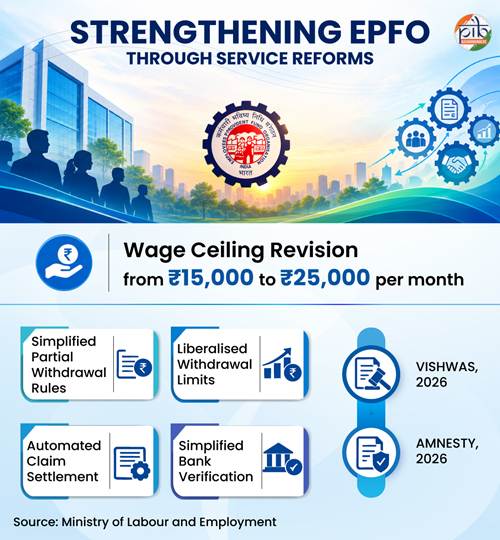
- In September 2026, the mandatory EPFO coverage wage ceiling was increased from ₹15,000 to ₹25,000 per month.
- Expected to bring over 51 lakh additional employees under mandatory coverage.
B. Streamlining PF Withdrawals and Claim Settlement
- Consolidated 13 partial withdrawal provisions into three categories:
- Essential Needs – illness, education and marriage.
- Housing Needs.
- Special Circumstances.
- Increased withdrawal limits to 10 times for education and 5 times for marriage, compared to a combined limit of three earlier.
- Allows eligible members to withdraw up to 75% of their PF balance.
- Standardised minimum service requirement at 12 months.
- Increased automated claim settlement limit to ₹5 lakh.
- Removed the requirement for cheque-leaf images or attested bank passbooks for eligible online claims.
C. Strengthening Compliance and Ease of Doing Business
VISHWAS, 2026
- Enables one-time settlement of eligible disputes involving damages and penalties under EPF legislation and the Social Security Code.
- Offers reduced damage rates of 0.25%, 0.50% or 1% for eligible pre-14 June 2024 defaults.
- Promotes voluntary compliance and reduces litigation through digital settlement.
AMNESTY, 2026
- Helps establishments regularise PF trusts lacking formal exemption under EPF legislation.
- Provides retrospective exemption subject to statutory contribution and interest conditions.
- Open until 28 December 2026.
D. Simplifying Registration with Digital Access
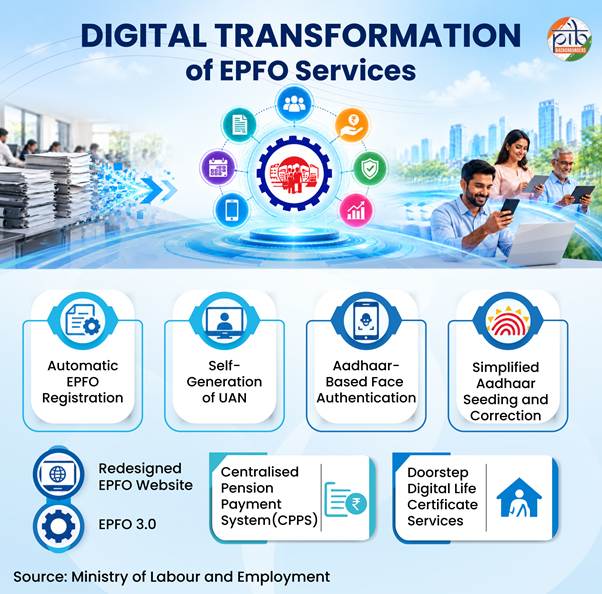
- Eligible companies can obtain automatic EPFO registration through the MCA portal using SPICe+ and AGILE-PRO forms.
- Workers can independently generate UANs, including through Aadhaar-based Face Authentication Technology on the UMANG app.
- Around 1.74 crore self-generated UANs were reported by October 2026.
- UAN provides a permanent account number, facilitating portability of PF savings across establishments.
- Aadhaar seeding and correction have been simplified through the UAN Member Portal.
E. Digital Transformation of EPFO Services
- Centralised Pension Payment System (CPPS): Enables pension disbursement through any bank branch across India without transferring PPOs.
- Doorstep Digital Life Certificate: EPFO and India Post Payments Bank provide free doorstep certificate services to pensioners.
- Redesigned EPFO Website: Provides a unified, mobile-responsive platform for employees, employers and pensioners.
- EPFO 3.0: Introduces core banking-based, cloud-native and API-driven services.
- Aims to enable instant withdrawals, multilingual services and automated claims.
- Risk-validated claims may be processed in under three days instead of up to 20 days.
- Designed to support over 30 crore members.
Beyond EPFO: India's Wider Social Security Framework
A. Pradhan Mantri Samajik Sahayata Yojana
- Revised from the National Social Assistance Programme (NSAP) in October 2026 and continued for 2026–27 to 2030–31.
- Provides financial assistance to elderly persons, widows, persons with disabilities and bereaved families.
|
Component
|
Monthly/One-time assistance
|
|
Disability pension
|
₹375 below 80 years; ₹625 for 80 years and above
|
|
Old-age pension
|
₹200 for 60–79 years; ₹500 for 80 years and above
|
|
Widow pension
|
₹300 for 40–79 years; ₹500 for 80 years and above
|
|
Family benefit
|
₹20,000 upon death of primary breadwinner aged 18–59 years
|
- Disability pension eligibility threshold reduced from 80% to 40%, with no minimum age requirement.
B. Code on Social Security, 2020
- Consolidates nine central labour laws into a unified social security framework.
- Covers provident fund, pension, insurance, maternity benefits and gratuity.
- Extends provisions to organised, unorganised, gig and platform workers.
- Provides proportionate gratuity to eligible fixed-term employees after one year of service.
- Women-centric provisions include:
- Maternity benefits up to 26 weeks.
- Work-from-home options where the nature of work permits.
- Crèche facilities in eligible establishments.
- Provides for a social security fund for gig and platform workers.
C. e-Shram: An Integrated Platform for Unorganised Workers
- Launched in August 2021 as India's first Aadhaar-seeded National Database of Unorganised Workers.
- Provides registered workers with a Universal Account Number (UAN).
- Recorded 31.89 crore registrations as of August 2026.
- The One-Stop Solution, launched in October 2024, integrates 15 social security and welfare schemes.
- Connects workers with employment, skilling and government welfare platforms.
D. Pradhan Mantri Shram Yogi Maandhan (PM-SYM)
- Voluntary contributory pension scheme for unorganised workers aged 18–40 years with monthly income up to ₹15,000.
- Provides an assured minimum pension of ₹3,000 per month after 60 years.
- Monthly contributions range from ₹55 to ₹200, matched equally by the Central Government.
- Supports old-age income security in the unorganised sector, which contributes around 50% of India's GDP.
Towards Universal Social Security
- India is expanding social protection through wider EPFO coverage, pension reforms and welfare schemes.
- Digital platforms are simplifying registration, claim settlement and benefit delivery.
- Extending protection to informal, gig and platform workers is essential for inclusive social security.
Reference
PIB



