Prelims: Current events of national and international importance | Geography
Why in News?
Iceland has expressed interest in collaborating with India on geothermal energy, Carbon Capture, Utilisation and Storage (CCUS), and Carbfix technology.
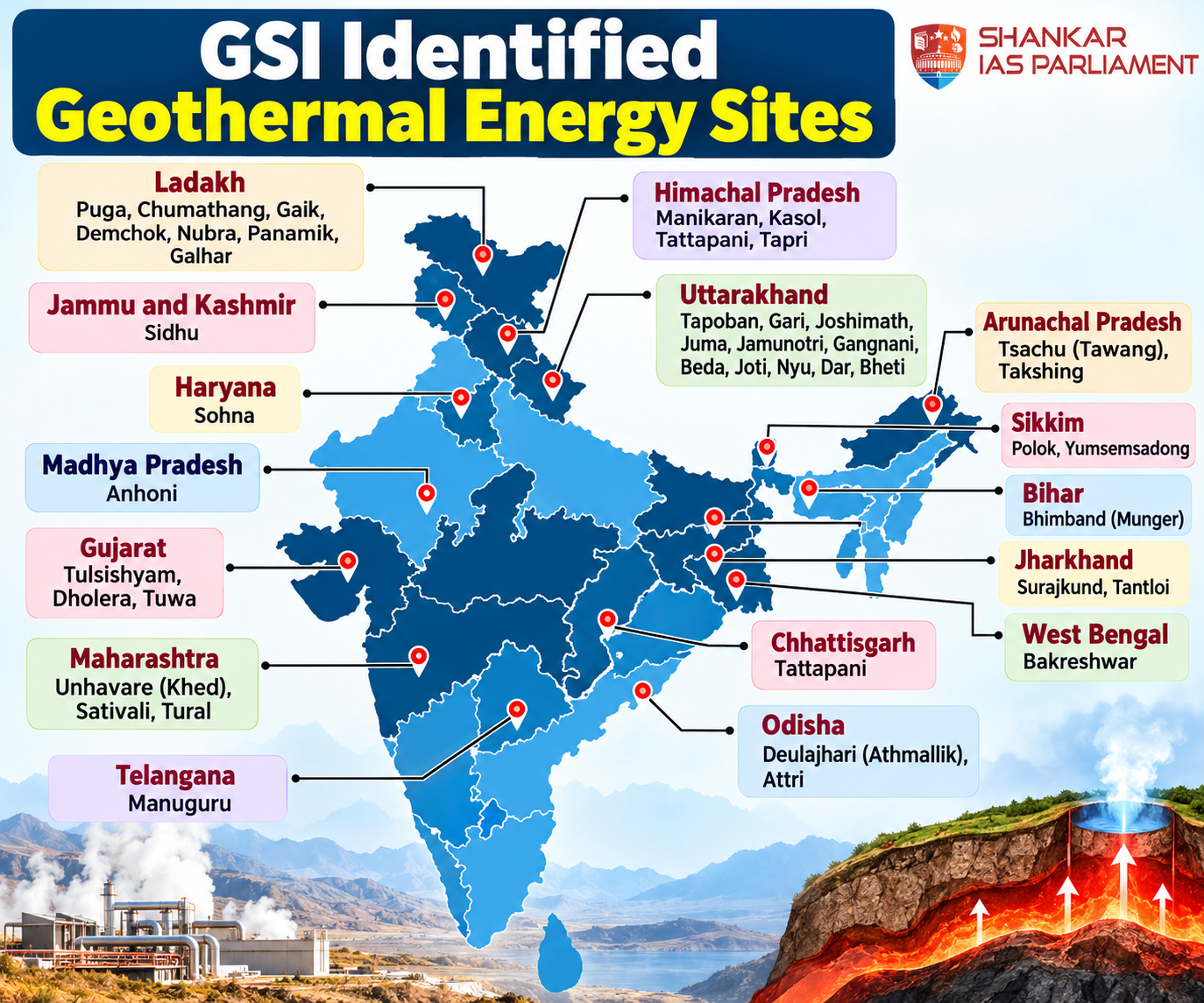
- India's estimated geothermal energy potential is approximately 10.6 gigawatts (GW).
- Iceland aims to share its expertise in geothermal power generation and CO₂ mineralisation.
Iceland–India Cooperation
- Iceland produces about 70% of its electricity from hydropower and 30% from geothermal sources.
- Iceland can assist India by providing technical expertise, advanced drilling technology, and regulatory guidance.
- Next-generation geothermal systems use deeper drilling methods, which can significantly increase energy output per borehole.
Carbfix Technology
- Carbfix, developed in Iceland, converts captured carbon dioxide into stable carbonate minerals through injection into appropriate underground rock formations.
- The injected carbon dioxide reacts with reactive rocks, particularly basalt, resulting in mineralisation.
- This process offers a potential long-term storage solution for captured carbon emissions.
- Potential applications in India include deployment in hard-to-abate sectors such as cement and steel production.
Geothermal Energy
- Geothermal energy refers to energy obtained from heat stored beneath the Earth's surface.
- Primary sources – It includes radioactive decay of elements within the Earth, residual heat from planetary formation, and ongoing geological activity.
- Uses – It is utilised for electricity generation, space heating, industrial processes, and greenhouse cultivation.
- Advantages – It is renewable, produces low operational emissions, provides reliable baseload power, and requires a relatively small land footprint.
- Limitations – It includes high initial drilling costs, location-specific resource availability, and potential risks such as induced seismicity or the release of underground gases.
Reference
The Hindu | Iceland–India Cooperation



