Prelims: Current events of national and international importance | Environment
Why in News?
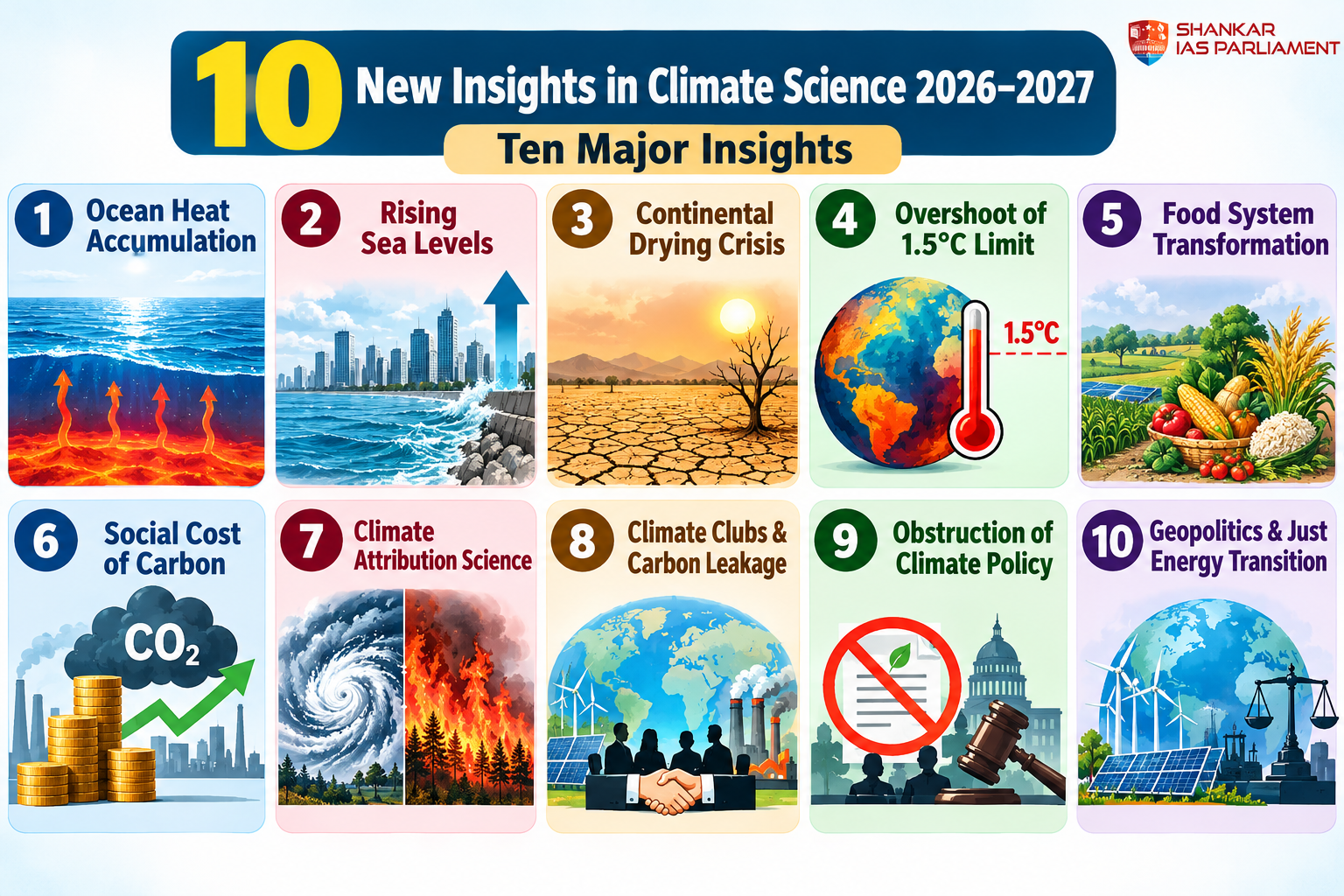
Recently, the International Science Council (ISC) released the report titled 10 New Insights in Climate Science 2026–2027.
10 New Insights in Climate Science 2026–2027
- The release of the report coincided with the pre-COP31 meeting held in Fiji.
- Prepared by – Future Earth, the Earth League and the World Climate Research Programme (WCRP).
- It presents recent scientific findings intended to inform climate negotiations in advance of COP31.
- Key Highlights
- Global warming – In 2025, global temperatures were approximately 1.43°C above the pre-industrial baseline.
- The years 2015 to 2025 represent the 11 warmest years on record.
- CO₂ emissions – In 2025, fossil fuel and cement production emitted a record 38.1 billion tonnes of CO₂.
- Atmospheric CO₂ concentrations reached 425.6 ppm, approximately 53% higher than pre-industrial levels.
- Ocean warming – Oceans absorb more than 90% of excess heat in the Earth system.
- In 2025, ocean heat content reached a record high for the ninth consecutive year.
- Sea-level rise – The global mean sea-level rise rate has doubled over the past 30 years, primarily due to thermal expansion of seawater and melting glaciers and ice sheets.
- Water insecurity – Approximately three-quarters of the global population live in 101 countries experiencing freshwater losses since 2002.
- The annual water gap is estimated at 458 km³, with South Asia facing significant groundwater depletion.
- Social Cost of Carbon (SCC) – Recent estimates suggest economic damages from carbon emissions may be up to four times higher than previously assessed.
- SCC quantifies the economic impact of one additional tonne of CO₂ emissions.
- Climate attribution science – Advances in research now link emissions from fossil fuel and cement producers to specific climate impacts, strengthening evidence for accountability and climate litigation.
- Climate clubs and Carbon Border Adjustment Mechanisms – It can reduce carbon leakage but may increase costs for exporters in developing countries.
- Climate obstruction – Common tactics include denial, delay, policy dilution, greenwashing, and digital disinformation.
- Just energy transition – Geopolitical instability can disrupt clean energy supply chains and increase reliance on fossil fuels.
Reference
Down to Earth | 10 New Insights in Climate Science 2026–2027



