Prelims: Current events of national and international importance | Art & Culture | History
Why in news?
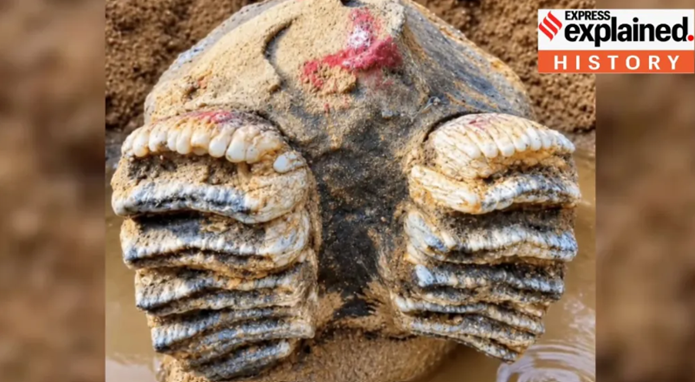
A fossilised jaw exposed by erosion along the Narmada in Madhya Pradesh’s Raisen district could belong to one of the largest elephant species ever to walk the earth — the extinct Palaeoloxodon namadicus.
- Palaeoloxodon namadicus – It is a prehistoric straight-tusked elephant that researchers believe may have roamed the region around four to five lakh years ago.
- Fossil Location – Patai Ghat, near Patai village in Deori tehsil, Raisen district, Madhya Pradesh.
- Age – Estimates place the fossil anywhere from the Quaternary Period to roughly 4-5 lakh years old, while some initial reports suggested it may be as old as 65 lakh years. Further dating studies are required.
- The fossil-bearing sediments are associated with the Pleistocene. The Pleistocene Epoch extended from approximately 2.58 million years ago to 11,700 years ago and witnessed repeated glacial and interglacial cycles.
- Physical Features – The fossil measures approximately 75 cm in length and 25 cm in width.
- Its molars have seven to nine parallel ridges, with prominent raised teeth and clearly visible grooves.
- The fossil displays large molar teeth and skull/jaw features characteristic of giant prehistoric elephant relatives that were considerably larger than modern elephants.
- Pleistocene-Era Geological Evidence – The yellow soil indicates the Pleistocene period. In this period, most of the elephant fossils that have been found belong to a genus called Palaeoloxodon.
- These were enormous elephants. Their fossils are found in geological formations dating from the period we are examining, approximately seven lakh years ago to 30,000 years ago.
- Verification – A Geological Survey of India (GSI) team inspected the site.
- The identification is not yet conclusive; further examination of the teeth, biological characteristics and geological context, along with scientific dating, is required.
- Hotspot for finding dinosaur fossils – India has been a hotspot for finding dinosaur fossils for decades.
- The first time dinosaur bones were found was in 1822 by Captain William H Sleeman of the East India Company army, also in Madhya Pradesh, near Jabalpur.
- Since then, evidence of several other kinds of dinosaurs has been found in states such as Rajasthan, Gujarat, Andhra Pradesh, Maharashtra, Telangana, Karnataka, and Tamil Nadu.
- Central India has unearthed fossilised dinosaur eggs in the past as well.
Reference
Indian Express | A 75-cm jaw, a prehistoric giant: What MP’s latest fossil discovery reveals



