Prelims: Current events of national and international importance | Species
Why in news?
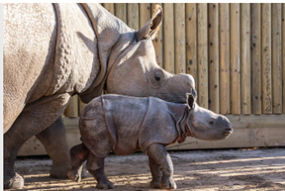
A greater one-horned rhinoceros calf was born at Chester Zoo in the United Kingdom on 11 October 2026, following a pregnancy of around 15 months, captured on CCTV cameras.
- Scientific name – Rhinoceros unicornis.
- Family – Rhinocerotidae.
- Distribution – Native to the Indian subcontinent and found in India and Nepal.
- Habitats – It inhabits wetlands, riverine grasslands and adjoining forests.
- India’s major habitats include Kaziranga, Pobitora, Orang and Manas in Assam, Jaldapara and Gorumara in West Bengal, and Dudhwa in Uttar Pradesh.
Key features
- The greater one-horned rhino is the largest rhino species in Asia.
- Appearance – It has a single horn made of keratin and thick, folded skin that gives an armour-like appearance.
- Size & Weight – It stands up to 1.8m at the shoulder and weighs more than two tonnes as an adult.
- It is a strong swimmer and primarily a grazer, and calves remain with their mothers during their early years.
- Population – Around 4,000 individuals are estimated to remain in the wild, with a large share concentrated in a limited number of protected areas, especially in India.
- Conservation status
- IUCN – Vulnerable
- CITES – Appendix I.
- Wildlife Protection Act, 1972 – Schedule 1.
- Threats – Habitat loss, poaching, etc.
The Chester Zoo calf forms part of a European conservation-breeding programme intended to maintain genetic diversity in human care; it is not an addition to the wild population.
Reference
Down to Earth | Rare greater one-horned rhino born at Chester Zoo, birth captured on CCTV



