Why in News?
Recently, the scientists have discovered new monkey species Popa Langur, is on the verge of extinction.
- Popa Langur – It is a newly-discovered species, occurs in central Myanmar which is named after the sacred Mount Popa.
- Discovered in – 2020.
- Taxonomy
- Scientific Name – Trachypithecus popa.
- Genus – Trachypithecus of Old-World primates.
- It was often referred as Leaf-Monkeys.
- Habitat – Found in the evergreen and deciduous forests, bamboo forests and plantations.
- Distribution – High evergreen forests of Myanmar.
The largest populations of Popa Langur live in Popa Mountain Park and Panlaung-Pyadalin Cave Wildlife Sanctuary, Myanmar.
- Morphology – It has soft fluffy gray fur, pointed cap of fur on their head, like most langurs, small heads and large eyes made bigger in appearance by thick white eye rings.
- It has small, elongated nostrils and a wide mouth covered in white fur, chest and belly are pale gray-white in color.
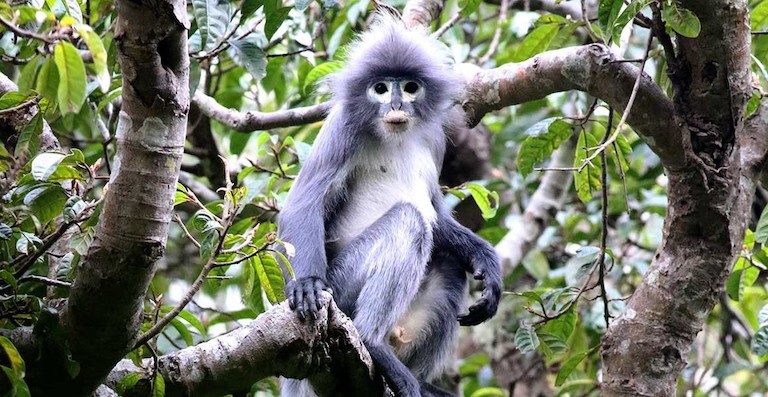
- Behavior – It is an arboreal (spending most of their time in trees) and diurnal (active during the day).
- It is capable of traveling long distances and has home ranges large as 256 acres.
- It is vocal primates and range calls to communicate with each other.
- Diet – It is a folivores (leaf eaters), which feed on leaves, fruits, green shoots and petioles.
- Researchers recently estimated that only 200 to 260 individuals remain now.
- Threats – Hunting for meat
- Illegal pet trade
- Agricultural encroachment
- Water and soil pollution
- Cattle ranching.
- Conservation Status
- IUCN – Critically Endangered.
- CITES – Appendix II.
References
- AZ Animals| Popa Langur Verge of Extinction
- NEPC| Popa Langur



