Prelims: Current events of national and international importance | Science & Technology
Why in News?
A recent study demonstrated that 5 evaluated plant-based meat products exhibited a greater percentage of protein bioavailability compared to their chicken counterparts.
- Conducted by – CSIR–Institute of Himalayan Bioresource Technology (CSIR-IHBT), Palampur.
- Collaboration with – Good Food Institute (GFI) India.
- Conducted under – Laboratory-simulated digestion.
- Key findings
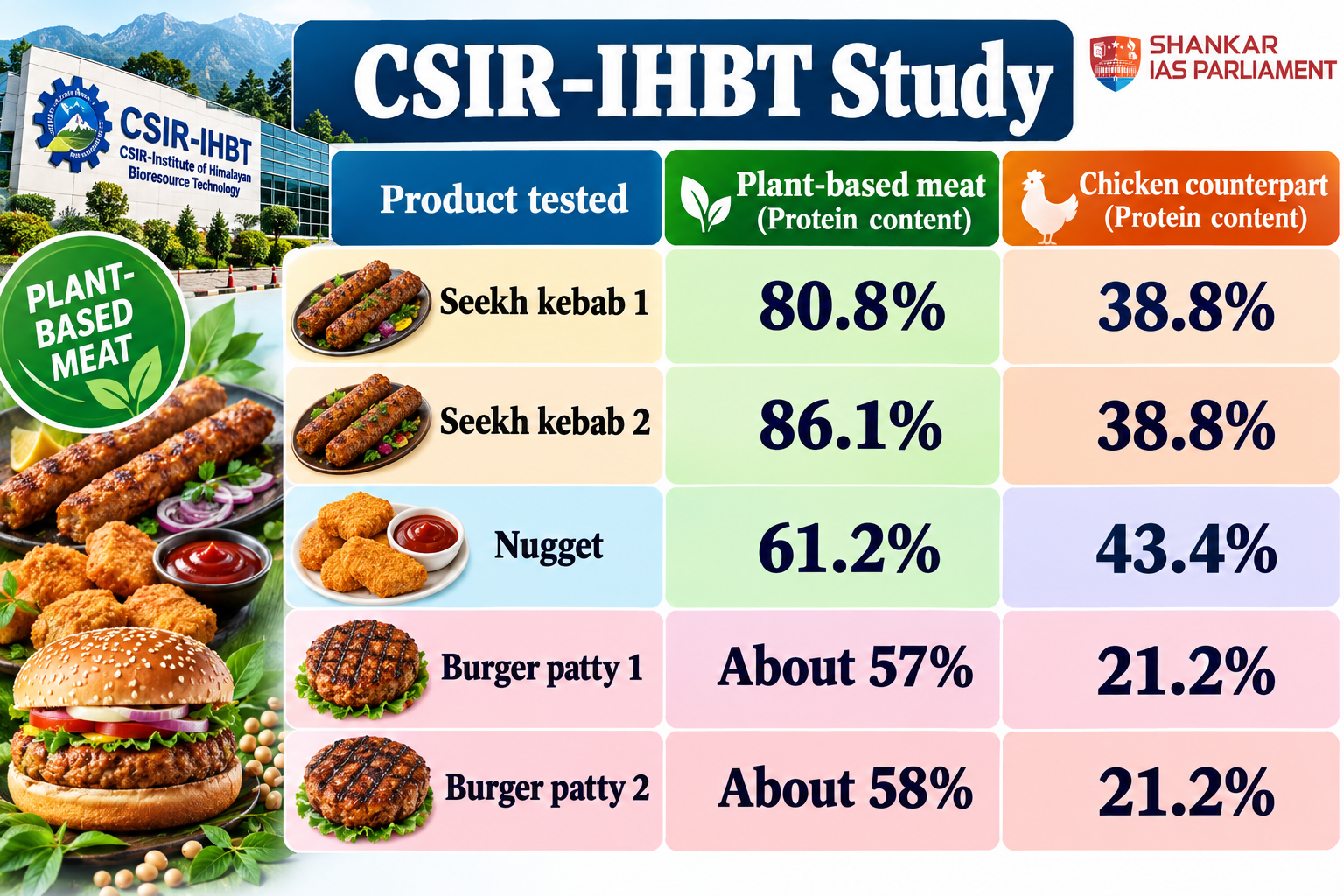
- Plant-based products demonstrated greater measured protein bioavailability across all five comparative analyses.
- Chicken products contained higher levels of crude protein and released a greater quantity of amino acids during digestion.
- The study focused exclusively on protein bioavailability rather than assessing overall health outcomes.
- Additional testing with a broader range of products and increased sample sizes is planned.
Protein bioavailability
- Protein bioavailability is defined as the extent to which a nutrient becomes available for absorption and utilization by the body.
- During digestion, proteins are hydrolyzed into amino acids and smaller peptides.
- Amino acids are utilized for tissue growth and repair, enzyme synthesis, and various physiological functions.
In vitro digestion
- In vitro refers to processes conducted outside a living organism, typically in a laboratory setting.
- The study employed the internationally harmonized INFOGEST protocol to simulate human digestion.
- Salivary phase – Samples were subjected to a simulated salivary phase with a duration of two minutes.
- Gastric phase – Digestive enzymes were applied under acidic conditions, maintaining a pH range of 2 to 3.
- Intestinal phase and ultrafiltration – A membrane replicating human intestinal pore size was utilized.
- The concentration of free amino acids passing through the membrane was measured to estimate bioavailability.
- Each sample was standardized to contain 40 mg of protein at the start of the experiment.
- Animal studies continue to serve as a critical benchmark for assessing biological effects, although they require additional time and ethical approval.
- The researchers plan to conduct inter-laboratory testing to facilitate broader adoption of the method, including implementation by NABL-accredited laboratories.
|
Plant-Based Meat Products
|
- Plant-based meat products are formulated to replicate the taste, texture, and appearance of animal-derived meat by utilizing plant-based ingredients.
- Common raw materials used in plant-based meat production include:
- Soy protein
- Pea protein
- Wheat gluten
- Manufacturing technique - Extrusion
- During extrusion, the material is forced through a shaped die under controlled heat and pressure, resulting in a meat-like texture.
|
Plant-based meat vs conventional meat
|
Feature
|
Plant-based meat
|
Conventional meat
|
|
Primary source
|
Plant proteins
|
Animal tissues
|
|
Protein content
|
Depends on formulation
|
Depends on meat type and cut
|
|
Dietary fibre
|
Can provide dietary fibre
|
Contains no dietary fibre
|
|
Saturated fat and sodium
|
Depend on ingredients and processing
|
Depend on meat type and preparation
|
|
Environmental impact
|
May offer sustainability benefits, depending on production
|
Depends on livestock system and supply chain
|
Reference
The Hindu | Plant-Based Meat Yields



