Prelims: Current events of national and international importance | Economy
Why in News?
The National Statistics Office (NSO), operating under the Ministry of Statistics and Programme Implementation (MoSPI), has proposed revisions to the Annual Survey of Unincorporated Sector Enterprises (ASUSE) for 2027–28.
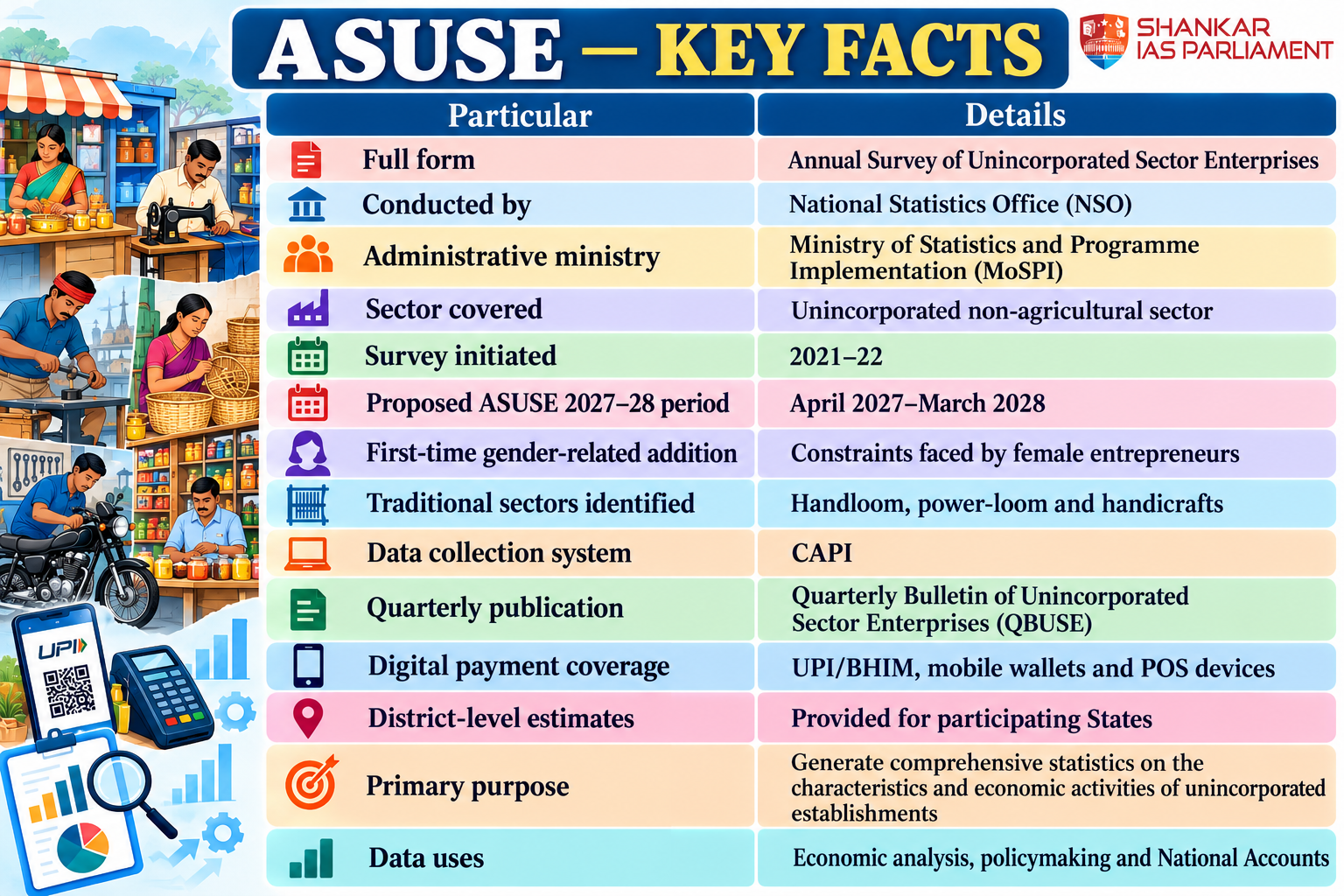
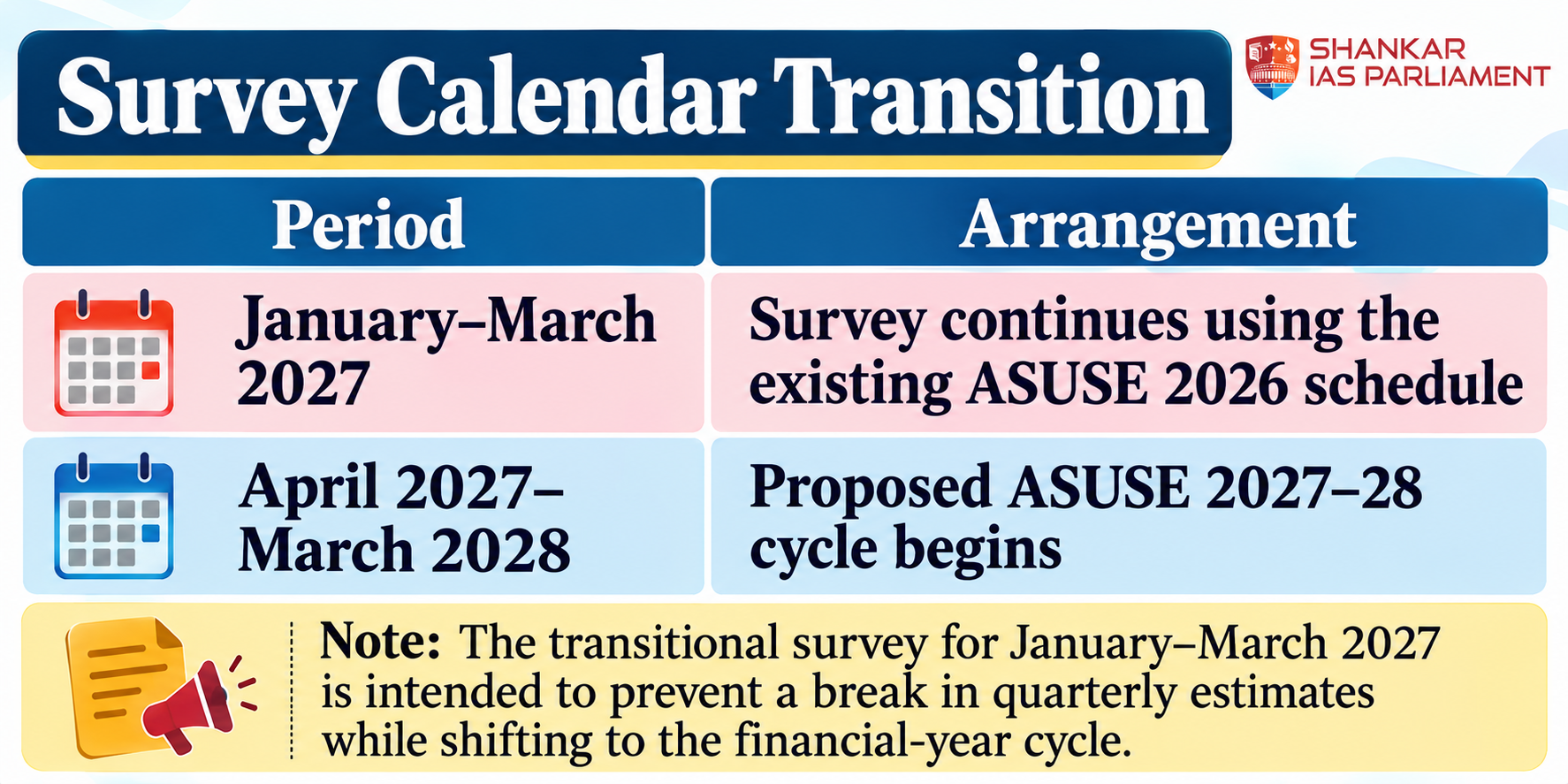
- Survey period – It is scheduled from April 2027 to March 2028, in alignment with the financial year.
- Objective – To enhance data collection on the unincorporated sector and to address emerging policy requirements.
- New focus areas – It includes women entrepreneurs, electricity sources, investment in fixed assets, and handloom, power-loom, and handicraft establishments.
Unincorporated sector – It comprises economic establishments that are not registered as companies under the relevant legal framework.
- This sector includes a wide range of small businesses and enterprises operating outside the incorporated corporate sector.
- The unincorporated sector plays a significant role in employment generation, livelihood provision, and overall economic activity.
- It maintains linkages with the incorporated sector through production processes, service provision, and supply chains.
ASUSE focuses on the unincorporated non-agricultural sector, not the entire economy or agricultural establishments.
Key changes proposed in ASUSE 2027–28
- Gender-specific constraints – For the first time, the survey will include questions to identify constraints faced by female entrepreneurs in operating and managing establishments.
- This addition will support analysis of barriers to women's entrepreneurship and economic participation.
- Sources of electricity – Additional questions will identify the various electricity sources used by establishments.
- This will improve understanding of energy-use patterns and operating conditions.
- Investment in fixed assets – A new question will capture investment over a longer reference period compared to the current schedule.
- This will help analyse investment trajectories and business development.
- Traditional industries – Two questions will help identify handloom, power loom, and handicraft establishments.
- These questions were introduced at the request of the Ministry of Textiles.
- They are intended to improve data availability for targeted policymaking.
- Financial-year alignment – The survey cycle will shift from the calendar year (January to December) to the financial year (April to March).
- This change is intended to improve comparability with other economic statistics and support National Accounts compilation.
Additional Key Features of ASUSE
- District-level estimates – The sampling design enables the generation of district-level estimates for participating States.
- Sampling design – The design has been revised to enhance survey coverage and improve statistical utility.
- Classification systems – Globally recognized classification standards are employed.
- Data collection – Computer-Assisted Personal Interviewing (CAPI) systems are utilized.
- Digital economy coverage – The survey includes questions regarding the following aspects:
- Presence on e-commerce marketplaces.
- Digital payment instruments, such as Unified Payments Interface (UPI), including BHIM.
- Mobile wallets and Point of Sale (POS) devices.
- Quarterly dissemination – Survey findings are disseminated quarterly through QBUSE.
- Stakeholder consultation – Feedback is solicited from ministries, researchers, policymakers, and other data users.
Significance
- Policy & Enterprise Development – Supports evidence-based policymaking by providing insights into employment generation, women-led enterprises, traditional industries, and enterprise investment growth.
- Digital & Economic Monitoring – Tracks digital adoption (e-commerce, digital payments) and strengthens national accounts through better-aligned, comparable economic data.
Reference
PIB | ASUSE



