Prelims: Current events of national importance | Environment
Why in News?
Recently, research has revealed microplastic contamination in aquatic species of Pichavaram mangroves, threatening the ecosystem.
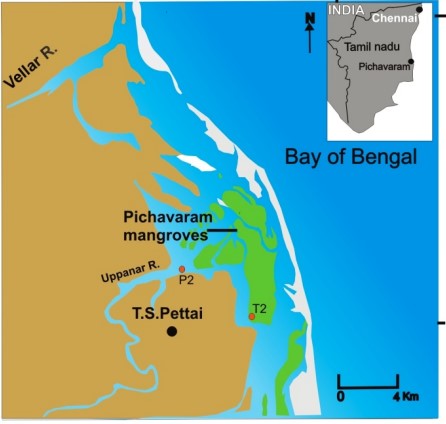
Pichavaram Mangrove Forest
- It is one of India’s largest mangrove ecosystems.
- Location – Cuddalore district, Tamil Nadu, between the Vellar and Coleroon estuaries along the Bay of Bengal.
- Type – Mangrove Ecosystems.
- Tree Species – Dominant mangrove species Avicennia marina and Rhizophora marina.
- Root Adaptations – Pneumatophores and Rhizophora.
Rhizophora have stilt roots act as anchors to provide stability in shifting mud and protection against strong wave energy.
Pneumatophores (breathing roots) are specialized aerial roots that grow vertically upward from the soil to facilitate gas exchange in oxygen-poor, waterlogged mangrove environments.
- Soil Type – Mangrove soils are typically anaerobic (oxygen-deficient) and halomorphic (saline).
- Landscape – Complex network of tidal channels, mudflats, and dense vegetation.
|
International & National Status
|
|
Ramsar Site – Designated in 2022.
|
|
CRZ Classification – Falls under CRZ‑IA (Ecologically Sensitive Areas), highest protection level.
|
|
IBA Status – Recognised as an Important Bird Area (IBA) by BirdLife International.
|
|
IUCN Red List of Ecosystems assessments - The Pichavaram mangroves in Tamil Nadu are classified as Critically Endangered.
|
The Sundarbans in India and Bangladesh is the world's largest mangrove forest. (10,000 sq.km).
- Ecological Significance - Coastal Defense – Natural buffer against cyclones, storm surges, and tsunamis (proved during 2004 tsunami).
- Carbon Sequestration – High “blue carbon” potential.
- Sediment Stabilisation – Roots trap debris and organic matter, preventing erosion.
- Biodiversity – Supports 177 species of resident and migratory birds, fish, prawns, and crabs.
Globally, mangroves cover about 15% of the world’s coastlines.
Findings of the recent study
- Recent findings indicated the significant seasonal microplastic contamination in Pichavaram’s aquatic species.
Microplastics, defined as plastic particles smaller than 5 millimetres, originate from the breakdown of larger plastic waste or from synthetic textiles, packaging and fishing gear.
- Highest record - The monsoon season recorded the highest levels, largely due to runoff from nearby settlements.
- Affected species - Lizatade showed notable particle ingestion, and shellfish including Scylla serrata and Portunus sanguinolentus.
- A substantial proportion of particles were below 1 millimetre, with blue fibres dominant.
- Common polymers - Includes polypropylene, polyethylene and PET (Polyethylene Terephthalate), confirms that contamination is systemic and widespread.
- Effects - Pneumatophores make them highly efficient filters but it also means plastic debris and microplastics settle within their root systems.
- Microplastics alter sediment composition and may interfere with nutrient exchange, affecting mangrove seedling growth.
- Benthic organisms such as worms and crustaceans, which maintain soil health, are also disrupted.
- Gradually, the forest’s regenerative capacity weakens.
- Through bioaccumulation and biomagnification, microplastics and associated toxins build up along trophic levels.
- Larger fish that consume contaminated prey accumulate higher toxin levels, which eventually reach humans.
Restoration Initiatives
- Tamil Nadu Coastal Restoration Mission (2025) – Large scale restoration with World Bank support; tidal mangrove nurseries at Killai.
Reference
Down to earth | Pichavaram



