Prelims: Current events of national and international importance | Ecology & Environment
Why in news?
Recently, researchers studied how mangrove cells enable the plants to survive in saltwater.
- Mangrove – It is a salt-tolerant plant community found in tropical and subtropical intertidal regions.
- Climate requirement – Mangroves can thrive in high-rainfall areas (1,000–3,000 mm) with temperatures ranging from 26°C to 35°C.
- Adaptation – Mangrove species are adapted to survive in waterlogged soils, high salinity, and frequent tidal surges.
- Ecological importance – They serve as crucial biodiversity refuges and act as bio-shields against extreme climatic events.
- Additionally, rural populations depend on mangroves for biomass-based livelihoods.
- Nature’s Carbon Vault – As per World Wildlife Fund mangroves store 7.5–10 times more carbon per acre than tropical forests.
- Their loss contributes to 10% of global greenhouse gas emissions from deforestation.
- India State of Forest Report, 2023 –
- India’s total mangrove cover stands at 4,991.68 sq. km, constituting 0.15% of the nation’s geographical area.
- From 2013 to 2023, mangrove cover in the country increased by 363.68 sq. km (7.86%).
- From 2001 to 2023, mangrove cover increased by 509.68 sq. km (11.4%).
- Highest share – West Bengal (42.45%) holds the largest share, followed by Gujarat (23.32%) and Andaman & Nicobar Islands (12.19%).
- Mangroves as ESAs – Mangroves are classified as Ecologically Sensitive Areas (ESAs) under the Environment (Protection) Act, 1986 by Coastal Regulation Zone (CRZ) Notification, 2019.
- Buffer Zone Rule – Activities are restricted within a 50‑metre buffer zone if mangrove cover is more than 1,000 sq. m under the 2019 notification.
- Replantation Mandate – If mangroves are damaged by development, compensatory replantation must be done at a 3:1 ratio.
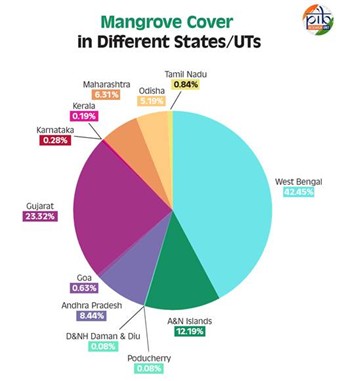
- Additional protection – Under the Wildlife (Protection) Act, 1972, Indian Forest Act, 1927, and Biological Diversity Act, 2002.
To know more about Mangrove Ecosystem, Click here
Quick Fact
|
How mangrove’s cells helps plants survive in saltwater?
|
|
Key Insights
- Mangroves vs. other plants – Saltwater would kill most plants, but mangroves thrive due to specialized adaptations.
- Cell traits identified – Small epidermal pavement cells help reduce stress from saline conditions.
- Thicker cell walls provide mechanical strength against osmotic pressure.
- Salt management strategies –
- Some species exclude salt using a waxy root layer that filters it out.
- Others absorb salt but then excrete it through leaves using specialized tissues.
- Evolutionary resilience – Mangroves have evolved around 30 times over 200 million years, adapting repeatedly to saline environments.
|
References
- The Hindu | How mangroves’ cells helps plants survive in saltwater
- PIB | Mangroves as Guardians of Life and Livelihoods



