Prelims: Current events of national and international importance | Species
Why in news?
The Pan-India Assessment and Monitoring of Endangered Species: Marine Turtles (covering December 2022–May 2025) was released recently.
- Assessed by – Wildlife Institute of India (WII), covering 360 beach stretches spanning over 1,300 km of coastline.
- It covered beaches across Gujarat, Maharashtra, Karnataka, Kerala, and Lakshadweep on the West Coast, and in Andaman and Nicobar Islands, Tamil Nadu, Andhra Pradesh, Odisha, and West Bengal on the East Coast.
Major Findings
- Most widespread species – Olive Ridley turtles were the most widely distributed marine turtle species along India's mainland coastline, along with Green turtles.
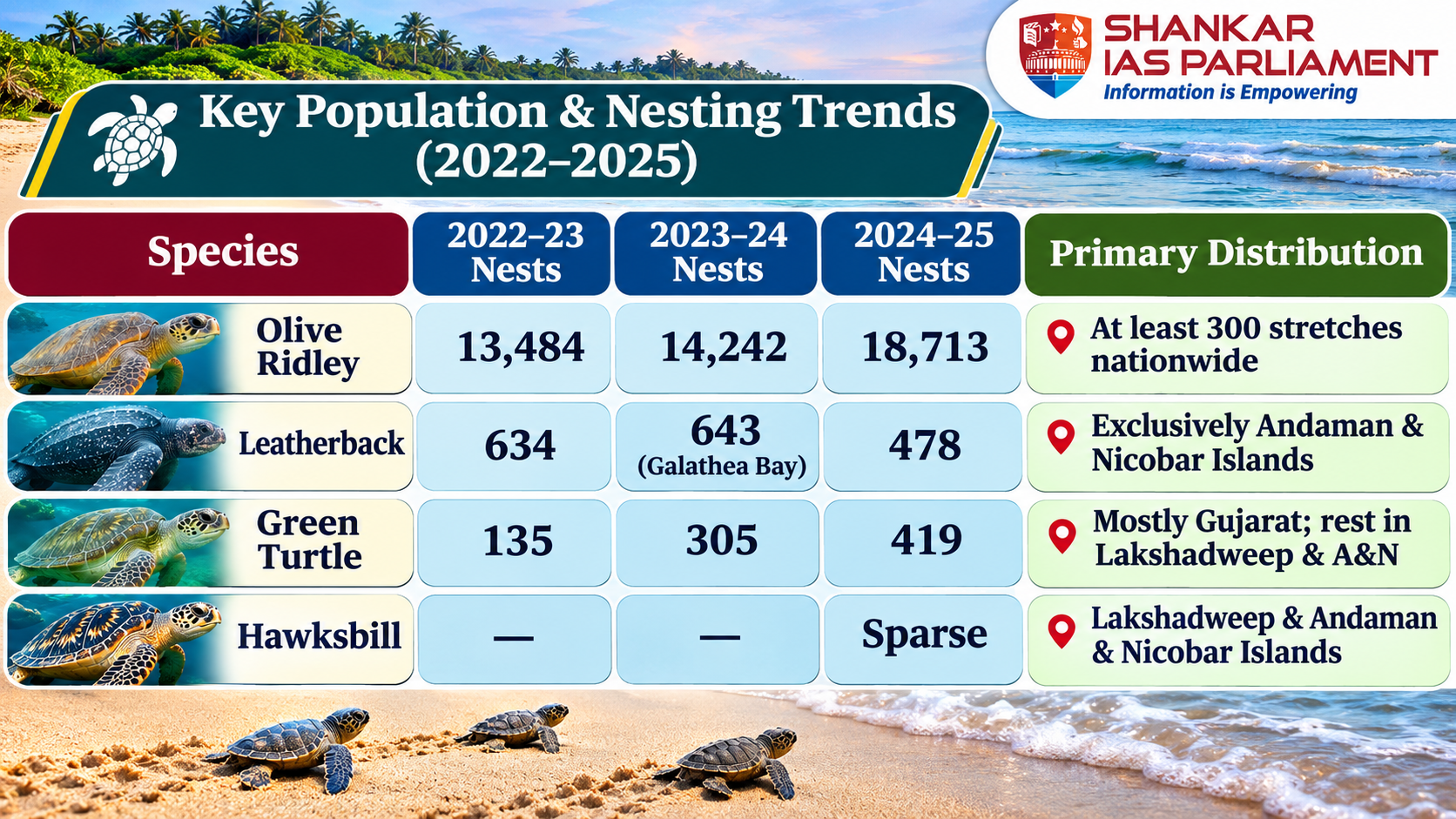
- More than 18,000 solitary nests were recorded during the 2024-25 nesting season.
- Olive Ridley Population Trends – An estimated 8,000 female Olive Ridley turtles nested on mainland India during 2024-25, based on an average of 2.5 clutches per female.
- Each female typically lays 100-110 eggs per clutch and nests multiple times in a season.
- A decline in nesting was observed in Gujarat, attributed to the closure of river mouths and loss of sandy nesting beaches.
- Leatherback Turtles & Great Nicobar – Separate data from the Andaman and Nicobar Forest Department recorded 889 Leatherback nests and 108 Olive Ridley nests at Galathea Beach between November 2025 and March 2026.
- Decline in nesting – The number of Leatherback turtle nests declined from 634 in 2022-23 to 478 in 2024-25 at Galathea Bay, Great Nicobar Island.
- Leatherback turtle nesting was found to be concentrated almost entirely in the Andaman and Nicobar Islands.
- Nesting Habitat – The study found that river-mouth beaches provide ideal nesting conditions for Olive Ridley turtles.
- Reduced microbial load, nutrient-rich sediments, and cyclical erosion near river mouths improve egg development and hatchling survival.
- Major east-coast rivers such as the Mahanadi, Godavari, Krishna, and Kaveri create favourable nesting environments.
- Hatchling emergence success was higher on the east coast (81.5%) than on the west coast (64.5%)
- Conservation Concerns – Galathea Bay is also the proposed site of the Rs. 92,000-crore Great Nicobar Island (GNI) transhipment port project, raising concerns over impacts on critical Leatherback nesting habitats.
- Recommendations – The report recommended
- Greater in-situ protection of turtle nests rather than relying solely on hatcheries.
- Flipper tagging and satellite tracking to monitor turtle movements.
- Improved monitoring in remote island regions.
Reference
Indian Express | What turtle survey says about Olive Ridley nesting, Leatherback presence in Nicobar



