Prelims: Current events of national and international importance | Species
Why in News?
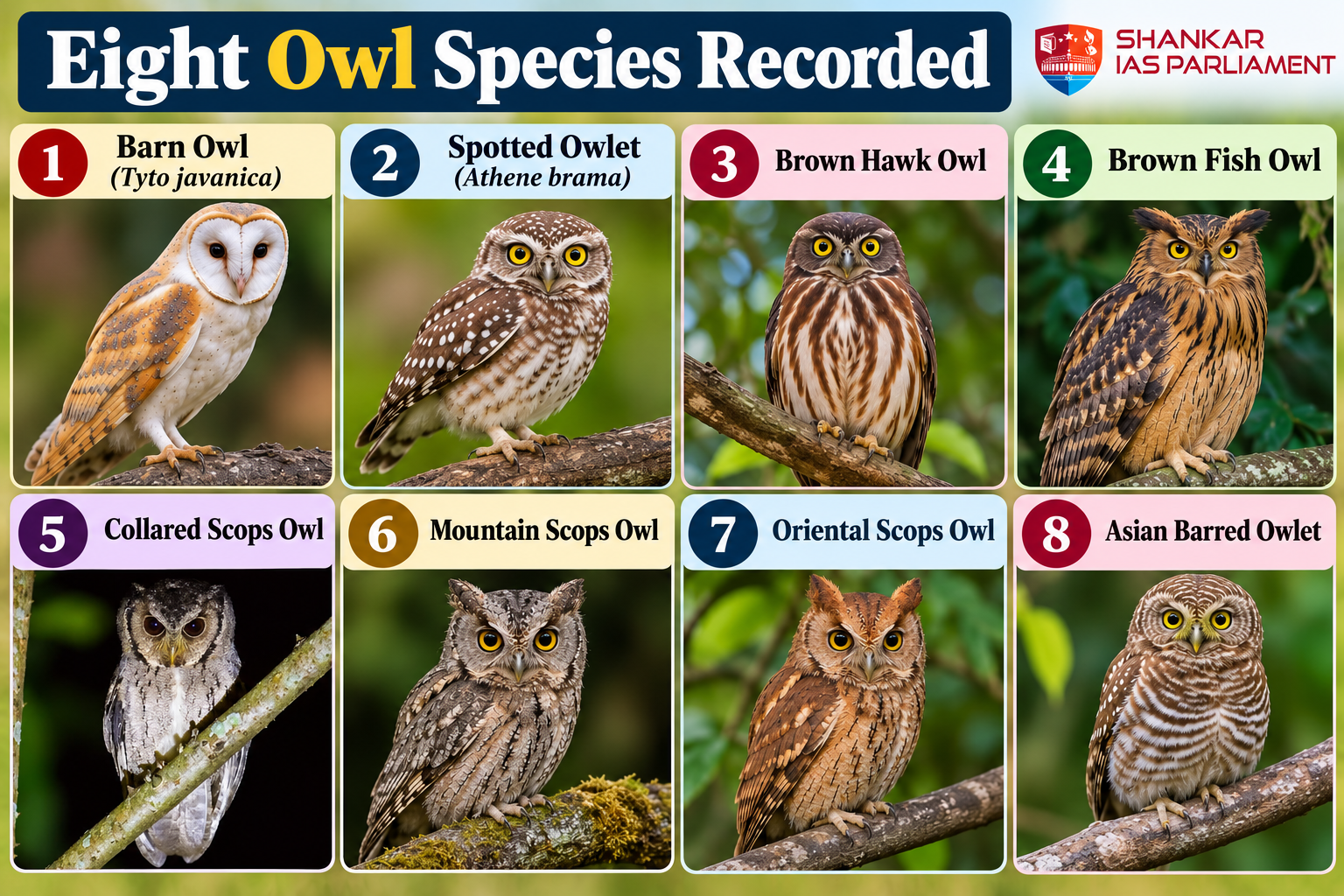
The study “Patterns and Predictors of Owl Occupancy in a Rapidly Urbanising Subtropical City, Guwahati, India” identified eight owl species in Guwahati, Assam.
- The study analysed owl occupancy across various urban land-use categories from November 2023 to July 2025.
Key Findings
- Dominant Species – Barn Owls and Spotted Owlets were the most frequently detected species.
- Both species maintained high occupancy throughout Guwahati's urban landscape.
- Impact of Ambient Noise – Ambient noise consistently reduced owl detection.
- Traffic and urban sounds masked owl calls and affected acoustic monitoring.
- Imperfect Detection – Actual sightings and detections underestimated owl occupancy.
- Model-based estimates that account for imperfect detection suggest owls may occupy more areas than conventional surveys indicate.
- Urban Adaptation – Barn Owls and Spotted Owlets demonstrated human commensalism by occupying diverse urban habitats.
Human Commensalism – An ecological association in which one species benefits from its relationship with humans without necessarily causing harm to them.
- Habitat Characteristics – It showed weaker, species-specific associations with owl occupancy.
Major Threats
- Noise pollution resulting from vehicular traffic and urban activities.
- Loss and fragmentation of natural habitats within urban environments.
- Accelerated urbanisation and alterations in land-use patterns.
- Degradation of wetlands and reduction of green spaces.
- Decline in mature trees and loss of native vegetation.
Significance
- Natural Pest Regulation – Control rodent populations and reduce reliance on chemical pest-control methods.
- Ecosystem Health Indicators – Maintain food-web balance and reflect the biodiversity-supporting capacity of ecosystems, including urban areas.
Reference
TOI | Eight Owl Species in Guwahati



