Mains: GS – III Science and Technology
What is the background and significance of the 2026 Physics Nobel Prize?
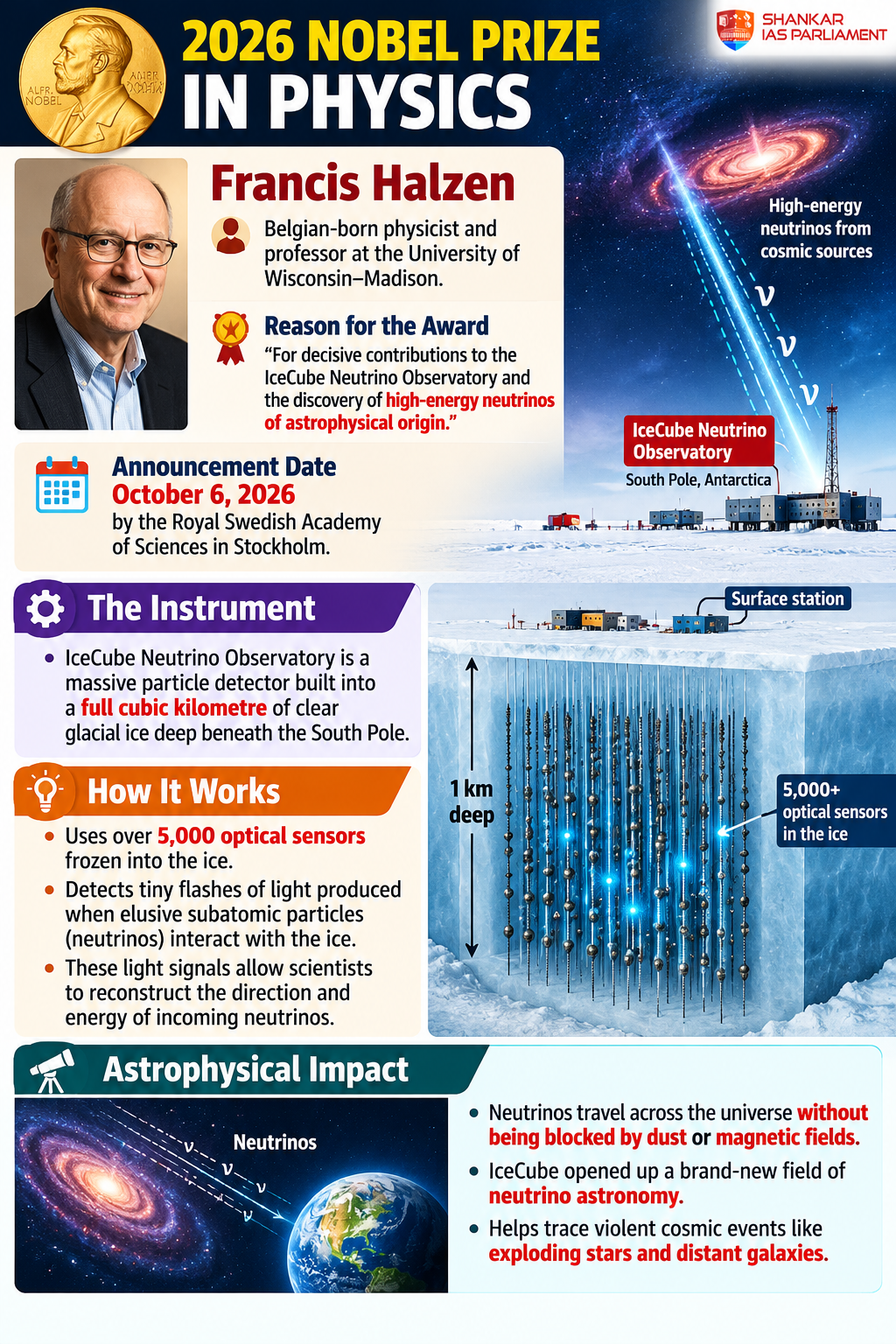
- Recognition of IceCube Observatory – Belgian-born U.S. physicist Francis Halzen was awarded the 2026 Nobel Prize in Physics for his pioneering role in conceptualizing and leading the development of the IceCube Neutrino Observatory in Antarctica.
- A New Astronomical Paradigm – IceCube is a unique telescope with no mirrors, lenses, or pointed dishes. Embedded deep within the Antarctic ice sheet, it detects high-energy subatomic particles from deep space, effectively founding the field of neutrino astronomy.
- Institutional and Operational Scale – Similar to the 2017 Nobel Prize awarded for the LIGO gravitational-wave detector, the award acknowledges both breakthrough theoretical vision and decades of complex international scientific management funded primarily by the U.S. National Science Foundation (NSF).
Why are neutrinos ideal cosmic messengers compared to traditional cosmic rays?
- Limitation of Charged Cosmic Rays – High-energy cosmic rays (protons, helium, and iron nuclei) from outer space carry energies far exceeding those produced by Earth's Large Hadron Collider (LHC).
- However, because they carry an electric charge, their paths are bent and deflected by intergalactic magnetic fields, making it impossible to trace them back to their point of origin.
- Unique Properties of Neutrinos –
- Neutral Charge – Neutrinos carry no electric charge, meaning they travel in perfectly straight lines across cosmological distances without magnetic deflection.
- Near-Zero Mass and Weak Interaction – Neutrinos interact extremely weakly with matter, passing unimpeded through dense cosmic clouds, stars, and planets.
- Direct Signature of Cosmic Accelerators – High-energy neutrinos are generated when high-energy cosmic ray protons collide with surrounding matter, producing pions that decay into neutrinos.
- Tracing a neutrino points directly to extreme cosmic events (e.g., exploding stars, active galactic nuclei).
How does the IceCube Observatory detect high-energy neutrinos?
- Antarctic Ice as a Natural Catching Medium – Because neutrinos rarely strike matter, an immense target volume is required. IceCube uses one cubic kilometre (1 km3
 ) of ultra-clear, deep Antarctic ice sheet located 1.4 km to 2.4 km beneath the Amundsen-Scott South Pole Station.
- Detection Architecture – Consists of 5,160 Digital Optical Modules (DOMs) deployed along 86 vertical cables lowered into deep holes melted into the ice using hot-water jets.
- Cherenkov Radiation Mechanism –
- When a high-energy neutrino collides with an atomic nucleus inside the ice, it creates secondary charged particles (e.g., muons).
- These charged particles streak through the ice faster than the phase velocity of light in ice.
- This faster-than-light movement creates an optical shockwave known as Cherenkov radiation, emitted as a faint blue light.
- The optical sensors record the intensity, timing, and direction of this blue light, allowing supercomputers to reconstruct the original neutrino's energy and directional origin in space.
What are the key scientific breakthroughs achieved by IceCube?
- Discovery of Astrophysical Neutrinos (2013) – Identified high-energy neutrinos with over 140 times the energy achievable by CERN's LHC, proving the existence of extra-galactic high-energy neutrino sources.
- Pinpointing Galactic Accelerators (2017 and 2022) –
- 2017 – Traced a high-energy neutrino back to a distant Blazar (a supermassive black hole emitting relativistic particle jets pointed toward Earth).
- 2022 – Mapped sustained high-energy neutrino emissions from NGC 1068 (Messier 77), an active galaxy 46 million light-years away.
- Advancing Multi-Messenger Astronomy – Pioneered a new era where cosmic events are studied simultaneously using multiple distinct signals – electromagnetic radiation (gamma rays, optical light), gravitational waves, and neutrinos.
What are the policy imperatives and takeaways for India?
- Revitalizing Indigenous Mega-Science Projects – The success of IceCube highlights the need to fast-track and fully support India's long-delayed India-based Neutrino Observatory (INO) project in Theni, Tamil Nadu, to build domestic expertise in particle astrophysics.
- Fostering International Collaborative Science – Modern astrophysics requires sustained multi-decade funding, inter-agency coordination, and global data-sharing networks.
- Strengthening STEM Infrastructure and Scientific Leadership – Investing in cutting-edge sensor technology, cryogenic engineering, big data analytics, and computational physics prepares indigenous talent for global mega-science consortiums.
Reference
The Hindu | Icecube



