Prelims: Current events of National and International Importance| Science and Technology
Why in News?
Researchers at the Centre for Nano and Soft Matter Sciences (CeNS) in Bengaluru and IIT Delhi developed a white LED technology using halide perovskite nanocrystals that prevents color blurring while allowing tunable white shades and scalable fabrication.
- Traditional commercial white LEDs rely on costly rare-earth elements, high-temperature manufacturing, and fixed color tones.
How the Technology Works?
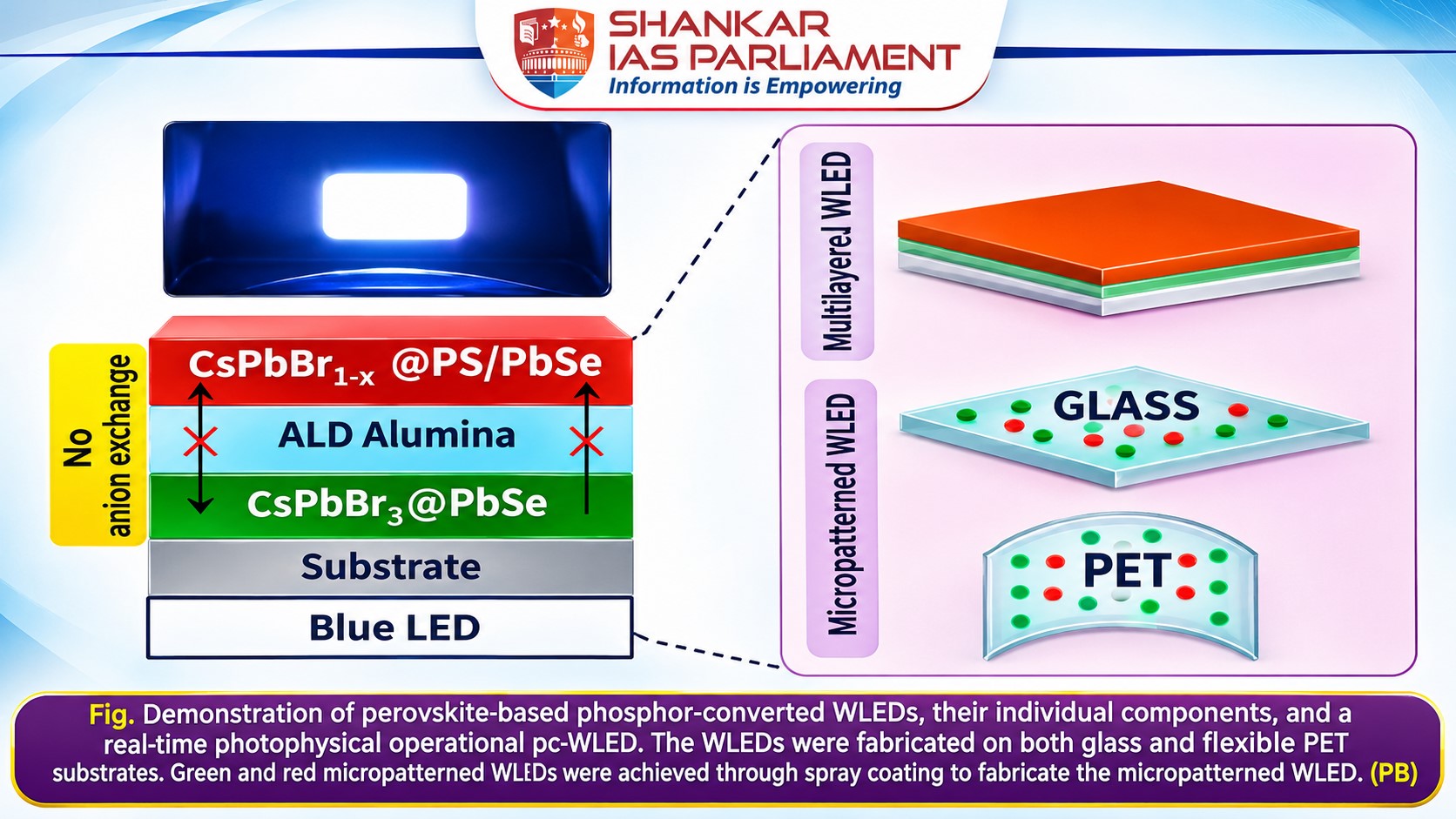
- Dual-protection barrier– The team used lead selenide to reduce halide vacancies on the nanocrystal surface, limiting ion movement without losing brightness or color purity.
- Ultrathin alumina coating– Atomic layer deposition (ALD) added a 5–6 nanometer transparent aluminum oxide layer to block ions from diffusing between adjacent color-emitting layers.
- Scalable manufacturing– Using spray coating and micropatterning, the researchers built multilayer white LEDs on rigid glass and flexible plastic (PET) substrates.
Key Capabilities and Limitations
- Tunability and stability– Changing the electrical current shifts the white light from dimmer to warmer shades, while devices maintained stable white emission during 24 hours of continuous operation and heating/cooling cycles.
- Applications– Potential uses include cost-effective home and smartphone lighting, displays, and flexible lighting systems, as highlighted by DD News.
- Remaining challenge– Further work is needed to address lead toxicity and find eco-friendly alternatives before commercial adoption.
Reference
DD News| New technology for stable, tunable and scalable white LEDs



