Prelims: Current events of national and international importance | Environment
Why in News?
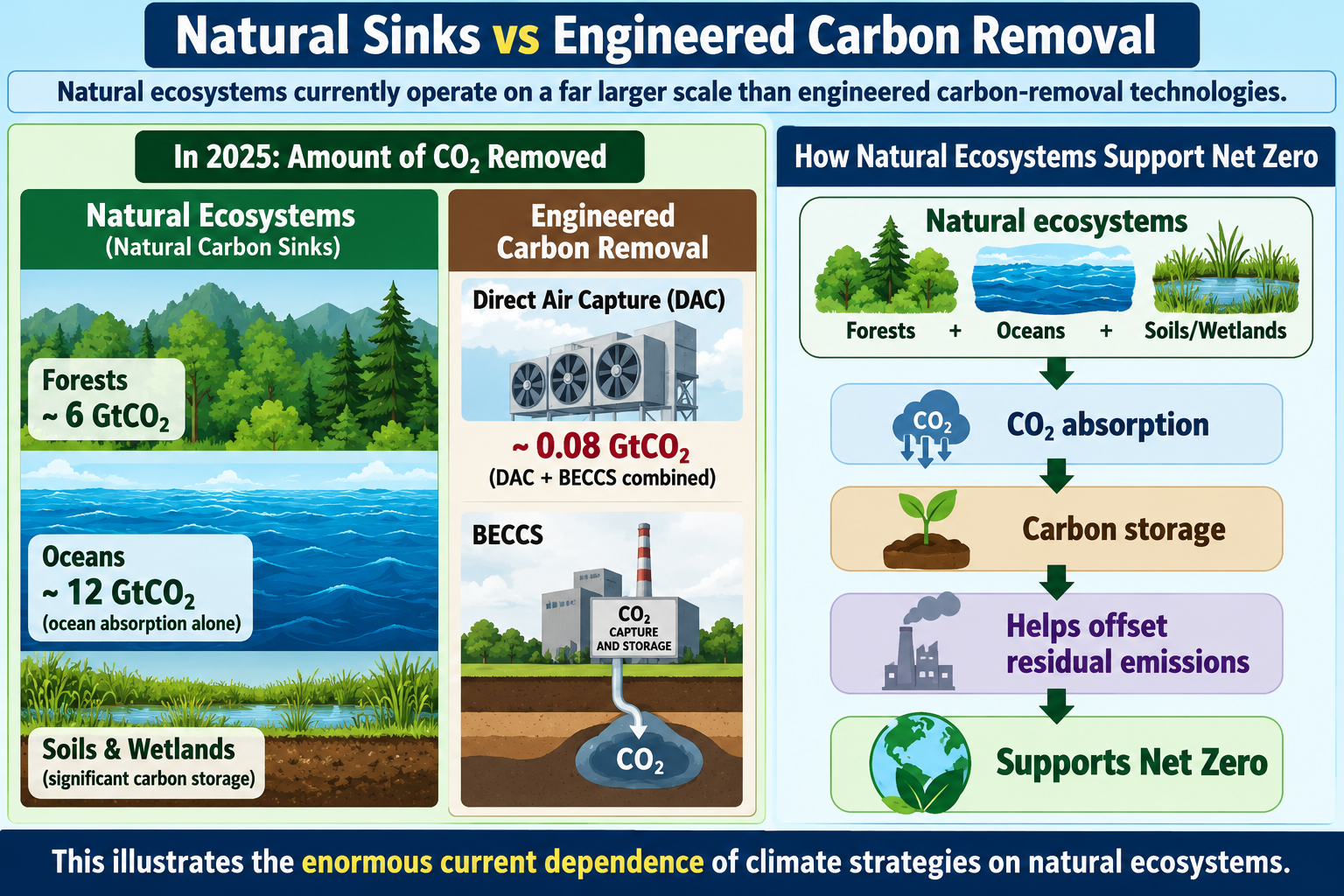
A recent analysis warns that weakening natural carbon sinks particularly forests and oceans could undermine global Net Zero strategies.
Natural Carbon Sinks
- Natural carbon sinks are ecosystems or processes that absorb more carbon dioxide (CO₂) from the atmosphere than they release.
- Major natural sinks include:
- Forests – Absorb CO₂ through photosynthesis and store carbon in vegetation and soils.
- Oceans – Absorb atmospheric CO₂ through physical and biological processes.
- Soils and wetlands – Store large quantities of organic carbon.
- Peatlands – Important long-term carbon stores.
Key 2025 Estimates
- Oceans absorbed: ~12 GtCO₂
- Forests absorbed: ~6 GtCO₂
- Total anthropogenic CO₂ emissions: ~48 GtCO₂
- Thus, natural sinks absorbed roughly 40% of human-generated CO₂ emissions.
Reason for weakening of Natural Carbon Sinks
- Deforestation-Global Forest area has declined by approximately 1.5 million sq km since 1990.
- Forest fires - Increasing frequency and intensity of fires can convert forests from carbon sinks into carbon sources.
- Climate change - Higher temperatures, drought and changing precipitation can reduce ecosystem carbon uptake.
- Ocean changes - Warming and other changes can affect the ocean's capacity to absorb and store CO₂.
- Ecosystem degradation - Damage to forests, wetlands, peatlands and marine ecosystems reduces carbon-storage capacity.
- Inadequate financing - Natural carbon sinks remain insufficiently valued in climate and carbon markets.
Reference
Down To Earth | Weakening natural carbon sinks threaten Net Zero plans



