Prelims: Current events of National and International Importance| Governance
Why in News?
The National Health Accounts (NHA) 2023–24 report (the 11th round of estimates), released by the Ministry of Health and Family Welfare, highlights a major shift toward public healthcare funding and a significant drop in direct household health spending in India.
Findings and Trends
- Tripling of Government Health Expenditure (GHE) – Public health spending more than tripled from ₹1.30 lakh crore in 2013–14 to ₹4.14 lakh crore in 2023–24. Per capita GHE rose from ₹1,042 to ₹2,959 over the same decade.
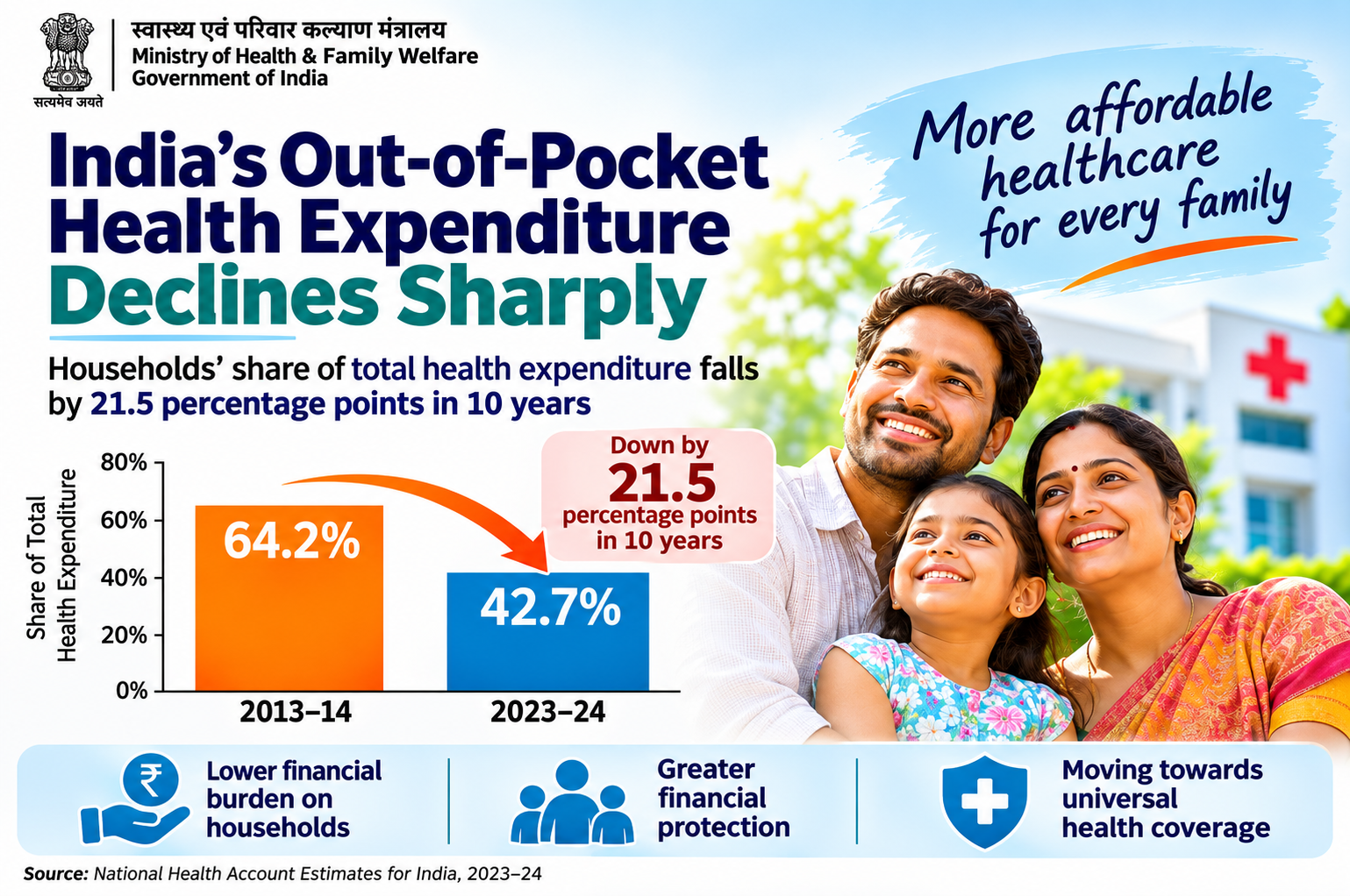
- Decline in Out-of-Pocket Expenditure (OOPE)– The share of health costs paid directly by households out-of-pocket fell sharply by 21.5 percentage points—dropping from 64.2% in 2013–14 down to 42.7% in 2023–24 (down from 43.4% in 2022–23).
- Share of Government in Total Health Expenditure (THE) – The government's contribution to THE increased from 28.6% in 2013–14 to 43.5% in 2023–24. State governments account for roughly 68% of GHE, while the Union government contributes about 32%.
- Increase in Social Security and Insurance–
- Social Security Expenditure (SSE) on health (including Ayushman Bharat PM-JAY, state health insurance schemes, and medical reimbursements for employees) nearly doubled from 6% to 11% of THE.
- Private health insurance share grew from 3.4% to 10.2% over the decade.
- Focus on Primary Healthcare– Public spending dedicated to primary healthcare reached ₹1.53 lakh crore, supported by programs like Ayushman Arogya Mandirs, Jan Aushadhi Kendras, and free drug/diagnostic initiatives.
Reference
National Health System| National Health Accounts (NHA) 2023–24 report



