Prelims: Current events of National and International Importance| Science & Technology
Why in News?
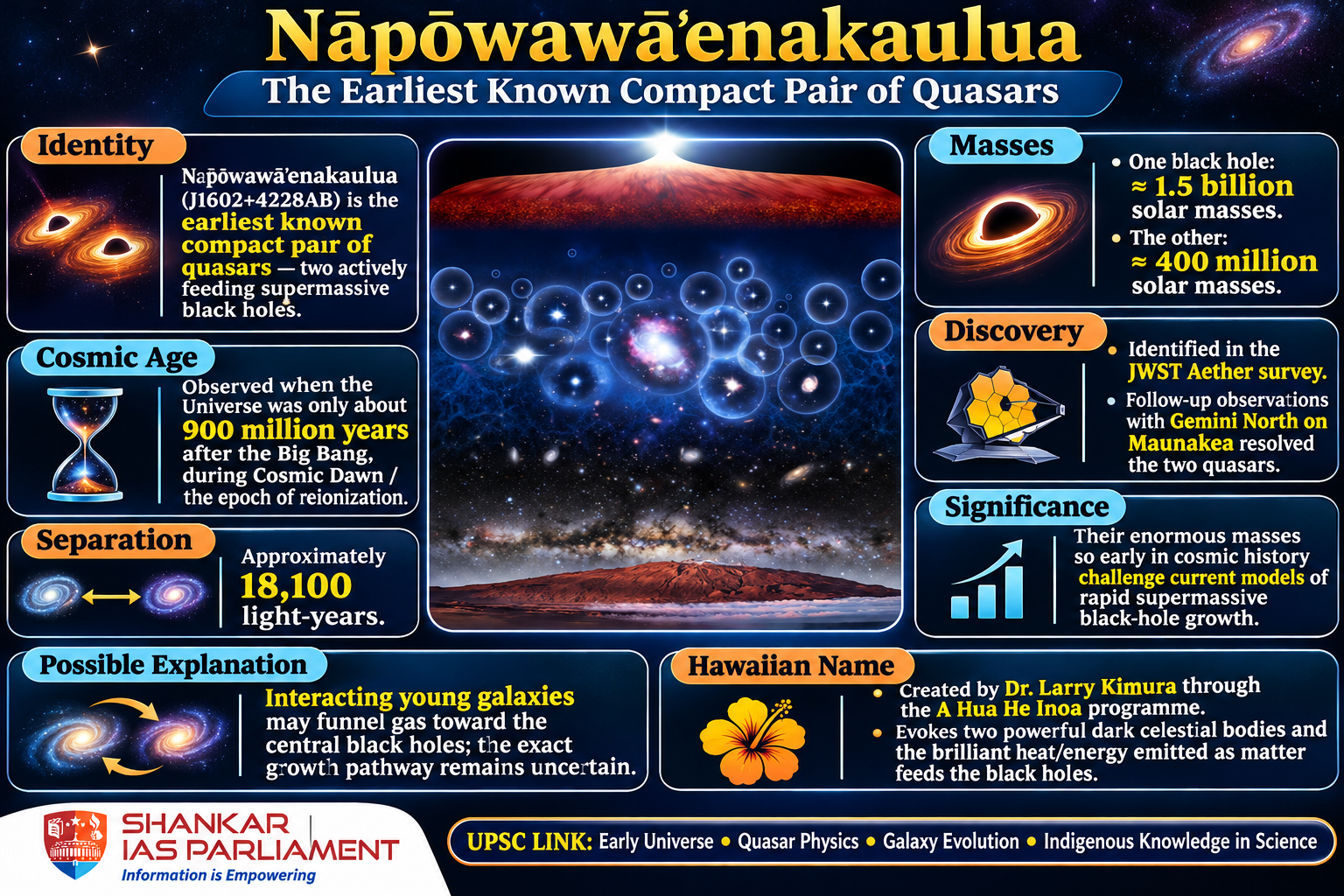
Nāpōwawāʻenakaulua (officially designated J1602+4228AB) is the oldest and most distant compact pair of quasars ever observed in the universe.
Discovered in November 2026, the system existed just 900 million years after the Big Bang during a period known as cosmic dawn.
- Hawaiian Translation – Named via the A Hua He Inoa program by the ʻImiloa Astronomy Center and the University of Hawaiʻi's Hawaiian Language College, the name poetically translates to "two celestial bodies of fathomless powerful darkness in the brilliance of heat reincarnating energy into the Universe."
- Proximity & Mass – The quasars sit just 18,100 light-years apart—about a fifth of the Milky Way's width—and are driven by supermassive black holes weighing 1.5 billion and 400 million times the mass of the Sun.
- Observation & Impact – Discovered by an international team led by NSF's NOIRLab using the James Webb Space Telescope (JWST) and resolved via the Gemini North telescope on Maunakea, the findings published in The Astrophysical Journal Letters challenge early black hole growth models.
Reference
The Hindu| Nāpōwawāʻenakaulua



