Prelims: Current events of National and International Importance| Environment
Why in News?
In a study reported in November 2026 by researchers at the Institute of Advanced Study in Science and Technology (IASST), Guwahati, copper nanowires inside isoreticular metal–organic framework-8 (IRMOF-8) paired with palladium or aluminum degraded up to 99% of pyrene—a toxic polycyclic aromatic hydrocarbon—under light irradiation and ultrasonication.
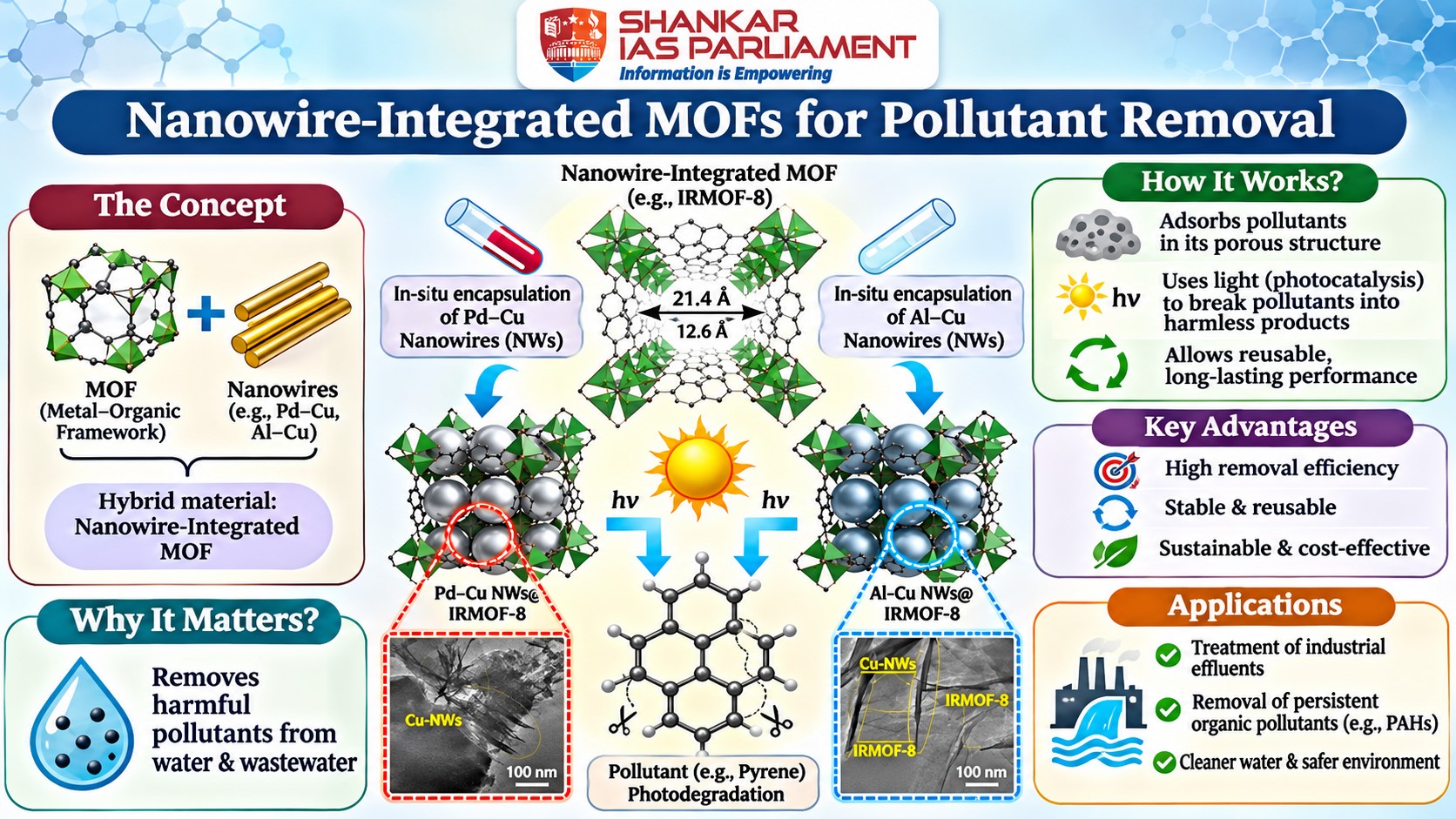
Nanowire-integrated metal–organic frameworks (MOFs) combine porous MOF structures with one-dimensional metallic nanowires to harvest light and break down persistent pollutants.
How It Works?
- Porous MOF Host (IRMOF-8)– Provides a confined space that brings components into close contact and supports efficient charge transfer.
- Metallic Nanowires– Capture a broad range of light wavelengths and enhance charge movement for photocatalytic breakdown.
- Palladium vs. Aluminum– Palladium boosts broadband light absorption through plasmonic interactions, while earth-abundant aluminum serves as a lower-cost antenna-reactor alternative.
Key Reported Results
- Palladium-modified Cu NW in IRMOF-8– 99% pyrene removal under tested irradiation and ultrasonication conditions.
- Aluminum-modified Cu NW in IRMOF-8– 85% pyrene removal under the same tested conditions.
- Publication– Led by Prof. Devasish Chowdhury and PhD scholar Netra Prova Baruah, published in ACS Applied Energy Materials.
- Broader Context in Pollutant Removal – Beyond light-driven PAH degradation, MOF hybrids and composites are researched for removing heavy metals, dyes, antibiotics, and emerging contaminants through adsorption, photocatalysis, and electrocatalytic membranes.
Reference
PIB| Nanowire-Integrated MOFs for Pollutant Removal



