0.1198
7667766266
x

Monetary Policy Committee (MPC)

iasparliament Logo
August 06, 2026

Mains: GS III - Economics

Why in News?

Recently, the monetary policy committee held its meeting to discuss the macroeconomic measures.

What is Monetary Policy Committee?

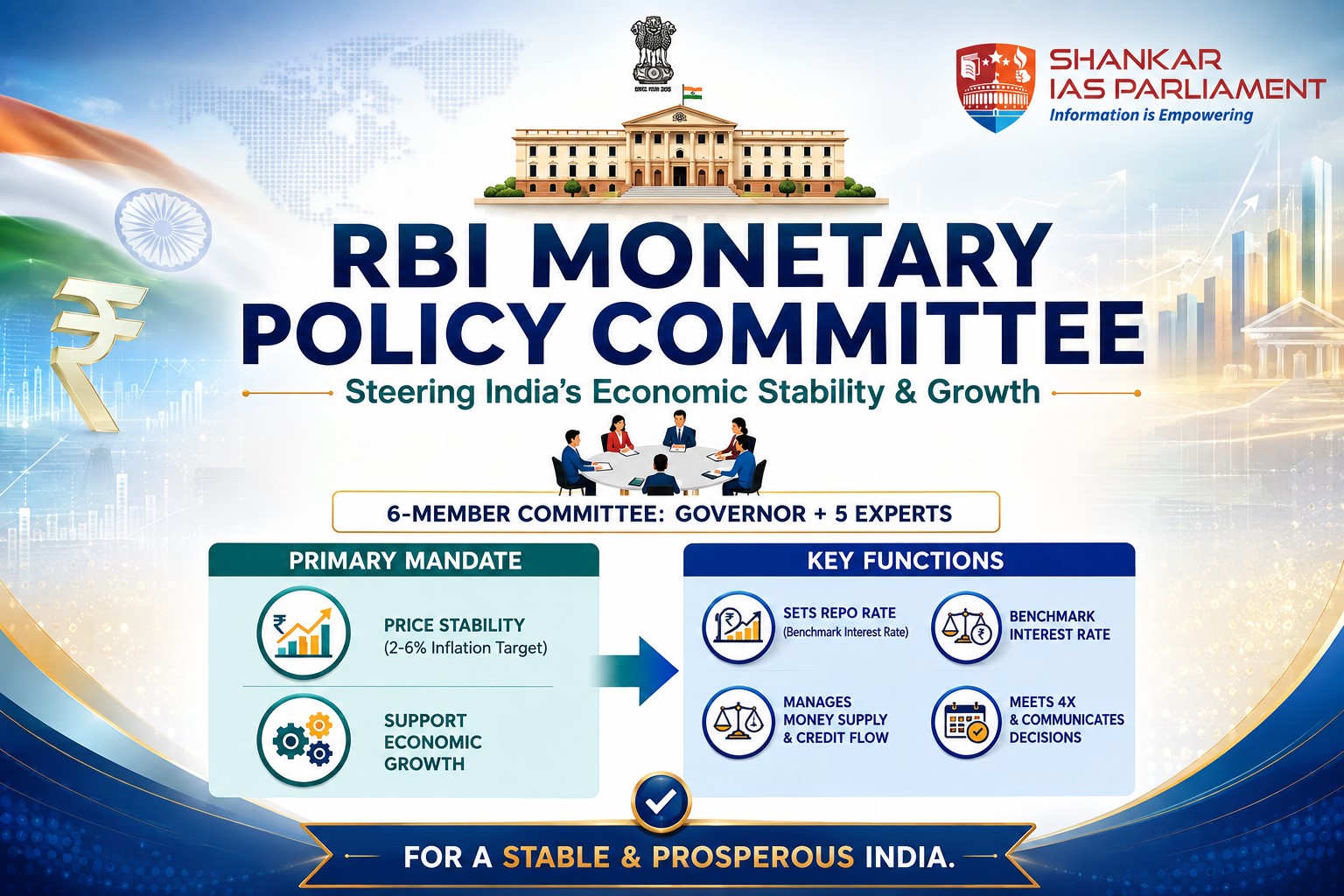
  • MPC – It is a committee of the Central Bank in India (Reserve Bank of India), which is entrusted with the task of fixing the benchmark policy interest rate (repo rate) to contain inflation within the specified target level.
  • Evolution – MPC was set up consequent to the agreement reached between Government and RBI to task RBI with the responsibility for price stability and inflation targeting.
  • The Reserve Bank of India and Government of India signed the Monetary Policy Framework Agreement on 20 February 2015.
  • Statutory backing – The government, amended the Reserve Bank of India (RBI) Act, 1934 for giving a statutory backing to MPC.

Monetary Policy Commitee . UPSC

  • Composition – The MPC has 6 members:
  • 3 official members from the RBI:
    • RBI Governor – Chairperson (ex officio)
    • RBI Deputy Governor – In charge of Monetary Policy (member, ex officio)
    • RBI Officer – Nominated by the Central Board (member, ex officio)
  • 3 external members:
    • Appointed by the Central Government from fields like economics, banking, or finance with a 4 year tenure.
  • Key Operational Rules
    • Quorum – At least four members must be present for a meeting.
    • Voting – Decisions are made by a majority vote.
    • Casting Vote – The Governor holds a second or casting vote in case of a tie

What are the key functions of MPC?

  • Setting the Repo Rate – Deciding the policy repo rate (the interest rate at which the Reserve Bank of India lends short-term money to banks) to regulate borrowing costs across the country.
  • Inflation Targeting – Managing monetary policy to keep consumer inflation anchored at a target of 4% with a tolerance band of +/- 2% (2% to 6%). 
  • Promoting Growth – Balancing price stability with the need to support sustainable economic growth and employment. 
  • Accountability and Reporting – Publishing resolution details after meetings held at least four times a year, and formally explaining to the government if the inflation targets are missed.

Monetary Policy

The RBI uses a variety of qualitative and quantitative tools to control money circulation in the market:

  • Repo Rate – The interest rate at which the RBI lends short-term money to commercial banks. Raising it makes loans costlier to curb inflation; lowering it encourages spending and investment.
  • Cash Reserve Ratio (CRR) – The minimum percentage of total deposits that commercial banks must keep as cash with the RBI.
  • Statutory Liquidity Ratio (SLR) – The minimum percentage of deposits that a commercial bank must maintain in the form of liquid assets like cash, gold, or approved securities before lending to customers.
  • Open Market Operations (OMOs) – The buying and selling of government securities by the RBI in the open market to regulate the money supply in the economy.

What are the challenges and structural criticisms faced by MPC?

  • Rigid targets vs. reality – Striking the right balance is hard when headline inflation spikes due to volatile food or fuel prices, which interest rate hikes cannot easily fix.
  • Growth trade-offs – Raising rates to cool down inflation can hurt business investments and slow down gross domestic product (GDP) growth.
  • Geopolitical shocks – Conflicts and trade tensions lead to sudden crude oil price swings and broken supply chains.
  • Currency volatility – Global shifts, like US monetary policy changes or capital outflows, put heavy pressure on local currency values and foreign exchange reserves.
  • Data reliance – Disagreements can occur when economic indicators send mixed signals—such as high growth paired with uneven job creation or sticky localized inflation.
  • Accountability constraints – If inflation stays outside the mandated tolerance band for too long, the committee must explain failures to the government, raising questions about forecasting accuracy.

What could be done to strengthen the MPC?

  • Strengthen Fiscal–Monetary CoordinationEnsure closer alignment between government fiscal measures, supply-side initiatives, and the RBI's monetary policy to manage food and fuel inflation more efficiently.
  • Enhance Policy TransmissionReduce structural bottlenecks in the banking system so that changes in policy rates are reflected more quickly in lending and deposit rates.
  • Develop Financial Markets – Broaden and strengthen domestic debt and corporate bond markets to improve liquidity management and enhance the effectiveness of open market operations.
  • Improve Research and Data AnalyticsModernize forecasting frameworks by incorporating the impact of global trade disruptions, geopolitical uncertainties, and fluctuations in commodity prices.
  • Strengthen Policy CommunicationProvide clear, forward-looking guidance and ensure transparent disclosure of differing committee views to stabilize market expectations while avoiding unnecessary volatility.

References

  1. The RBI| MPCs
  2. The TOI| Recommendations of MPC
Login or Register to Post Comments
There are no reviews yet. Be the first one to review.

ARCHIVES

sidetext