0.0941
7667766266
x

India’s Tiger Conservation

iasparliament Logo
August 05, 2026

Mains: GS III – Environment

Why in News?

India highlighted its success in tiger conservation, hosting approximately 70% of the world’s wild tigers and establishing itself as a global leader.

What is the current status of the tiger population in India?

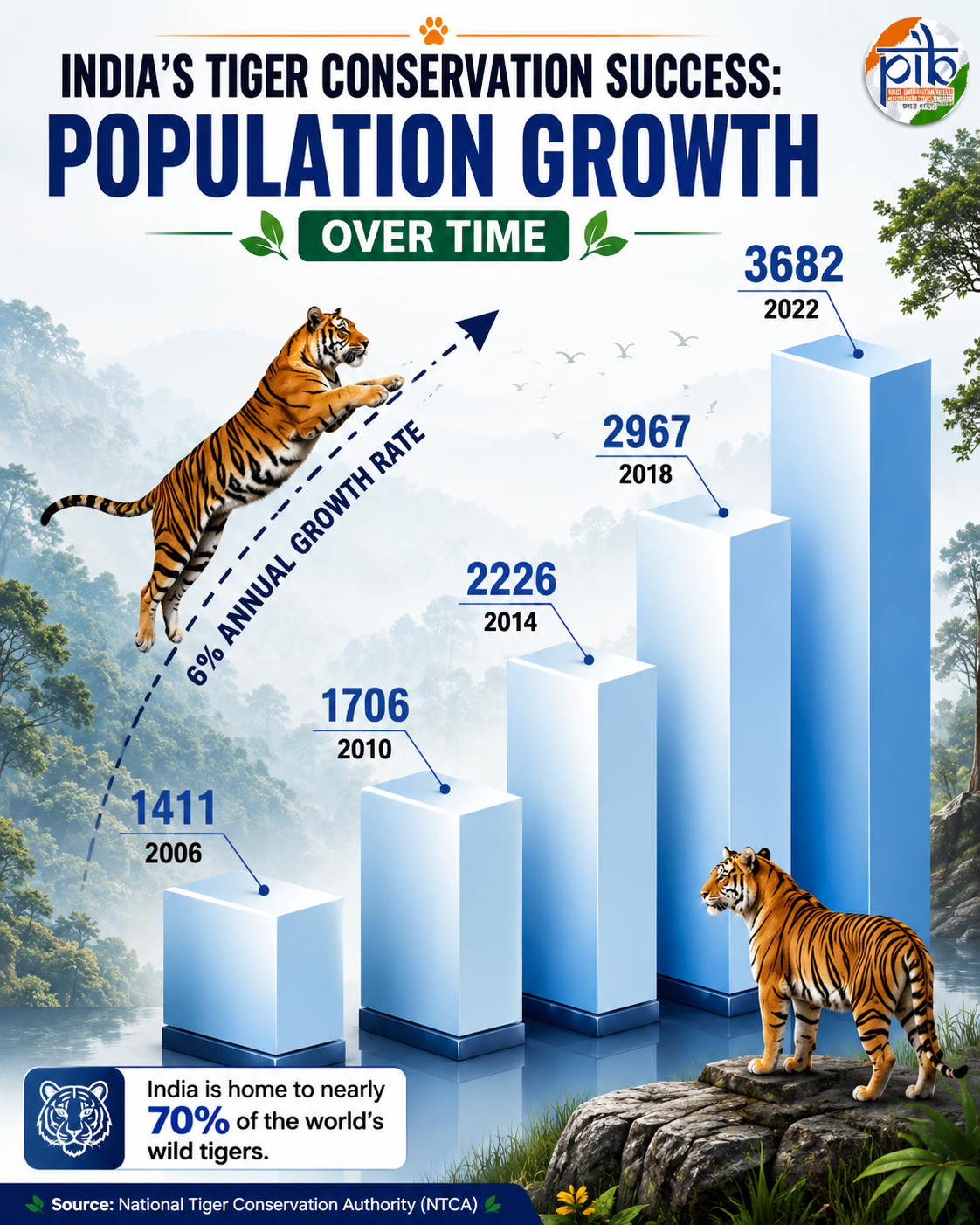
  • According to the 2022 All India Tiger Estimation (AITE), the tiger population in India is 3,682.
  • Since 2006, the tiger population in India has more than doubled.
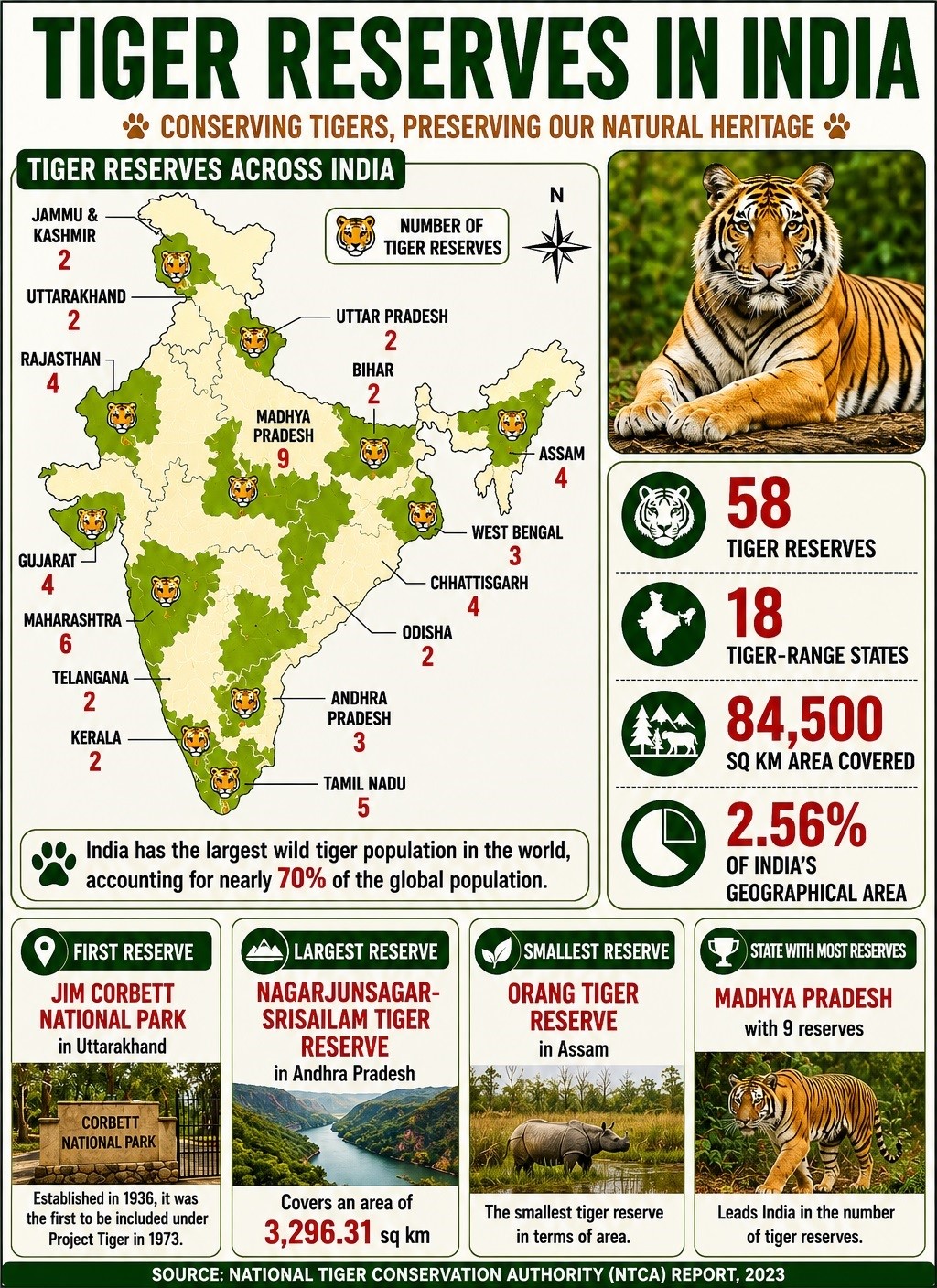
  • India is home to nearly 70 percent of the global wild tiger population.
  • The 2022 All India Tiger Estimation (AITE) is considered the largest biodiversity survey globally, encompassing more than 641,000 square kilometres across 20 states.

International Tiger Day, observed every year on 29 July, highlights the global importance of tiger conservation.

tiger polpulation increase upsc

What are the ecological significance of tigers in India?

  • Apex predator – It maintains ecological balance within its habitat.
  • Umbrella species – The tiger conservation efforts provide protection for numerous other species within the same ecosystem.
  • Indicator species – The presence and health of tigers reflect the overall condition of forest ecosystems.
  • The tiger has been recognised as the national animal of India since 1972.
  • Eco Benefits – It supports forest and soil conservation, watershed protection, carbon storage, climate regulation, biodiversity, livelihoods, and ecological security.

tiger reserves in india upsc

What are key challenges faced by tigers in India?

  • Habitat fragmentation – Expansion of highways, railways, mining, dams, industries, agriculture, and urbanization, threatens tiger movement and genetic diversity. Wildlife corridors are essential for connectivity and long-term survival.
  • Human–tiger conflict – It increases as tiger populations recover and move into human areas. This results in livestock losses, human injuries or fatalities, retaliatory killings, and relocations, particularly in regions with high tiger density.
  • Human-related causes include electrocution, poisoning, snaring, road & rail accidents and poaching.
  • Poaching and illegal wildlife trad – It is driven by demand for tiger skins, bones, and body parts through organized crime networks, continue to pose a persistent threat despite conservation gains.
  • Tiger Mortality – According to NTCA, 54% of tiger deaths in 2023 occurred outside reserves, and its 2026 mortality database records deaths both inside and outside protected areas. These findings underscore the necessity for landscape-level protection.
  • Prey Base Decline – Due to hunting, grazing, and habitat degradation, reduces populations of chital, sambar, wild boar, gaur, and other ungulates. This undermines sustainable tiger survival.
  • Climate Change Image – It affects tiger habitats by changing water availability, forest productivity, prey populations, fire risk, and species distribution.
  • These impacts require climate-resilient landscapes, particularly in fragmented and water-stressed regions.

What are the key initiatives taken by Indian government?

India’s Tiger Population

Rajasthan & Tiger Reserves

  • Tiger Count – Rajasthan hosts 149 tigers, with 72 in Ranthambore.
  • Breeding Success – Ranthambore is noted for high cub survival.
  • Survival Rate – Ranthambore records about 80% survival, one of India’s best.
  • Machli’s Legacy – Iconic tigress Machli (T‑16) birthed 18 cubs.
  • Repopulation Role – Sariska repopulated in 2008 using Machli’s descendants.
  • Scientific Relocation – Sariska achieved the world’s first successful tiger translocation.
  • Current Status – Sariska now houses 53 tigers, marking successful reintroduction.

Madhya Pradesh & Tiger Conservation

  • Tiger Deaths – MP reported 45 deaths in 2026, about 40% of the national total.
  • Population – MP had 785 tigers (2022), highest in India
  • Causes – Deaths from age, fights, electrocution, accidents, poisoning, and poaching (NTCA).
  • National Count – India’s tiger population: 3,682 (2022) across 20 states.

Project Tiger & Legal Framework

  • A network of 58 reserves in 18 states, covering 84,500 sq km or 2.56% of India’s area.
  • National Animal – Royal Bengal Tiger declared in 1972.
  • Project Tiger – Flagship Centrally Sponsored Scheme implemented by MoEFCC.
  • Legal Mandate – Wildlife Protection Act (1972) requires State Tiger Conservation Plans.
  • 2006 Amendments – Established NTCA & WCCB as statutory bodies.
  • NTCA Role – Chaired by the Union Environment Minister; oversees Project Tiger & conservation initiatives.

Conservation Approach

  • Approach – Reserves follow landscape‑based conservation.
  • Core Area – Critical Tiger Habitat receives the highest level of protection.
  • Buffer Area – Balances conservation efforts with sustainable livelihoods. 
  • Wildlife Corridors – Connect reserves to ensure safe movement and maintain healthy wildlife populations

Global Initiatives

  • International Tiger Day traces its origins to the Saint Petersburg Tiger Summit held in November 2010.
  • Tx2 Goal – 13 tiger‑range nations pledged to double wild tiger population by 2022.
  • Global Tiger Recovery Program (GTRP): Launched in 2010 by the World Bank’s Global Tiger Initiative, the program aims to double tiger numbers, improve habitat management, and stop poaching.
  • Phase I (2010–2022) – This phase focused on the Tx2 goal, with India achieving notable success.
  • GTRP 2.0 (2023–2034) – Through the Global Tiger Forum, this phase addresses human-wildlife conflict and governance gaps.

Surveys & Recognition

  • All-India Tiger Estimation (AITE) – This is the world’s largest biodiversity survey, conducted every four years by the NTCA and WII.
  • 2022 Survey – For the first time, the survey included a nationwide assessment of ungulates, highlighting the importance of a strong prey base.
  • Global Recognition – NTCA’s camera trap survey holds Guinness World Record as largest wildlife camera trap survey.

Monitoring Tools

  • The Monitoring System for Tigers – Intensive Protection and Ecological Status (M-STrIPES) uses GPS, GPRS and remote sensing technologies for field monitoring.
  • The Camera Trap Data Repository and Analysis Tool (CaTRAT)  It automatically classify camera trap images by species.
  • ExtractCompare It identifies individual tigers using their unique stripe patterns. Collectively, these tools improve the accuracy and reliability of tiger population estimates. 

Global Alliances

International Big Cat Alliance (IBCA)

  • IBCA is a global coalition of 95 big cat range and partner countries, scientific organisations and conservation partners.
  • The Alliance promotes cooperation for conserving seven big cats—tiger, lion, leopard, snow leopard, cheetah, jaguar and puma.

Global Tiger Forum

  • GTF is the world's only intergovernmental organisation dedicated exclusively to tiger conservation.
  • Headquartered in New Delhi, it brings together 13 tiger range countries-Bangladesh, Bhutan, Cambodia, China, India, Indonesia, Lao PDR, Malaysia, Myanmar, Nepal, Russia, Thailand and Vietnam.

Integrated Tiger Habitat Conservation Programme (ITHCP)

  •  ITHCP is the International Union for Conservation of Nature's (IUCN) flagship tiger conservation initiative.
  • It is funded by the German Government through KfW Development Bank.
  • The programme supports science-based conservation projects across priority tiger landscapes in Asia.

Conservation Assured Tiger Standards CA|TS

  • It is a global certification system that ensures effective management specifically of tiger conservation areas.
  • It was launched at the 1st Asian Parks Congress in Japan in 2013.
  • CA|TS supports efforts to create safe, sustainable environments for tigers and preserve global biodiversity.
  • CA|TS has accredited 23 Indian tiger reserves ensuring global best practices in conservation.

What to be done?

  • Corridor Connectivity – Strengthening wildlife corridors enhances ecological connectivity and minimizes habitat fragmentation.
  • Human–Tiger Coexistence – Expedite compensation processes, promote ecological development, and enhance community participation.
  • Anti–Poaching – Employ artificial intelligence, drones, satellite surveillance, and intelligence-led enforcement strategies.
  • Climate–Resilient Conservation – Restore degraded forests and protect vulnerable habitats, such as the Sundarbans.
  • Landscape Planning – Integrate conservation measures into infrastructure development and implement wildlife-friendly crossings.
  • Genetic Connectivity – Maintain wildlife movement corridors and consider scientific translocation when necessary.
  • Eco–Tourism – Regulate tourism activities and ensure that local communities receive tangible benefits.
  • International Cooperation – Expand transboundary conservation initiatives and facilitate technology sharing through IBCA and GTF.
  • Capacity Building – Provide training for frontline staff and invest in advanced monitoring technologies and research.

What lies ahead?

India’s success in tiger conservation demonstrates that legal protection, scientific monitoring, habitat conservation, technological advancements, and community participation can reverse population declines.However, maintaining these gains requires the establishment of connected, climate-resilient landscapes, the reduction of human-wildlife conflict, the strengthening of ecological corridors, and enhanced global cooperation to ensure long-term survival.

Reference

PIB |India Leads the Wilderness in Tiger Conservation

Login or Register to Post Comments
There are no reviews yet. Be the first one to review.

ARCHIVES

sidetext