Mains: GS I – Urbanization, their problems and their remedies
Why in News?
Recently ,Kerala urban policy commission(KUPC) submitted a report on urban policy of the state.
What is Kerala urban policy commission(KUPC)?
- KUPC – It is an initiative by the government of Kerala, to develop and implement comprehensive policies for urban development and governance in the state.
- Establishment – It was set in motion in December 2023.
- Mission – It was charged with designing a 25-year urban roadmap that sees cities not as concrete problems, but as organic, climate-aware ecosystems.
- Report – The KUPC handed its report to the State in March 2025, the result was not a mild adjustment it was a structural reset.
- The blueprint promised nothing less than a data revolution, governance recalibration, identity revival, and finance empowerment all tied together in one bold vision.
What is the need for KUPC?
- Rapid urbanisation – Kerala was urbanising at a pace well ahead of the national average by late 2023.
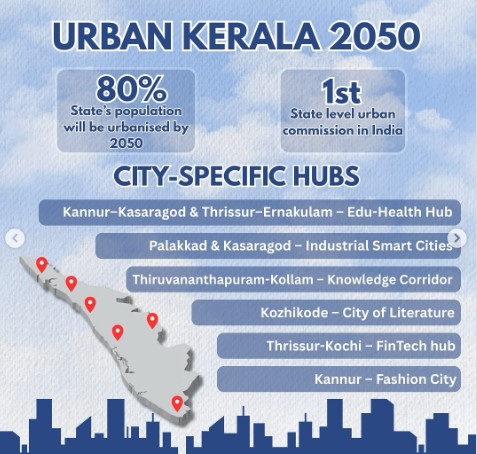
- Population explosion – Estimates projected an urban population of over 80% by 2050.
- A seismic shift in a region where villages and towns interconnect in a delicate mosaic will take place.
- Intensifying climate change – Meanwhile, climate threats were intensifying.
- Floods devastated Ernakulam
- Landslides shattered hillsides
- Coastal zones reeled from sea-level pressures.
- The gap between crisis and planning was growing wide.
What were the recommendations of the commission?
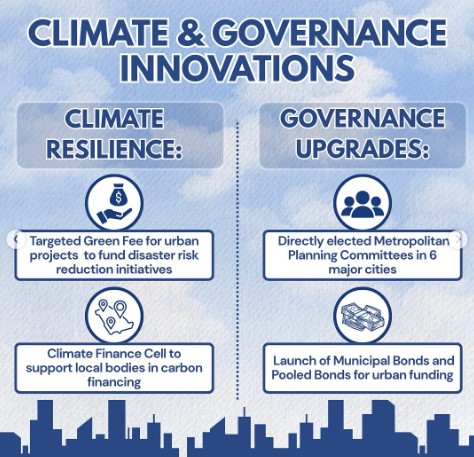
- Climate and risk-aware zoning – Any kind of urban planning must reflect hazard mapping of landslides, coastal inundation, flood zones etc.
- Planning becomes proactive, instead of being reactive.
- A digital data observatory – A real-time data nerve centre should be setup at the Kerala Institute of Local Administration.
- It could collate high-resolution Light Detection and Ranging, and ground penetrating radar, tide/water gauge, satellite and real-time weather data.
- Every municipality gains a living intelligence feed.
- Green fees – Projects in eco-sensitive zones could come with environmental levies (green fees) which would fund urban resilience.
- Climate insurance – A parametric insurance model ensures pre-approved payouts for disaster-prone areas.
- Municipal bonds – While Thiruvananthapuram, Kochi, and Kozhikode, being bigger cities, could issue municipal bonds.
- Pooled bonds – Smaller towns would use pooled instruments.
A pooled bond is a type of investment bond where multiple investors combine their money to invest in a diversified portfolio of securities.
- Governance overhaul – City cabinets, led by mayors, could replace bureaucratic inertia.
- Specialist cells (climate, waste, mobility, law) with dedicated municipal cadres should be formed.
- A Jnanashree program would recruit and deploy youth tech talent.
- Place-based economic revival – Regions to be developed based on the place based economic activity.
- Commons, culture, and care – The report stressed the need to revive wetlands, reactivate waterways and preserve heritage zones.
- It also recommended city health councils to cater to migrants, students, gig workers.
Why is the report unique?
- Blend of regional descriptions – The KUPC highlighted a deeper innovation with the fusion of local narratives and data systems.
- Fishermens’ ordeals with coastal recession,
- youth-crafted water conservation drives
- Mobility woes voiced by bazaar vendors
- All became structured into the urban data apparatus.
- Use of satellite imaging – LIDAR maps are now used to
- Register tidal health near fishing zones
- Develop municipal dashboards carrying community-generated indicators
- Construct city briefing templates reflecting lived stories.
- Address local needs – Rather than imposing top-down solutions, policies were co-produced with citizens.
- It gives Kerala an urban intelligence engine a living, breathing system where city systems absorb, interpret and act on the emotional, lived intelligence of local communities.
- KUPC isn’t one big idea but it’s the collision of several game-changing ones.
- Considers regional issues – The KUPC is the first State-level commission built for sub-national realities and not recycled from national frameworks.
- Disaster management – In its report, climate resilience is embedded and not appended every pillar integrates disaster awareness.
- Innovative funding mechanisms – The report also calls for the emancipation of public finance through municipal bonds and green levies which give local bodies fiscal agency.
- Overhauls urban governance – It also re-defines governance from passive bureaucracies to dynamic election-led city cabinets, guided by youth technocrats.
- Use of data – Rich stories fuel data, and data fuels policy, closing the feedback loop between lived reality and institutional action.
- Together, these features dismantle silos in planning, finance, governance and re-assemble them into a 360° urban system.
- Model for other states – Kerala’s Urban Commission offers a template with tangible takeaways for other States
- Mandate a time-bound commission
- Combine technical data with lived experience
- Create dialogic systems where citizen inputs are mapped into data observatories
- Empower local bodies with green levies, bonds, and risk premiums
- Insert youth and specialists in governance.
What lies ahead?
- The KUPC entwined climate awareness, community narrative, financial empowerment, digital governance, and identity economy into a living document-functional plan.
- As the first such State-level commission in the country, KUPC isn’t an end it’s a beginning.
- For Kerala, it’s a chance to grow not just richer, but wiser, not just bigger, but better not just more urban, but more human.
- For others, it’s a call to action, urban transformation isn’t a problem to solve but It’s a story to be authored together.
Reference
The Hindu| Kerala’s Innovation to Tackle Rapid Urbanisation



