Mains: GS I – Population and Associated Issues
Why in news?
Recently, a 25-year-old an MBBS graduate from Hyderabad was saved from her attempt to suicide by reaching to the Tele-MANAS helpline.
What is suicide?
- Suicide – The act or an instance of ending one's own life voluntarily and intentionally.
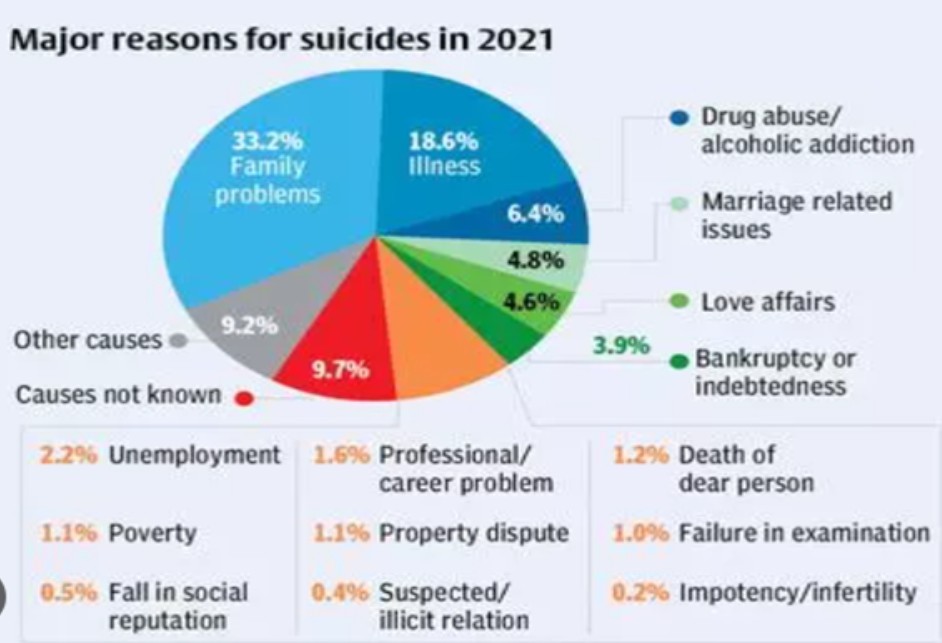
- Reasons – The reasons for suicide are multi-faceted, influenced by social, cultural, biological, psychological, and environmental factors present across the life-course.
- Complex issue – Suicide is not only a mental health issue but is also deeply rooted in social determinants such as poverty, discrimination, gender inequity, and isolation.
What are the challenges in the system?
- Shortage of trained mental health professionals – Estimates indicate that India has 0.75 psychiatrists per 1,00,000 population.
- It is dismally lower than the World Health Organization’s recommended 3 per 1,00,000 population.
- Shortage of clinical psychologists and psychiatric nurses – there is a lack of more clinical psychologists who can be trained to offer therapy, help people manage their thoughts better and improve their general sense of well-being.
- For instance, in Kerala, this shortage is a huge problem in the mental health sector.
- Inadequate resources – Most helplines today struggle with inadequate resources, limited operating hours, and insufficiently trained counsellors.
- Inaccessible and expensive – The stigma around mental health has reduced in India, but only superficially while Help is still inaccessible and expensive.
- For instance, in Kolkata many working professionals with depression are not being able to reach a professional at a moment of crisis.
What are the measures taken by the States?
- Community efforts – Broader community participation have been trialled in some States, often linking existing or new services to the Tele MANAS helpline, to stem suicide numbers.
- For instance, in Karnataka, where the suicide rate stands at 20.2 per lakh population as of 2022, significantly higher than the national average of 12.4, several initiatives have been tried.
- Karnataka – SURAKSHA project under N-SPRITE a comprehensive community-based suicide prevention model in partnership between NIMHANS, the government of Karnataka, and a corporate.
- Kerala – Jeevanraksha, a district-level service has community gatekeepers stepping in to prevent suicides.
- Trained people are given periodic refresher training to recognise warning signs of suicide, give psychological first aid and refer people to mental health professionals.
- Kerala also has two other community-level mental health programmes, one of which specifically tackles post-partum depression.
- Tamil Nadu – TeleMANAS also collaborates with the helplines of the School Education and Social Welfare Departments.
- District Mental Health Programme and it has improved accessibility and helped reduce stigma around accessing mental health care.
What lies ahead?
- Understanding the issue – We must acknowledge that suicide is not only a mental health issue but also deeply rooted in social determinants such as poverty, discrimination, gender inequity, and isolation.
- Decoding the cause – Addressing systemic drivers of distress must be undertaken.
- Timely interventions – Suicide prevention must include building an ecosystem of empathy, inclusion, and timely care.
- For instance, with over 1.7 lakh lives lost to suicide in 2022 and 1.8 million calls to the Tele-MANAS helpline as of February 2025, thousands of Indians need mental health help.
- Increasing funding – Increased government funding for awareness and trained human resources.
- Social and community participation – Building strong school and college-level mental health programmes, addressing social determinants.
- Combating stigma are some steps that need to be urgently undertaken.
Those in distress could seek help and counselling by clicking here.
Reference
The Hindu| Looking Beyond Helplines



