Mains: GSIII – Infrastructure
Why in News?
Recent suspected cable-sabotage incidents in the Baltic and Arctic regions have exposed vulnerabilities in subsea cables, making their protection vital for digital and economic security.
what is the Importance of Subsea Cables?
- Subsea cables – These are fibre-optic systems laid across the seabed that connect countries and continents.
- These cables carry over 99% of international internet traffic.
- They support:
- International internet and telecommunications.
- Global financial transactions and digital payments.
- Government and defence communications.
- Cloud computing and data-centre connectivity.
- Emerging technologies such as Artificial Intelligence (AI), which require high-bandwidth data exchange.
- Damage to a cable can disrupt connectivity, financial transactions, government services and emergency communications, potentially causing significant economic losses.
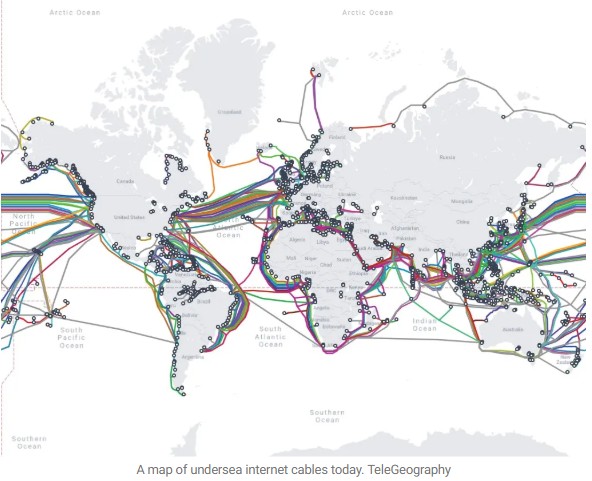
Why are Subsea Cables Vulnerable?
- Physical vulnerability – Cables can be damaged by anchors, fishing activity, natural hazards and maritime accidents.
- Recent incidents have raised concerns about deliberate sabotage by State or non-State actors.
- The vast geographical spread of cable networks makes continuous surveillance difficult.
- Cybersecurity risks – Since sensitive information travels through these networks, disruption or compromise can have implications for data security and national security.
- Concentrated supply chain – Cable manufacturing is dominated by three major companies — Alcatel Submarine Networks (France), SubCom (US) and NEC (Japan).
- Together, they have built around 90% of the cable length currently deployed.
- Repair and maintenance capabilities are also concentrated among a limited number of specialised operators.
- Limited repair capacity – Cable repair requires specialised vessels, equipment and trained crews.
- Limited global repair capacity can therefore increase the duration and economic impact of disruptions.
- Changing Ownership – Traditionally, subsea cables were financed and operated through telecommunication consortiums.
- However, large technology companies or hyperscalers are increasingly investing directly in cable infrastructure because of rising bandwidth requirements.
- Growth of AI – It is further increasing demand for high-speed connectivity, as AI applications generate large volumes of continuously changing data.
- This is contributing to a shift from consortium-based models towards hyperscaler-led cable projects.
- Implications for Digital Sovereignty – The concentration of subsea cable ownership, manufacturing and repair capabilities raises concerns over digital sovereignty.
- Countries may have limited control over Cable routes and landing sites, Availability and allocation of bandwidth, Repair and maintenance capabilities.
- Hyperscaler-led projects may also favour direct intercontinental routes, potentially influencing the emergence of future connectivity hubs and data-centre locations.
|
India’s Position
|
- India currently has 18 subsea cables landing at five major sites.
- Although there is no identified immediate threat of deliberate sabotage in the Indian Ocean region, India remains vulnerable because:
- Cable damage can be difficult to attribute.
- Disruptions can affect economic and strategic communications.
- India depends significantly on foreign companies for cable manufacturing and repair.
- Regulatory and permit-related hurdles have historically discouraged domestic private investment in cable repair capabilities.
|
What is the Way Forward for India?
- Develop domestic repair capacity – India should encourage indigenous cable-repair vessels, specialised equipment and trained manpower.
- Streamline regulations – A single-window clearance mechanism can reduce delays in permits for cable laying, maintenance and repair.
- Strengthen maritime surveillance – Subsea infrastructure should be integrated into maritime domain awareness through satellite monitoring, Automatic Identification Systems and other surveillance mechanisms.
- Diversify cable routes – Multiple geographically diverse cable routes can prevent excessive dependence on a single connectivity corridor.
- Promote public-private partnerships – Given the capital-intensive nature of subsea infrastructure, government support can complement private-sector investment.
- Strengthen international cooperation – India should cooperate with other Indo-Pacific countries on cable protection, information sharing, rapid repair and mechanisms for attribution of deliberate damage.
What lies ahead?
- Subsea cables are the physical foundation of the global digital economy.
- Their increasing strategic importance, combined with concentrated ownership, repair capabilities, makes resilience a matter of both economic security and national sovereignty.
- For India, developing diversifying connectivity and strengthening maritime surveillance will be crucial to ensuring secure and uninterrupted digital connectivity.
Reference
The Indian Express| Subsea Cables



