Mains: GS II – International Relations
Why in News?
Recently, Japanese PM urged the UN to remove World War II Enemy State clauses after China and Russia used them to critique Japan's defense spending.
What is the historical origin and intent of the 'Enemy State' clauses in the UN Charter?
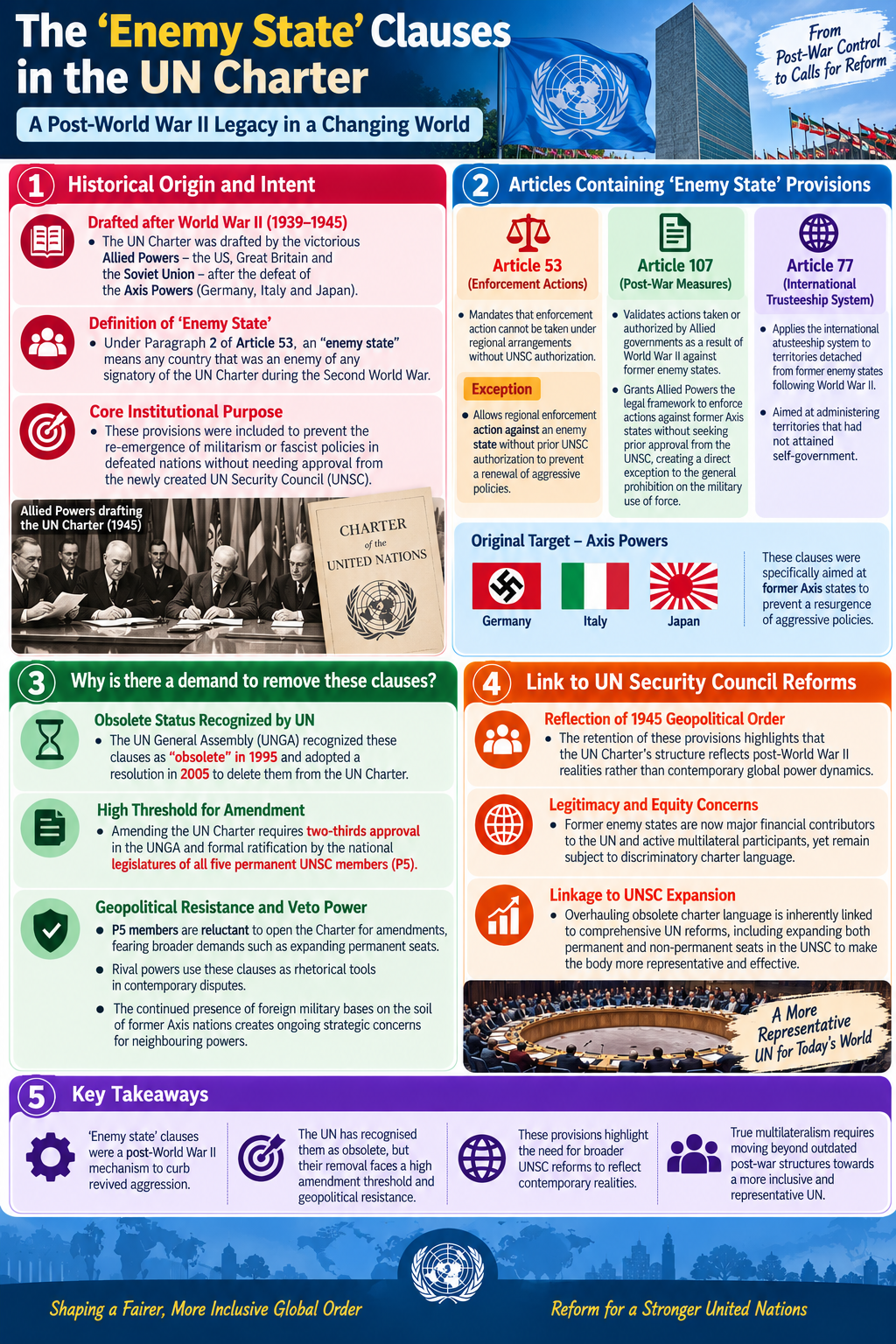
- The United Nations (UN) Charter – It was drafted toward the end of World War II (1939–1945) by the victorious Allied Powers (including the US, Great Britain, and the Soviet Union) following the defeat of the Axis Powers (Germany, Italy, and Japan).
- Definition of Enemy State – Under Paragraph 2 of Article 53, an "enemy state" is defined as any country that was an enemy of any signatory of the UN Charter during the Second World War.
- Core Institutional Purpose – The Allied Powers incorporated these provisions to prevent the re-emergence of militarism or fascist policies in defeated nations without needing to rely on approval from the newly created UN Security Council (UNSC).
Which specific articles of the UN Charter contain the 'Enemy State' provisions?
- Article 53 (Enforcement Actions) – Mandates that enforcement action cannot be taken under regional arrangements without UNSC authorization.
- Exception – Allows regional enforcement action against an enemy state without prior UNSC authorization to prevent a renewal of aggressive policies.
- Article 107 (Post-War Measures) –
- Validates actions taken or authorized by Allied governments as a result of World War II against former enemy states.
- Grants Allied Powers the legal framework to enforce actions against former Axis states without seeking prior approval from the UNSC, creating a direct exception to the general prohibition on the military use of force.
- Article 77 (International Trusteeship System) – Applies the international trusteeship system to territories detached from former enemy states following World War II to administer territories that had not attained self-government.
Why is there a demand to remove these clauses, and what prevents their deletion?
- Obsolete Status Recognized by UN – The UN General Assembly (UNGA) recognized these clauses as "obsolete" in 1995 and adopted a resolution in 2005 to delete them from the UN Charter.
- High Threshold for Amendment – Amending the UN Charter requires two-thirds approval in the UNGA and formal ratification by the national legislatures of all five permanent UNSC members (P5).
- Geopolitical Resistance and Veto Power –
- P5 Reluctance – Permanent members hesitate to open the UN Charter for amendments, fearing it could lead to broader structural demands, such as expanding the permanent seats of the UNSC.
- Geopolitical Weaponization – Rival powers use these legacy clauses as rhetorical tools in contemporary diplomatic disputes; such as defending post-war territorial boundaries or criticizing defensive policy shifts.
- Foreign Military Presence – The continued presence of foreign military bases on the soil of former Axis nations creates ongoing strategic concerns for neighbouring powers.
How do these clauses relate to broader UN Security Council reforms?
- Reflection of 1945 Geopolitical Order – The retention of these provisions highlights that the UN Charter's foundational structure reflects post-World War II realities rather than contemporary global power dynamics.
- Legitimacy and Equity Concerns – Former enemy states are major financial contributors to the UN and active multilateral participants, yet remain subject to discriminatory charter language.
- Linkage to UNSC Expansion – Overhauling obsolete charter language is inherently linked to comprehensive UN reforms, including expanding both permanent and non-permanent seats in the UNSC to make the body more representative and effective.
Reference
Indian Express | Enemy State



